 Back
Themes and Chemical Foundations in General Biology
Study Guide - Smart Notes
 Tailored notes based on your materials, expanded with key definitions, examples, and context.
Introduction to Biology
Themes in the Study of Life
Biology is unified by several key themes that help explain the complexity and diversity of life. Understanding these themes provides a foundation for further study in biological sciences.
Organization: Life is structured hierarchically, from atoms to the biosphere.
Information: DNA is the molecule of inheritance, storing and transmitting genetic information.
Energy & Matter: Living organisms acquire and use energy to sustain life.
Interactions: All organisms respond to stimuli in their environment.
Evolution: Populations of organisms change over time, leading to diversity.
Hierarchy of Biological Organization
Biological organization is structured in levels, each with emergent properties:
Biosphere → Ecosystems → Communities → Populations → Organisms → Organs → Tissues → Cells → Organelles → Molecules
Emergent properties arise when smaller parts combine to form more complex structures, resulting in new functions.
Cell Structure and Types
All cells share certain characteristics, but there are important distinctions:
Membrane-bound organelles and ribosomes are present in all cells.
Prokaryotic cells: No nucleus, smaller, no membrane-bound organelles, usually unicellular (e.g., bacteria, archaea).
Eukaryotic cells: Have a nucleus, larger, contain membrane-bound organelles, can be unicellular or multicellular (e.g., plants, animals, fungi, protists).
DNA Structure and Function
DNA is a double helix composed of two strands of nucleotides. Each nucleotide contains a phosphate group, deoxyribose sugar, and a nitrogenous base. Bases pair specifically: Adenine (A) with Thymine (T), Cytosine (C) with Guanine (G). DNA stores genetic information and passes it from one generation to the next.
Regulatory Mechanisms
Living organisms use regulatory mechanisms to maintain homeostasis and control biological pathways:
Negative Feedback: The final product inhibits an earlier step, slowing or stopping the process (e.g., body temperature regulation).
Positive Feedback: The final product stimulates an earlier step, amplifying the process (e.g., blood clotting).
Domains and Kingdoms of Life
Life is classified into three domains and several kingdoms:
Bacteria: Prokaryotic, unicellular organisms with no nucleus.
Archaea: Prokaryotic, unicellular, unique membrane lipids, often found in extreme environments.
Eukarya: Eukaryotic cells, includes plants, animals, fungi, and protists.
Kingdoms of multicellular, eukaryotic life:
Plantae: Multicellular, photosynthetic organisms.
Fungi: Multicellular (except yeasts), absorb nutrients from their environment.
Animalia: Multicellular, ingest their food.
Unity and Diversity of Life
All living things share fundamental traits due to common ancestry (unity), but adapt to different environments through evolution, resulting in diversity.
Darwin's Theory of Evolution by Natural Selection
Darwin observed that individuals vary in traits, traits are inherited, species produce more offspring than the environment can support, and many offspring do not survive. He inferred that individuals with advantageous traits survive and reproduce, making those traits more common over generations.
The Process of Science
Science advances through both discovery and hypothesis-based approaches:
Discovery Science: Observations and data collection to describe phenomena.
Hypothesis-Based Science: Proposing explanations (hypotheses) and testing them.
Both approaches are essential for understanding nature.
Types of Data and Reasoning
Quantitative Data: Numerical measurements.
Qualitative Data: Descriptive, non-numerical information.
Inductive Reasoning: Generalizing from specific observations.
Deductive Reasoning: Predicting specific results from general principles.
Hypotheses and Experiments
Hypotheses must be testable and falsifiable, but are not provable. Controlled experiments test the effect of a single variable by comparing an experimental group to a control group.
Scientific Theory
Everyday meaning: A guess or hunch.
Scientific meaning: A well-supported, broad explanation for a wide range of observations.
Chemistry
Elements and Compounds
Understanding the chemical context of life is essential for biology. Elements are pure substances that cannot be broken down further, while compounds are combinations of elements in fixed ratios with unique properties.
Four elements make up 96% of living matter: Carbon (C), Hydrogen (H), Oxygen (O), Nitrogen (N).
Trace elements: Essential in minute amounts (e.g., Iron (Fe) for oxygen transport).
Atomic Structure
Atoms consist of protons, neutrons, and electrons. Protons have a positive charge, neutrons are neutral, and electrons are negatively charged. Atomic number is the number of protons, mass number is protons plus neutrons, and atomic weight is the average mass of isotopes.
Number of neutrons = Mass Number - Atomic Number.
Isotopes have the same atomic number but different mass numbers due to varying neutron counts.
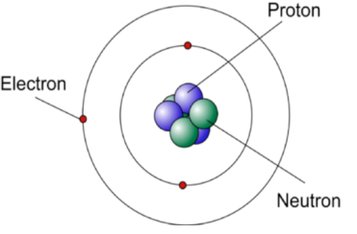
Additional info: The model shown is a simplified representation; in reality, electrons occupy three-dimensional orbitals rather than neat, planar tracks.
Biological Applications of Radioactive Isotopes
Radioactive isotopes are used as metabolic tracers in research and medicine (e.g., PET scans) and for radiometric dating.
Electron Distribution and Chemical Properties
Electrons in the first shell have less potential energy than those in higher shells. Chemical bonds form based on electron distribution:
Nonpolar Covalent: Electrons shared equally (e.g., C-H bonds).
Polar Covalent: Electrons shared unequally, creating partial charges (e.g., O-H bond in water).
Ionic: Electrons transferred, forming charged ions (e.g., Na+Cl-).
Importance of Strong and Weak Bonds
Strong covalent bonds provide stability, while weak bonds (hydrogen bonds, ionic interactions, van der Waals forces) allow reversible interactions essential for processes like DNA replication and protein folding.
Hydrogen Bonds and van der Waals Interactions
Hydrogen Bond: Attraction between a partially positive hydrogen and an electronegative atom.
Van der Waals Interactions: Weak, transient attractions due to temporary charge asymmetries.
Molecular Shape and Biological Function
The 3D shape of a molecule determines its biological function. For example, morphine and heroin mimic the shape of endorphins, allowing them to bind to endorphin receptors.
Chemical Equilibrium
Chemical equilibrium occurs when forward and reverse reaction rates are equal, stabilizing reactant and product concentrations.
Water
Properties of Water
Water's unique properties arise from hydrogen bonding:
Cohesion and Adhesion: Water molecules stick to each other and to other surfaces, enabling surface tension and fluid transport.
Temperature Moderation: High specific heat and heat of vaporization buffer environments and prevent overheating.
Expansion upon Freezing: Ice is less dense than liquid water, insulating aquatic life.
Versatility as a Solvent: Water dissolves ions and polar molecules, facilitating biological reactions.
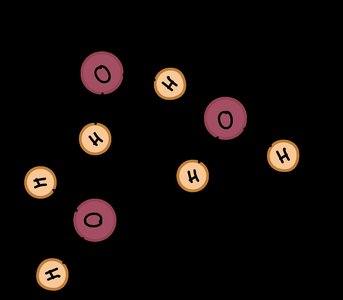
Additional info: The diagram illustrates water's polarity and its ability to form hydrogen bonds with up to four neighboring molecules, which is fundamental to its emergent properties.
Cohesion and Adhesion
Cohesion: Attraction between water molecules via hydrogen bonding, producing high surface tension.
Adhesion: Attraction between water molecules and other polar surfaces, aiding processes like transpiration.
The Solvent of Life
Solution: Homogeneous mixture of substances.
Solvent: The dissolving agent (water in aqueous solutions).
Solute: The substance dissolved.
Hydrophobic and Hydrophilic Substances
Hydrophobic: Nonpolar substances that repel water (e.g., oils, lipids).
Hydrophilic: Polar or ionic substances with affinity for water (e.g., salts, sugars).
The pH Scale
Acid: Increases hydrogen ion concentration (H+).
Base: Decreases hydrogen ion concentration (often by donating OH- or absorbing H+).
pH: Negative logarithm of hydrogen ion concentration:
Acids, Bases, and Buffers
Acids and bases alter hydrogen ion concentration directly or indirectly. Buffers, composed of a weak acid and its conjugate base, stabilize pH by absorbing or releasing H+ as needed.
Biomolecules: Carbon and Molecular Diversity
The Importance of Carbon
Carbon's electron configuration allows it to form four stable covalent bonds, creating diverse and complex organic molecules with tetrahedral or planar shapes.
Variation in Carbon Skeletons
Carbon skeletons vary in length, branching, double-bond placement, and ring structures, contributing to molecular diversity.
Hydrocarbons
Hydrocarbons are composed solely of carbon and hydrogen. Their nonpolar covalent bonds make them hydrophobic.
Types of Isomers
Structural Isomers: Differ in covalent arrangement.
Geometric Isomers (Cis-Trans): Differ in spatial arrangement around double bonds.
Enantiomers: Non-superimposable mirror images, often only one is biologically active.
Chemical Groups in Organic Molecules
Hydroxyl (--OH): Alcohols.
Carbonyl (>C=O): Ketones or aldehydes, found in sugars.
Carboxyl (--COOH): Acts as an acid.
Amino (--NH2): Acts as a base.
Sulfhydryl (--SH): Important in protein structure.
Phosphate (--OPO2-/3-): Releases energy in ATP.
Methyl (--CH3): Molecular tag (e.g., DNA methylation).
ATP: The Primary Energy Transfer Molecule
ATP stores chemical energy in unstable phosphate bonds and releases it through hydrolysis to drive cellular work, functioning as the primary energy transfer molecule in cells.
