 Back
Themes of Biology and Scientific Inquiry: Foundations of General Biology
Study Guide - Smart Notes
 Tailored notes based on your materials, expanded with key definitions, examples, and context.
Introduction to Biology
What is Biology?
Biology is the scientific study of living organisms, encompassing their structure, function, growth, origin, evolution, and distribution. Any living thing is referred to as an organism. Organisms display a wide range of complexity, from single-celled bacteria to multicellular plants and animals. To understand this complexity, biologists often use reductionism, breaking down complex systems into simpler components for study.
Unifying Themes of Biology
Overview of the Five Unifying Themes
Despite the diversity of life, all biological information can be organized into five unifying themes:
Order/Organization
Information
Energy and Matter
Interactions
Evolution
Levels of Biological Organization
Hierarchy from Largest to Smallest
Biological systems are organized into a hierarchy, with each level building upon the previous one. The main levels are:
The Biosphere
Ecosystems
Communities
Populations
Organisms
Organs
Tissues
Cells
Organelles
Molecules
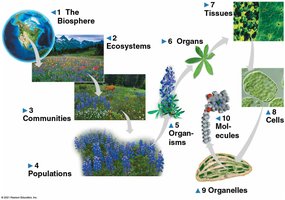
Emergent Properties and Structure-Function Relationships
At each level of organization, new properties—called emergent properties—arise that were not present at the previous level. These properties result from the arrangement and interactions of parts. There is a strong correlation between structure and function: analyzing a biological structure provides clues about its function, and vice versa.
The Cell: The Fundamental Unit of Life
The cell is the smallest unit capable of performing all activities required for life. All living organisms are composed of cells, each enclosed by a membrane that regulates the passage of materials between the cell and its environment.
Prokaryotic cells: Simpler, usually smaller, lack a nucleus and other membrane-bound organelles; typically unicellular organisms.
Eukaryotic cells: More complex, contain membrane-bound organelles (including a nucleus); can be unicellular or multicellular.
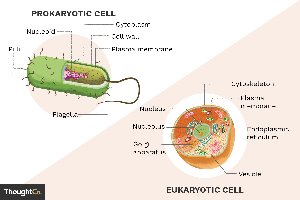
Information: Genetic Material and Gene Expression
Genetic Information and DNA
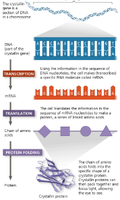
Life’s processes depend on the expression and transmission of genetic information. The genetic material of all cells is DNA (deoxyribonucleic acid). The complete set of genetic information in an organism is called its genome. DNA is organized into genes, which are further organized into chromosomes. Genes are the units of inheritance that contain the instructions for building the molecules necessary for life.
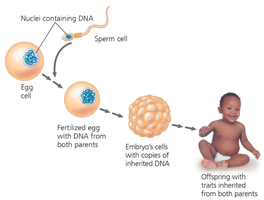
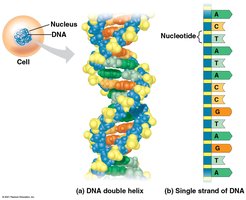
Gene Expression: From DNA to Protein
Gene expression is the process by which the information in a gene is used to synthesize a functional product, typically a protein. This process involves two main steps:
Transcription: DNA is transcribed into RNA.
Translation: RNA is translated into a protein.
This flow of information is often summarized as: DNA → RNA → Protein.
Energy and Matter
Energy Flow and Chemical Cycling
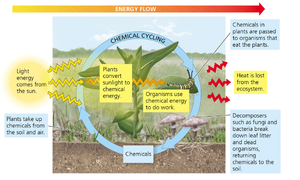
All living organisms require energy to maintain order and carry out life processes. Energy flows through ecosystems in one direction, primarily from the sun, while matter cycles within ecosystems. Organisms are classified as:
Producers: Acquire energy from the environment (usually through photosynthesis).
Consumers: Obtain energy by eating other organisms.
Key biological processes involving energy include cellular respiration, metabolism, and photosynthesis.
Interactions
Biological Interactions and Feedback Regulation
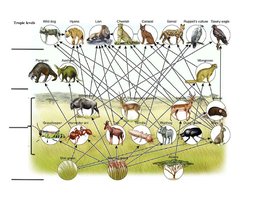
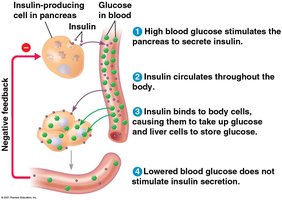
Interactions occur at all levels of biological organization, from molecules within a cell to organisms within an ecosystem. These interactions ensure the smooth integration of all parts. Feedback regulation is a common mechanism:
Negative feedback: The product of a process inhibits its own production.
Positive feedback: The product of a process stimulates more production.
Evolution
The Central Theme of Biology
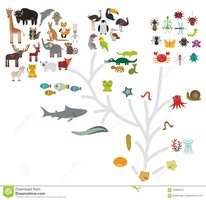
Evolution explains both the unity and diversity of life. It is the process by which species accumulate differences from their ancestors as they adapt to different environments over time. Populations evolve from one generation to the next, and new species can arise from common ancestors.
Domains of Life and Taxonomy
The Three Domains of Life
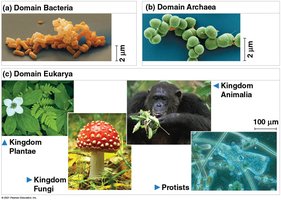
Taxonomy is the science of classifying organisms based on shared characteristics and ancestry. All life is grouped into three domains:
Bacteria: Unicellular prokaryotes found in diverse environments.
Archaea: Unicellular prokaryotes, often found in extreme environments.
Eukarya: Unicellular and multicellular organisms with eukaryotic cells, including plants, animals, fungi, and protists.
The Scientific Method and Biological Inquiry
Steps of the Scientific Method
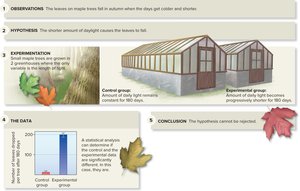
The scientific method is a systematic approach to understanding the natural world. The main steps are:
Observation
Hypothesis
Prediction
Experimentation
Conclusion
A hypothesis is a testable explanation for an observation. Experiments are designed to test hypotheses, often using control and experimental groups to isolate variables.
Variables and Controls
In experiments:
Independent variable: The factor manipulated by the researcher.
Dependent variable: The factor measured in response to changes in the independent variable.
Control group: The group not exposed to the experimental variable, used for comparison.
Types of Data
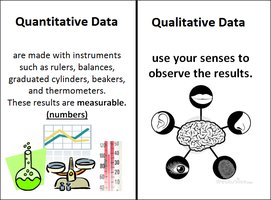
Data collected in experiments can be:
Quantitative data: Numerical measurements (e.g., height, mass, temperature).
Qualitative data: Descriptive observations (e.g., color, texture, behavior).
Types of Reasoning
Two main types of reasoning are used in science:
Deductive reasoning: Drawing specific conclusions from general principles.
Inductive reasoning: Forming generalizations based on specific observations.
