 Back
Themes of Biology and the Scientific Method
Study Guide - Smart Notes
 Tailored notes based on your materials, expanded with key definitions, examples, and context.
Biology: The Study of Life
Characteristics of Living Things
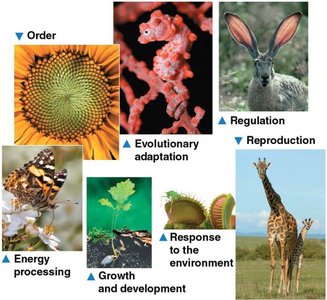
Biology is the scientific study of life. To distinguish living organisms from non-living matter, biologists identify several key characteristics shared by all living things:
Order: Living things exhibit complex but ordered organization, often at the cellular level. The cell theory states that all living things are composed of cells, cells are the basic unit of life, and all cells arise from pre-existing cells.
Growth and Development: Organisms grow and develop according to specific instructions coded in their DNA.
Response to the Environment: All living things respond to environmental stimuli.
Evolutionary Adaptation: Populations of organisms evolve over generations through the process of natural selection.
Energy Processing: Living organisms obtain and use energy to power their activities and maintain internal order (metabolism).
Regulation: Organisms regulate their internal environment to maintain a stable, constant condition (homeostasis).
Reproduction: Living things reproduce, passing their genetic information to the next generation.
Is It Living? Comparing Prokaryotes, Eukaryotes, and Viruses
Not all entities that interact with living things are themselves alive. The table below compares the main characteristics of prokaryotes, eukaryotes, and viruses:
Characteristic | Prokaryotes | Eukaryotes | Viruses |
|---|---|---|---|
Order | Yes | Yes | No |
Grow/Develop | Yes | Yes | No |
Respond | Yes | Yes | No |
Evolve | Yes | Yes | Yes |
Process Energy | Yes | Yes | No |
Reproduce | Yes | Yes | No (only with host) |
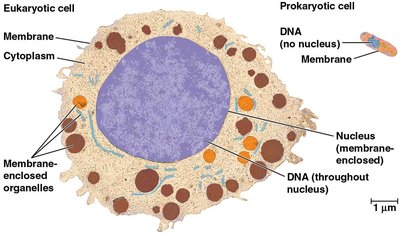
Prokaryotes (e.g., bacteria) and eukaryotes (e.g., plants, animals) are considered living, while viruses lack many characteristics of life and are not considered alive by most biologists.
Organization of Living Things
Levels of Biological Organization
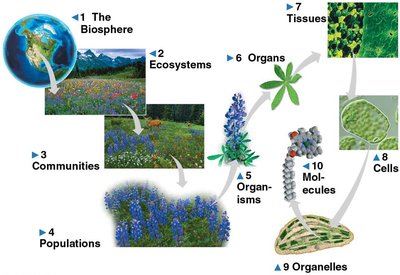
Life is organized in a hierarchical fashion, from the smallest chemical building blocks to the entire biosphere:
Chemical Level/Molecules: Atoms combine to form molecules (e.g., proteins, DNA).
Organelles: Specialized structures within cells (e.g., mitochondria).
Cells: Basic unit of life; can be prokaryotic or eukaryotic.
Tissues: Groups of similar cells performing a common function (e.g., epithelial tissue).
Organs/Organ Systems: Structures composed of multiple tissues working together (e.g., stomach, digestive system).
Organisms: Individual living entities (e.g., a dog).
Populations: Groups of organisms of the same species in a defined area.
Communities: All living organisms in a defined area interacting together.
Ecosystems: All living and non-living components in a defined area (e.g., coral reef).
Biosphere: All regions of Earth where life exists.
Classifying the Diversity of Life: Evolution and Taxonomy
Evolution and Unity of Life
Evolution explains both the unity and diversity of life. Through evolution, organisms adapt to their environments, leading to the vast diversity observed in nature. Taxonomy is the science of classifying living things based on similarities and evolutionary relationships.
Levels of Classification
Living things are classified into hierarchical groups, from the most broad to the most specific. A common mnemonic for remembering the order is: "Dashing King Philip Came Over For Good Spaghetti," representing:
Domain
Kingdom
Phylum
Class
Order
Family
Genus
Species
Binomial System of Naming (Scientific Names)
The first word is the Genus (capitalized), and the second is the species (lowercase), e.g., Homo sapiens.
Scientific names are used to avoid confusion caused by common names and to provide a universal standard for identifying organisms.
The Scientific Method
Steps of the Scientific Method
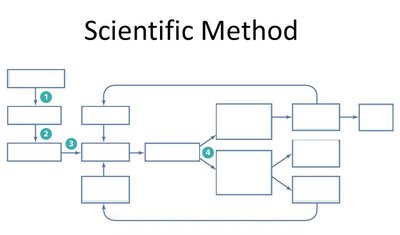
The scientific method is a systematic approach to understanding the natural world. It involves making observations, forming hypotheses, conducting experiments, and drawing conclusions.
Hypothesis: A testable explanation for an observation or scientific question.
Controlled Experiment: An experiment in which only one variable is changed at a time.
Variables:
Independent Variable: The factor being tested.
Dependent Variable: The factor being measured.
Controlled Variables: Factors kept constant between groups.
Control Group: Group lacking the independent variable.
Experimental Group: Group receiving the independent variable.
Field Studies: Observational studies in natural settings, focusing on one variable at a time.
Theory vs. Law
Theory: A well-supported explanation of some aspect of the natural world, based on a body of evidence (e.g., theory of evolution).
Law: A statement describing consistent, universal relationships under certain conditions (e.g., law of gravity).
Example: Louis Pasteur and Fermentation
In the late 1800s, Louis Pasteur studied why wine was spoiling.
He observed yeast cells in grape juice and hypothesized that microorganisms caused fermentation and spoilage.
Pasteur's control group would have been grape juice not exposed to microorganisms.
He discovered pasteurization: heating a substance to kill contaminants without altering its properties.
Example: Pasteur's work demonstrated the importance of controlled experiments and led to advances in food safety and microbiology.
