 Back
Thermochemistry: Energy, Heat, and Work in Chemical Systems
Study Guide - Smart Notes
 Tailored notes based on your materials, expanded with key definitions, examples, and context.
Thermochemistry and Energy
Introduction to Thermochemistry
Thermochemistry is the study of the energy changes, particularly heat, that accompany chemical reactions and physical transformations. Understanding energy flow is essential for analyzing biological and chemical systems.
Energy: The capacity to do work or transfer heat.
Thermodynamics: The scientific study of energy and its transformations.
Work: The process of causing matter to move against an opposing force.
Forms of Energy
Kinetic Energy (KE): Energy of motion. where m is mass and v is velocity.
Potential Energy (PE): Stored energy due to position or composition.
Units of Energy: The joule (J) is the SI unit of energy.
First Law of Thermodynamics
Law of Conservation of Energy
The first law states that energy can be converted from one form to another but cannot be created or destroyed. In biological systems, this means that chemical energy from food or sunlight is transformed into other forms, such as heat or work.
Example: Photosynthesis converts sunlight into chemical energy in plants.
System and Surroundings
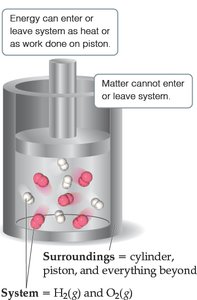
In thermodynamics, the universe is divided into the system (the part under study) and the surroundings (everything else).
System: The specific part of the universe being studied (e.g., reactants and products in a reaction vessel).
Surroundings: Everything outside the system (e.g., the container, air, etc.).
Types of Systems
Open System: Can exchange both matter and energy with surroundings.
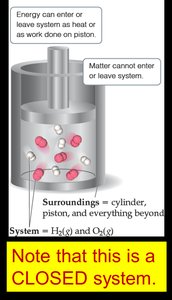
Closed System: Can exchange energy but not matter with surroundings.
Isolated System: Cannot exchange either energy or matter with surroundings.
Internal Energy and Its Changes
Internal Energy (E)
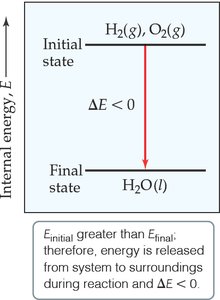
Internal energy is the sum of all kinetic and potential energies of all particles in the system. We usually measure changes in internal energy, not its absolute value.
Change in Internal Energy:
Interpreting ΔE
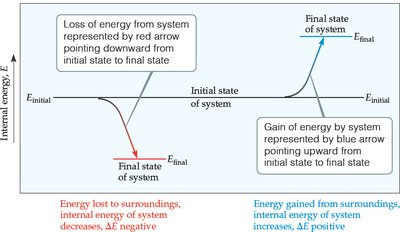
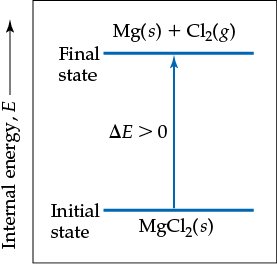
If , the system absorbs energy from the surroundings.
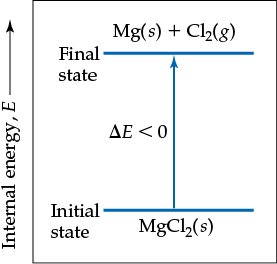
If , the system releases energy to the surroundings.
Energy Diagrams for Chemical Reactions
Energy diagrams visually represent the change in internal energy during a reaction. For example, if the products have higher energy than the reactants, (endothermic); if lower, (exothermic).
Thermodynamic Quantities
Each thermodynamic quantity has three parts: a number, a unit, and a sign.
The sign indicates the direction of energy flow (positive for gain, negative for loss).
Heat, Work, and Internal Energy
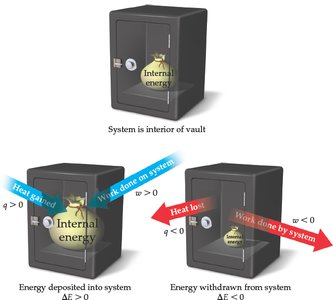
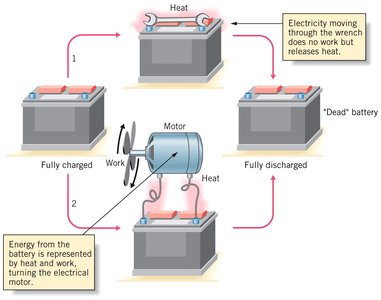
Energy is exchanged as heat (q) or work (w):
q: Heat absorbed (+) or released (−) by the system.
w: Work done on (+) or by (−) the system.
Sign Conventions
Quantity | Positive (+) | Negative (−) |
|---|---|---|
q (heat) | System gains heat | System loses heat |
w (work) | Work done on system | Work done by system |
ΔE | Net gain of energy by system | Net loss of energy by system |
Endothermic and Exothermic Processes
Endothermic Processes
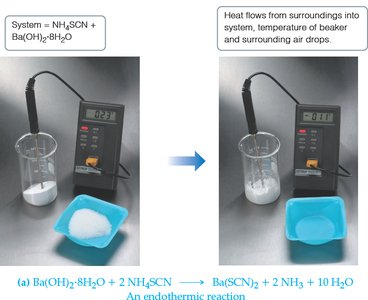
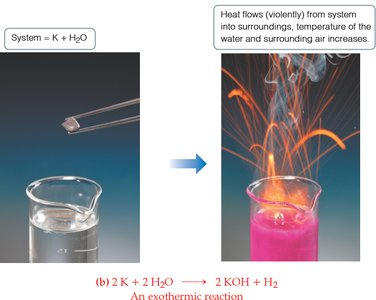
When heat is absorbed from the surroundings, the process is endothermic (). Examples include melting ice and boiling water.
Exothermic Processes
When heat is released to the surroundings, the process is exothermic (). Examples include combustion and freezing water.
Measuring Heat Flow: Calorimetry
Heat Capacity and Specific Heat
Heat Capacity (C): Amount of heat required to raise the temperature of an object by 1°C (or 1 K). Units: J/°C
Specific Heat (C_s): Amount of heat required to raise the temperature of 1 g of a substance by 1°C. Units: J/(g·°C)
Molar Heat Capacity: Heat capacity per mole of substance.
Properties of Heat Capacity
Heat capacity is an extensive property (depends on amount of substance).
Specific heat is an intensive property (independent of amount, unique to each substance).
State Functions
Definition and Examples
A state function is a property that depends only on the current state of the system, not on the path taken to reach that state. Examples include internal energy (E), pressure (P), temperature (T), and volume (V).
ΔE is a state function; q and w are not (they depend on the process path).
Additional info: In biological systems, understanding energy flow and heat exchange is crucial for studying metabolism, enzyme activity, and cellular processes. Thermochemistry provides foundational concepts for these analyses.
