 Back
BackTraining Adaptations in Skeletal Muscle: Anaerobic and Aerobic Power
Study Guide - Smart Notes
 Tailored notes based on your materials, expanded with key definitions, examples, and context.
General Principles of Training
Overload Principle
The overload principle states that a system or tissue must be exercised at a level above what it is accustomed to in order to induce a training effect. This principle is foundational for both aerobic and anaerobic training adaptations.
Overload: Imposing greater demands on the body than usual stimulates physiological adaptations.
Application: Increasing intensity, duration, or frequency of exercise sessions.
Specificity Principle
The specificity principle asserts that training adaptations are specific to the muscle fibers and metabolic systems engaged during the activity.
Muscle Fiber Recruitment: Only trained muscles adapt; benefits do not transfer to untrained muscles.
Activity Type: Anaerobic training minimally benefits endurance athletes, and vice versa.
General Fitness: Any aerobic training can improve overall health and cardiac function.
Example: Swim-trained athletes perform better on swim tests than run tests, demonstrating specificity.
Individual Differences & Reversibility
Not all individuals respond identically to training due to genetic and physiological differences. Additionally, training adaptations are reversible; detraining for 1-2 weeks can lead to significant losses in fitness.
Individual Differences: Factors include genetics, age, sex, and baseline fitness.
Reversibility: Training effects diminish rapidly without continued overload.
Types of Training Workouts
Aerobic Training Goals and Methods
Aerobic training aims to improve cardiovascular and muscular endurance through various workout structures.
Continuous Workouts: Sustained exercise at a steady intensity.
Fartlek Training: Unstructured speed play, alternating between fast and slow segments.
Interval Training: Alternating periods of high-intensity work and recovery.
Lactate Level Techniques: Workouts designed to target specific lactate thresholds.
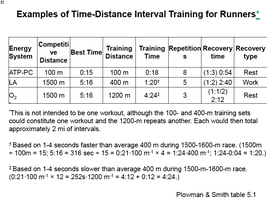
Table Purpose: The table above provides examples of time-distance interval training for runners, illustrating how different energy systems are targeted by manipulating distance, intensity, repetitions, and recovery.
Training the ATP-PCr System
Short-Duration, High-Intensity Training
The ATP-PCr system supports short, explosive efforts (e.g., 100m sprints). Training involves repeated maximal efforts with sufficient rest to allow phosphocreatine (PCr) resynthesis.
Restoration: 20-30 seconds restores half of ATP-PCr; full restoration may require 2-8 minutes.
Adaptation: Repeated stimulation increases system capacity without significant anaerobic glycolysis involvement.
Enzyme Changes: Creatine kinase (CK) and myosin ATPase activity increase with training.
Training Anaerobic Glycolysis
Medium-Duration, High-Intensity Training
Anaerobic glycolysis supports efforts lasting 30 seconds to 2 minutes (e.g., 400m sprints). Training involves repeated bouts with incomplete recovery, increasing tolerance to lactic acid accumulation.
Enzyme Adaptations: Endurance training increases hexokinase and slightly increases phosphofructokinase (PFK) activity.
Lactate Tolerance: Incomplete recovery enhances the ability to tolerate and clear lactate.
Training Aerobic Metabolism
Long-Duration, Moderate-Intensity Training
Aerobic training involves prolonged exercise at or above competition pace, with short recovery periods. This enhances cardiovascular and muscular endurance.
Training Volume: Higher volume is crucial for endurance athletes; lower intensity allows for greater frequency and duration.
VO2max: Maximal oxygen uptake can increase by 2-50% with training, influenced by genetics and environment.
Oxygen Utilization Adaptations
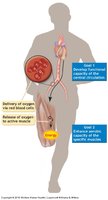
Endurance training increases maximal oxygen uptake and myoglobin concentration, reduces oxygen deficit, and accelerates recovery (lower EPOC).
Absolute Workload: Oxygen cost remains the same before and after training for a given workload.
Relative Workload: After training, a given workload represents a lower percentage of VO2max.
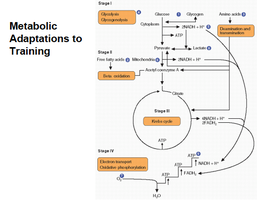
Metabolic Adaptations to Training
Oxidative Phosphorylation
Aerobic training increases the number and size of mitochondria, enhancing the capacity for oxidative phosphorylation. These changes are not observed with resistance training.
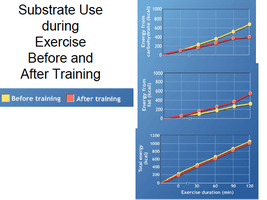
Fuel Utilization Adaptations
Carbohydrates: Increased GLUT4 expression, higher glycogen stores, and reduced reliance on carbohydrates during moderate exercise.
Fats: Enhanced mobilization and utilization of free fatty acids (FFA), increased fat storage near mitochondria, and greater reliance on fat during exercise.
Proteins: Improved utilization of branched-chain amino acids (BCAA) and increased capacity for gluconeogenesis.
Beta-Oxidation
Endurance training increases the rate of beta-oxidation, allowing for greater fat utilization during prolonged exercise. The rate-limiting enzyme, carnitine palmityl transferase, shows increased activity post-training.
Enzyme Adaptations
Glycogen Phosphorylase: Increased activity with sprint training.
Phosphofructokinase (PFK): Increased with both endurance and sprint training.
Lactate Dehydrogenase (LDH): Endurance training shifts LDH to the cardiac muscle form, while sprint training increases the skeletal muscle form.
Structural Adaptations in Muscle
Increased Capillary Density
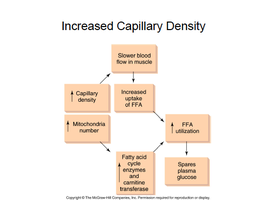
Endurance training increases capillary density, which slows blood flow, enhances FFA uptake, and spares plasma glucose by increasing mitochondrial number and fatty acid enzyme activity.
Mitochondrial Adaptations
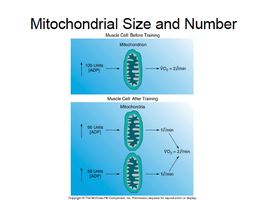
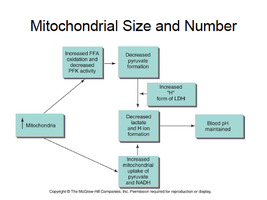
Training increases both the size and number of mitochondria in muscle cells, enhancing the capacity for aerobic metabolism and ATP production.
Lactate Accumulation and Clearance
Endurance training reduces lactate accumulation at a given workload by decreasing carbohydrate utilization, increasing pyruvate dehydrogenase activity, and enhancing lactate clearance through increased gluconeogenesis and mitochondrial content.
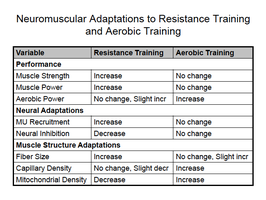
Neuromuscular Adaptations
Resistance Training
Performance: Increases muscle strength and power.
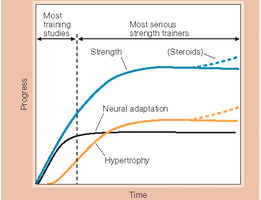
Neural Adaptations: Increased motor unit recruitment and synchronization, decreased neural inhibition.
Muscle Structure: Increased fiber size, possible decrease in mitochondrial density.
Aerobic Training
Performance: Increases aerobic power and endurance, but not strength or power.
Muscle Structure: Increases capillary and mitochondrial density, slight increase in fiber size (mainly slow-twitch fibers).
Principles of Resistance Training
Progressive Resistance Exercise (PRE): Overload is achieved by increasing resistance as strength improves.
Periodization: Training is divided into phases (preparation, transition, competition, recovery) to optimize performance and recovery.
Specificity: Training adaptations are specific to the type of contraction, load, and muscle group targeted.
Concurrent Training
Combining resistance and aerobic training can lead to different adaptations. Resistance training gains may be less pronounced, but aerobic adaptations are generally maintained.
Summary of Adaptations
Metabolic System: Enhanced enzyme activity, substrate utilization, and mitochondrial adaptations.
Skeletal Muscle System: Increased fiber size, capillary density, and neuromuscular efficiency.
Benefits: Improved endurance, strength, power, and recovery capacity.
Study Questions
How does endurance training change muscle fibers and related structures?
How does resistance training change muscle fibers and related structures?
What is the difference between fatigue and delayed onset muscle soreness (DOMS)?
How does DOMS occur, and how does the muscle recover from it?
