 Back
Transcription and Gene Expression: From DNA to mRNA
Study Guide - Smart Notes
 Tailored notes based on your materials, expanded with key definitions, examples, and context.
Transcription and the Central Dogma of Molecular Biology
Overview of the Central Dogma
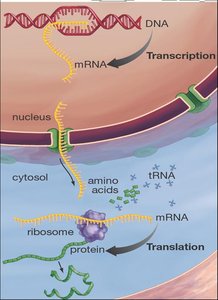
The central dogma of molecular biology describes the flow of genetic information within a biological system. It explains how DNA is transcribed into RNA, which is then translated into protein. This process is fundamental to all living organisms and underlies the expression of genetic traits.
DNA stores genetic instructions for cellular processes.
Transcription is the process of copying DNA into messenger RNA (mRNA).
Translation is the process by which mRNA is decoded to synthesize proteins.
Proteins perform structural and functional roles in the cell.
Genetic Information Flow
Genetic information is stored in the sequence of DNA bases.
This information is transcribed into a sequence of RNA bases.
The RNA sequence is then translated into a sequence of amino acids to form proteins.
Example: The sequence of nucleotides in a gene determines the sequence of amino acids in a protein, which in turn determines the protein's structure and function.
Gene Structure and Expression
Genes and Chromosomes
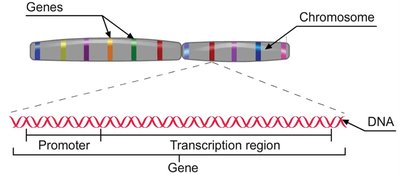
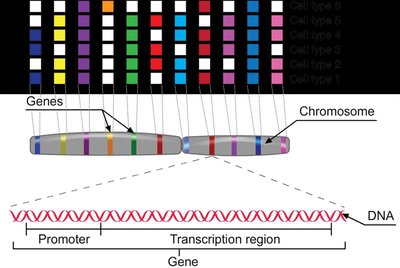
A gene is a segment of DNA that contains the instructions for making a specific protein or functional RNA. Chromosomes are long DNA molecules that contain many genes.
Each human chromosome contains about 1000 genes.
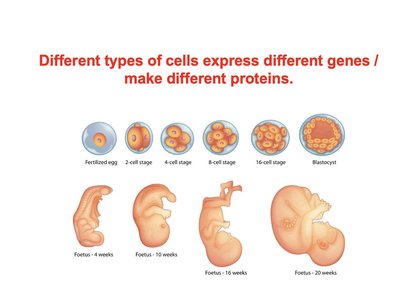
All cells in an organism contain the same DNA, but different cell types express different sets of genes.
Cell Differentiation and Gene Expression
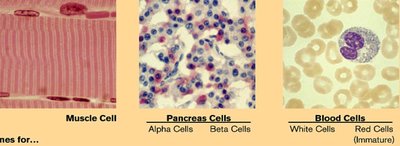
Although all cells in a multicellular organism have the same DNA, they can differentiate into various cell types by expressing different genes. This selective gene expression leads to the formation of specialized cells such as muscle cells, pancreas cells, and blood cells.
Cell differentiation is the process by which cells become specialized in structure and function.
Different cell types express different genes, resulting in the production of different proteins.
Mechanism of Transcription
Initiation of Transcription
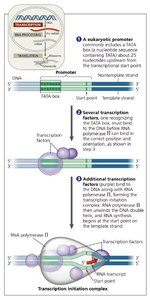
Transcription begins at specific DNA sequences called promoters. Transcription factors (proteins) bind to the promoter region, recruiting RNA polymerase to initiate transcription.
Promoter: A DNA sequence where transcription factors and RNA polymerase bind to start transcription.
Transcription factors: Proteins that regulate the binding of RNA polymerase to the promoter.
RNA polymerase: The enzyme that synthesizes RNA from the DNA template.
Stages of Transcription
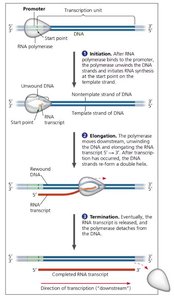
Transcription occurs in three main stages: initiation, elongation, and termination.
Initiation: RNA polymerase binds to the promoter and unwinds the DNA.
Elongation: RNA polymerase moves along the template strand, synthesizing RNA in the 5' to 3' direction.
Termination: Transcription ends when RNA polymerase reaches a terminator sequence, releasing the newly made RNA.
Directionality and Template Strand
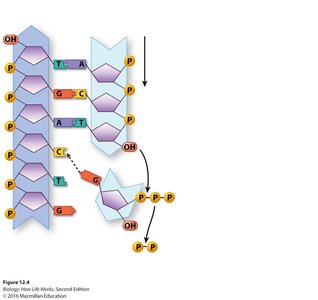
During transcription, only one strand of DNA (the template strand) is used to synthesize RNA. The RNA sequence is complementary and antiparallel to the template strand, and nearly identical to the coding strand (except RNA has uracil (U) instead of thymine (T)).
RNA is synthesized in the 5' to 3' direction.
The template strand is read in the 3' to 5' direction.
Equation:
Regulation of Gene Expression
Transcriptional Regulation
The initiation of transcription is the most common point of regulation for gene expression. The presence and combination of transcription factors determine when, where, and how much a gene is transcribed.
Promoter sequences and transcription factors are key regulatory elements.
Different cell types express different sets of genes by regulating transcription.
Processing of mRNA in Eukaryotes
mRNA Modifications
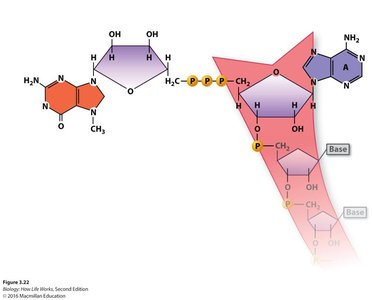
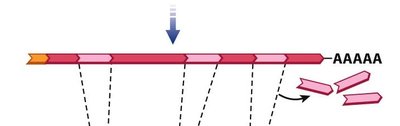
In eukaryotes, the primary RNA transcript (pre-mRNA) undergoes several modifications before becoming mature mRNA:
5' Cap: Addition of a modified guanine nucleotide to the 5' end, which stabilizes mRNA and helps with export and translation initiation.
Poly(A) Tail: Addition of a string of adenine nucleotides to the 3' end, which stabilizes mRNA and promotes translation.
Splicing: Removal of non-coding sequences (introns) and joining of coding sequences (exons). Alternative splicing allows for the production of multiple proteins from a single gene.
Export and Translation
Once processed, the mature mRNA is exported from the nucleus to the cytoplasm, where it is translated by ribosomes into protein.
Summary Table: Key Steps in Transcription and mRNA Processing
Step | Description | Key Molecules |
|---|---|---|
Initiation | RNA polymerase binds to promoter with help of transcription factors | Promoter, transcription factors, RNA polymerase |
Elongation | RNA polymerase synthesizes RNA strand complementary to DNA template | DNA template, RNA nucleotides |
Termination | RNA polymerase reaches terminator sequence and releases RNA | Terminator sequence |
5' Capping | Modified guanine nucleotide added to 5' end | 7-methylguanosine |
Polyadenylation | Poly(A) tail added to 3' end | Adenine nucleotides |
Splicing | Introns removed, exons joined | Spliceosome, introns, exons |
Key Terms and Concepts
Gene: A segment of DNA that codes for a protein or functional RNA.
Promoter: DNA sequence where transcription begins.
Transcription factor: Protein that regulates transcription initiation.
RNA polymerase: Enzyme that synthesizes RNA from DNA template.
mRNA: Messenger RNA, carries genetic information from DNA to ribosome.
Exon: Coding region of a gene that is expressed.
Intron: Non-coding region of a gene that is removed during splicing.
5' Cap: Modified nucleotide added to the 5' end of mRNA.
Poly(A) Tail: String of adenine nucleotides added to the 3' end of mRNA.
