 Back
Transcription and Gene Expression in Eukaryotes
Study Guide - Smart Notes
 Tailored notes based on your materials, expanded with key definitions, examples, and context.
Gene Expression and the Central Dogma
Overview of Genetic Information Flow
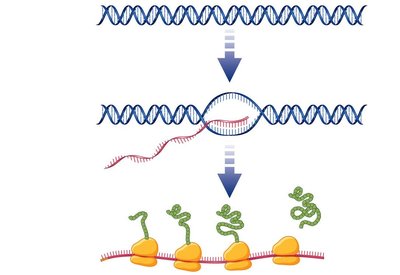
The central dogma of molecular biology describes the flow of genetic information within a biological system. Genetic information is stored in DNA, transcribed into messenger RNA (mRNA), and then translated into proteins, which perform essential cellular functions.
DNA stores the instructions for cellular processes.
Transcription is the process of copying DNA information into mRNA.
Translation is the process where ribosomes use mRNA to synthesize proteins.
Proteins provide structure and catalyze biochemical reactions in the cell.
Gene expression refers to the process by which information from a gene is used to synthesize a functional gene product, typically a protein.
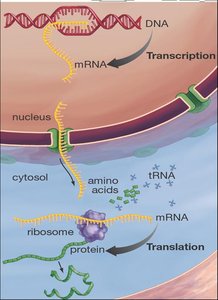
Transcription: DNA to mRNA
Definition and Process
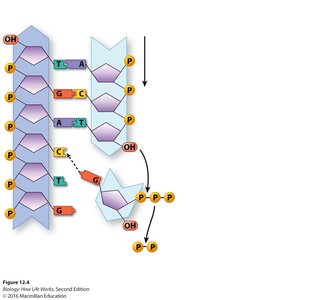
Transcription is the synthesis of RNA from a DNA template. It involves copying the nucleotide sequence of a gene into a complementary RNA sequence.
Template strand: The DNA strand that is read by RNA polymerase to synthesize RNA.
Coding strand: The DNA strand with the same sequence as the RNA (except T is replaced by U in RNA).
RNA is synthesized in the 5' to 3' direction, using the 3' to 5' DNA template strand.
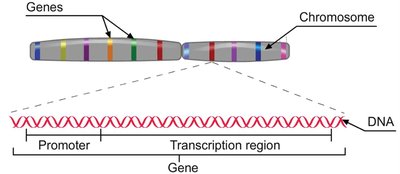
Transcription begins at a promoter sequence and ends at a terminator sequence.
Promoters and Transcription Factors
Transcription starts at specific DNA regions called promoters. Transcription factors are proteins that bind to promoter sequences and recruit RNA polymerase to initiate transcription.
Promoter: A DNA sequence upstream of a gene that signals the start site for transcription.
Transcription factors: Proteins that bind to specific DNA sequences to regulate transcription initiation.
RNA polymerase binds to the promoter with the help of transcription factors and synthesizes RNA.
Directionality and Template Selection
The direction of transcription is determined by the orientation of the promoter. The template strand is read 3' to 5', and RNA is synthesized 5' to 3'.
Only one DNA strand is used as the template for a given gene.
The coding strand is not used as a template but has the same sequence as the RNA (except U for T).
RNA Processing in Eukaryotes
mRNA Modifications
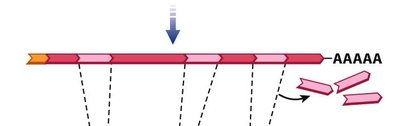
In eukaryotes, the primary RNA transcript (pre-mRNA) undergoes several modifications before becoming mature mRNA:
5' Cap: Addition of a modified guanine nucleotide to the 5' end, which stabilizes mRNA and aids in ribosome binding.
Poly(A) tail: Addition of a string of adenine nucleotides to the 3' end, which stabilizes mRNA and promotes export from the nucleus.
Splicing: Removal of non-coding sequences (introns) and joining of coding sequences (exons).
Alternative splicing: Allows a single gene to code for multiple proteins by varying the combination of exons included in the final mRNA.
Gene Regulation and Cellular Differentiation
Gene Expression in Different Cell Types
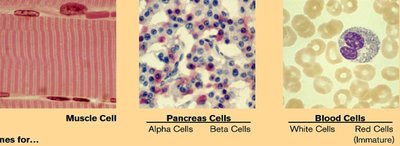
Although all cells in an organism contain the same DNA, different cell types express different sets of genes, leading to cellular differentiation. This selective gene expression allows cells to perform specialized functions.
Muscle cells, pancreas cells, and blood cells express different proteins based on their function.
Gene expression is regulated primarily at the level of transcription initiation, but also at other stages.
Development and Differentiation
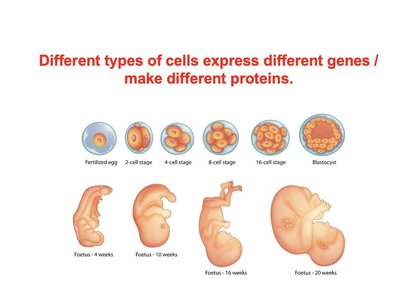
During development, a single fertilized egg divides and differentiates into various cell types by expressing different genes at different times and locations.
Cellular differentiation is driven by changes in gene expression, not changes in DNA sequence.
All cells have the same genome but differ in the subset of genes they express.
Summary Table: Key Steps in Transcription and mRNA Processing
Step | Description | Key Enzyme/Factor |
|---|---|---|
Initiation | Transcription factors bind promoter; RNA polymerase recruited | RNA polymerase, transcription factors |
Elongation | RNA polymerase synthesizes RNA 5' to 3' using DNA template | RNA polymerase |
Termination | Transcription ends at terminator sequence | RNA polymerase |
5' Capping | Modified guanine added to 5' end | Capping enzymes |
Splicing | Introns removed, exons joined | Spliceosome |
Polyadenylation | Poly(A) tail added to 3' end | Poly(A) polymerase |
Key Terms and Concepts
Gene: A segment of DNA that encodes a functional product (protein or RNA).
Promoter: DNA sequence where transcription machinery assembles.
Transcription factor: Protein that regulates gene expression by binding DNA.
RNA polymerase: Enzyme that synthesizes RNA from a DNA template.
Exon: Coding region of a gene that is expressed in the final mRNA.
Intron: Non-coding region removed during RNA processing.
Alternative splicing: Process by which different mRNAs are produced from the same gene.
Practice Questions
What is the central dogma of molecular biology?
How does RNA polymerase know where to start transcription?
What modifications occur to eukaryotic mRNA before it leaves the nucleus?
How can one gene produce multiple proteins?
Why do different cell types express different proteins if they have the same DNA?
