 Back
Transcription and Its Regulation in Gene Expression
Study Guide - Smart Notes
 Tailored notes based on your materials, expanded with key definitions, examples, and context.
Transcription and Its Regulation in Gene Expression
Overview of the Central Dogma
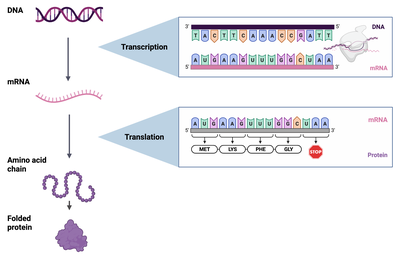
The central dogma of molecular biology describes the flow of genetic information within a biological system. It states that information is transferred from DNA to RNA through the process of transcription, and from RNA to protein through translation. This framework is fundamental to understanding how genes dictate cellular function.

DNA vs. RNA
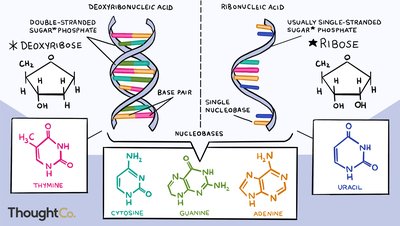
DNA (deoxyribonucleic acid) and RNA (ribonucleic acid) are nucleic acids that differ in structure and function:
DNA is double-stranded, contains deoxyribose sugar, and uses thymine (T) as a base.
RNA is usually single-stranded, contains ribose sugar, and uses uracil (U) instead of thymine.
Transcription: The Synthesis of RNA
Definition and Purpose
Transcription is the process by which an RNA molecule is synthesized from a DNA template. The main product is messenger RNA (mRNA), which carries genetic information from DNA to the ribosome for protein synthesis.
Transcription in Prokaryotes vs. Eukaryotes
Transcription differs between prokaryotic and eukaryotic cells in several key ways:
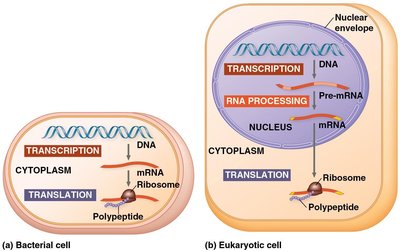
In prokaryotes, transcription and translation occur simultaneously in the cytoplasm.
In eukaryotes, transcription occurs in the nucleus, and translation occurs in the cytoplasm. Eukaryotic mRNA undergoes additional processing (e.g., splicing, capping, polyadenylation).
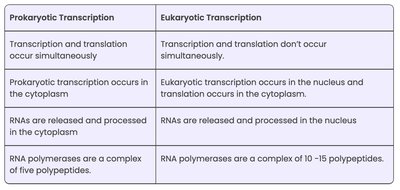
Prokaryotic Transcription | Eukaryotic Transcription |
|---|---|
Transcription and translation occur simultaneously. | Transcription and translation do not occur simultaneously. |
Occurs in the cytoplasm. | Occurs in the nucleus; translation in cytoplasm. |
RNAs are released and processed in the cytoplasm. | RNAs are released and processed in the nucleus. |
RNA polymerase: 5 polypeptides. | RNA polymerase: 10–15 polypeptides. |
Key Molecules in Transcription
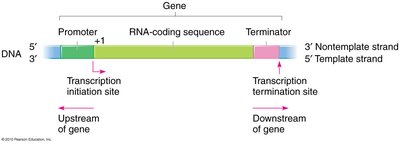
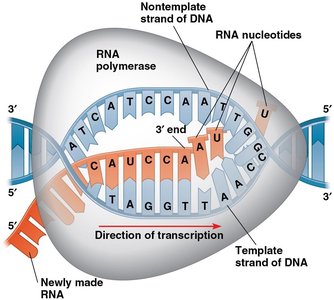
RNA Polymerase: The enzyme that synthesizes RNA by reading the DNA template strand and assembling RNA nucleotides in the 5' to 3' direction.
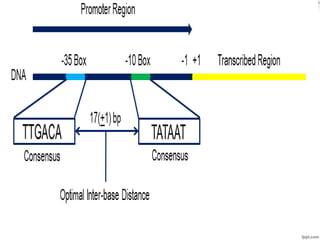
Promoter: A DNA sequence where RNA polymerase binds to initiate transcription.
Terminator: A DNA sequence signaling the end of transcription (mainly in prokaryotes).
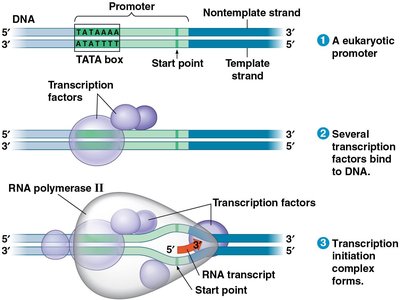
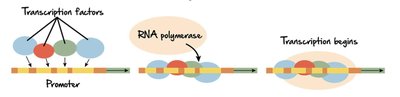
Transcription Factors: Proteins in eukaryotes that help RNA polymerase bind to the promoter and regulate transcription initiation.
Coding Strand vs. Template Strand
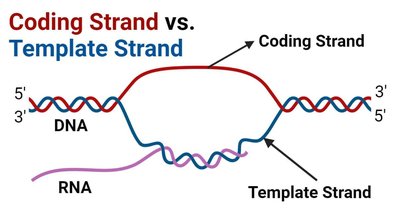
During transcription, only one DNA strand is used as a template:
The template strand is read by RNA polymerase to synthesize RNA.
The coding strand has the same sequence as the RNA (except T is replaced by U).
Genes on Both DNA Strands
Genes can be located on either strand of the DNA duplex, and only one strand is transcribed at a time for a given gene.

Stages of Transcription
1. Initiation
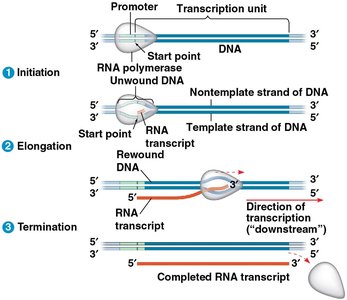
Transcription begins when RNA polymerase binds to the promoter region with the help of transcription factors (in eukaryotes). The DNA is unwound, and the first RNA nucleotide is added.
2. Elongation
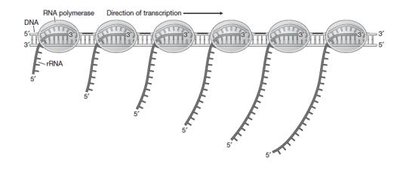
RNA polymerase moves along the DNA template, unwinding the DNA and synthesizing the RNA strand by adding complementary nucleotides. The RNA grows in the 5' to 3' direction.
Transcription progresses at about 40 nucleotides per second in eukaryotes.
Multiple RNA polymerases can transcribe a single gene simultaneously.
3. Termination
Transcription ends when RNA polymerase reaches a terminator sequence (in prokaryotes) or after transcribing a polyadenylation signal (in eukaryotes). The RNA transcript is released.
Transcriptional Regulation
Levels of Gene Expression
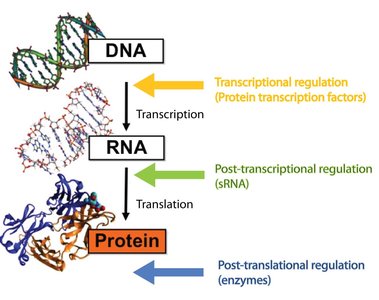
Gene expression can be regulated at multiple levels, including transcriptional, post-transcriptional, and post-translational stages. Transcriptional regulation is often the most significant control point.

Role of Promoters and Transcription Factors
Promoters contain specific DNA sequences recognized by RNA polymerase and transcription factors.
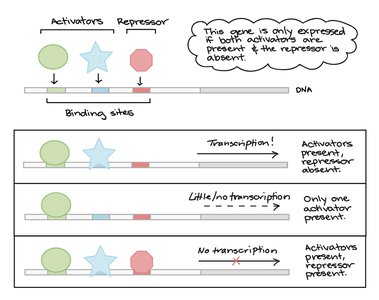
Transcription factors can act as activators or repressors, increasing or decreasing the rate of transcription.
Binding sites for transcription factors can be located at varying distances from the gene.
Activators and Repressors
Activators increase the rate of transcription by facilitating the binding of RNA polymerase to the promoter, while repressors decrease transcription by blocking this interaction.

Practice Questions and Applications
Given a DNA template strand, determine the sequence of the resulting mRNA transcript by replacing A with U, T with A, C with G, and G with C.
Mutations in the promoter region can affect the binding efficiency of RNA polymerase, altering gene expression levels.
Transcription factors are essential for efficient transcription initiation in eukaryotes.
Summary Table: Key Differences in Transcription
Feature | Prokaryotes | Eukaryotes |
|---|---|---|
Location | Cytoplasm | Nucleus |
RNA Processing | None | Splicing, capping, polyadenylation |
Transcription & Translation | Simultaneous | Separate |
RNA Polymerase | Single type | Multiple types |
Additional info: In eukaryotes, the primary transcript (pre-mRNA) undergoes extensive processing before becoming mature mRNA. This includes the addition of a 5' cap, splicing out of introns, and addition of a poly-A tail at the 3' end.
