 Back
Transcription and RNA Modification in Eukaryotes
Study Guide - Smart Notes
 Tailored notes based on your materials, expanded with key definitions, examples, and context.
Transcription and RNA Modification in Eukaryotes
Introduction to Genes and the Central Dogma
Genes are fundamental units of heredity, encoding instructions for the synthesis of functional molecules, primarily proteins. The central dogma of molecular biology describes the flow of genetic information from DNA to RNA to protein, highlighting the processes of transcription and translation.
Gene: A segment of DNA that codes for a functional molecule, such as a protein or RNA.
Central Dogma: DNA → RNA → Protein. Not all RNA is translated (e.g., rRNA, tRNA).
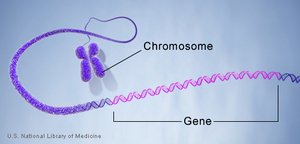
Chromosomes: Structures composed of DNA and proteins, containing many genes.
Human Genome: Contains approximately 20,000-25,000 genes distributed across 23 pairs of chromosomes.
Structure of Genes
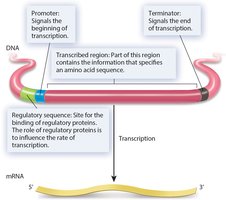
A gene is an organized unit of DNA sequences that can be transcribed into RNA and ultimately results in a functional product. Genes contain several important regions:
Promoter: Signals the beginning of transcription.
Coding Sequence: Contains the information for the amino acid sequence of a protein.
Terminator: Signals the end of transcription.
Regulatory Sequences: Sites for binding regulatory proteins that influence the rate of transcription.
The Central Dogma and Flow of Genetic Information
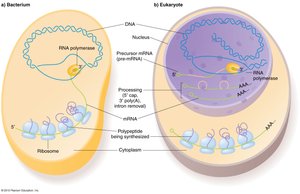
The central dogma describes how genetic information is transferred from DNA to RNA (transcription) and from RNA to protein (translation). In prokaryotes, transcription and translation occur simultaneously, while in eukaryotes, transcription occurs in the nucleus and translation in the cytoplasm.
DNA Replication: Copying DNA for cell division.
Transcription: Synthesis of RNA from a DNA template.
Translation: Synthesis of protein from an mRNA template.
Transcription: Synthesis of RNA from DNA
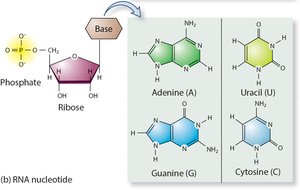
DNA vs. RNA Nucleotides
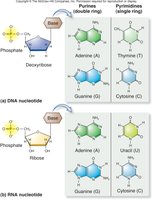
DNA and RNA are polymers of nucleotides, but they differ in sugar, bases, and structure:
DNA: Contains deoxyribose sugar; bases are adenine (A), thymine (T), guanine (G), and cytosine (C).
RNA: Contains ribose sugar; bases are adenine (A), uracil (U), guanine (G), and cytosine (C). Uracil replaces thymine in RNA.
Directionality: Both DNA and RNA are synthesized in the 5' to 3' direction.
Transcription in Bacteria
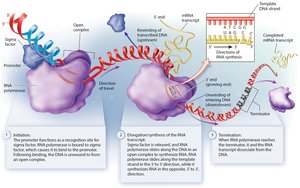
Transcription in bacteria involves three main stages: initiation, elongation, and termination.
Initiation: Sigma factor binds to the promoter, recruiting RNA polymerase, which unwinds DNA to form an open complex.
Elongation: RNA polymerase synthesizes RNA in the 5' to 3' direction, reading the DNA template strand 3' to 5'. Multiple RNA polymerases can transcribe a gene simultaneously.
Termination: A terminator sequence causes RNA polymerase to dissociate, releasing the RNA transcript.
Transcription in Eukaryotes
Transcription in eukaryotes is more complex than in bacteria, involving multiple RNA polymerases and additional regulatory mechanisms.
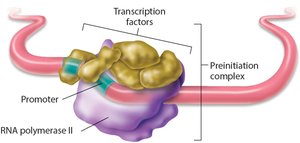
RNA Polymerases: RNA polymerase II transcribes mRNA; RNA polymerase I and III transcribe rRNA and tRNA.
Initiation: Requires several general transcription factors to form a preinitiation complex at the promoter.
Separation of Processes: Transcription occurs in the nucleus, and mRNA must be processed before export to the cytoplasm for translation.
RNA Modification in Eukaryotes
Overview of mRNA Processing
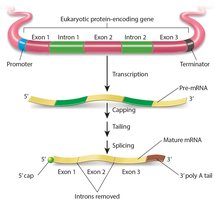
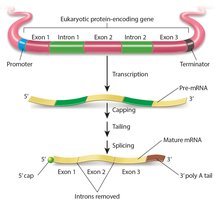
In eukaryotes, the primary RNA transcript (pre-mRNA) undergoes several modifications before becoming mature mRNA:
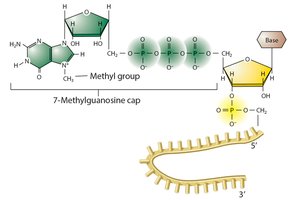
5' Capping: Addition of a 7-methylguanosine cap to the 5' end.
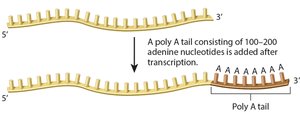
3' Polyadenylation: Addition of a poly A tail (100-200 adenines) to the 3' end.
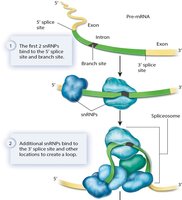
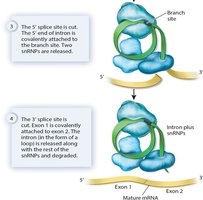
Splicing: Removal of non-coding introns and joining of coding exons.
5' Cap Addition
The 5' cap is added during transcription and serves several functions:
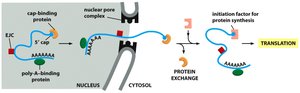
Facilitates export of mRNA from the nucleus.
Protects mRNA from degradation in the cytosol.
Enables recognition by ribosomes for translation initiation.
3' Poly A Tail Addition
The poly A tail is added after transcription is complete by poly-A polymerase:
Enhances export of mRNA from the nucleus.
Increases mRNA stability by preventing degradation.
Not encoded in the DNA sequence.
RNA Splicing
Splicing removes introns (non-coding regions) from pre-mRNA and joins exons (coding regions):
Spliceosome: A complex of small nuclear ribonucleoproteins (snRNPs) that catalyzes splicing.
Key Sequences: 5' splice site (cut first), branch site (middle of intron), and 3' splice site.
Splicing is essential for producing mature, translatable mRNA.
Summary of Eukaryotic mRNA Processing
All RNA processing steps occur in the nucleus. After capping, polyadenylation, and splicing, the mature mRNA is exported to the cytoplasm for translation.
Key Terms and Concepts
Gene: DNA segment coding for a functional product.
Transcription: Synthesis of RNA from DNA template.
RNA Polymerase: Enzyme that synthesizes RNA.
Promoter: DNA sequence where transcription begins.
Terminator: DNA sequence signaling end of transcription.
Introns: Non-coding regions removed from pre-mRNA.
Exons: Coding regions joined to form mature mRNA.
Spliceosome: Complex that removes introns.
5' Cap: Modified guanine nucleotide added to 5' end of mRNA.
Poly A Tail: String of adenines added to 3' end of mRNA.
