 Back
Transcription and RNA Modification in Eukaryotes: Study Guide
Study Guide - Smart Notes
 Tailored notes based on your materials, expanded with key definitions, examples, and context.
Transcription and RNA Modification in Eukaryotes
What is a Gene?
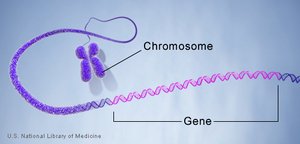
A gene is a segment of DNA that codes for a functional molecule, typically a protein or RNA. Genes are organized units of DNA sequences that enable transcription into RNA, ultimately resulting in the formation of a functional product. In humans, there are approximately 20,000-25,000 genes distributed across 23 pairs of chromosomes.
Functional products: Proteins, rRNA, tRNA, and other non-coding RNAs
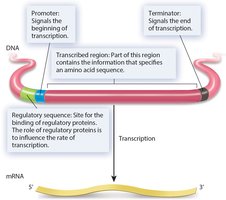
Gene structure: Includes promoter, coding sequence, terminator, and regulatory sequences
Chromosome: Genes are located on chromosomes, which are long DNA molecules
The Central Dogma of Biology
The Central Dogma describes the flow of genetic information: DNA is transcribed into RNA, which is then translated into protein. Not all RNA molecules are translated; some, like rRNA and tRNA, serve structural or functional roles.
DNA language: Sequence of nucleotide bases (A, T, C, G)
RNA language: Sequence of nucleotide bases (A, U, C, G)
Protein language: Sequence of amino acids
Key processes: DNA replication, transcription, translation
Transcription: From DNA to RNA
Gene Structure and Requirements for Transcription
Transcription requires specific DNA sequences and regulatory elements:
Promoter: Signals the beginning of transcription
Coding sequence: Contains information for the amino acid sequence
Terminator: Signals the end of transcription
Regulatory sequences: Bind regulatory proteins to influence transcription rate
DNA vs RNA Nucleotides
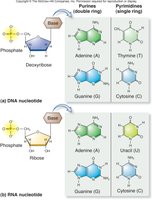
DNA and RNA are both nucleic acids, but differ in their nucleotide composition:
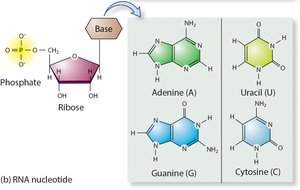
DNA nucleotides: Adenine (A), Thymine (T), Guanine (G), Cytosine (C)
RNA nucleotides: Adenine (A), Uracil (U), Guanine (G), Cytosine (C)
Structural difference: RNA has an -OH group on the 2' carbon of ribose; DNA has deoxyribose
Base pairing: In RNA, U pairs with A
Transcription in Bacteria
Initiation
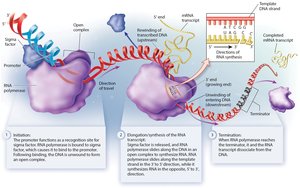
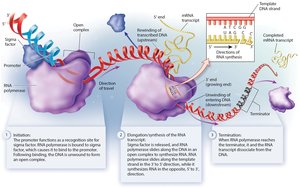
Transcription begins when the sigma factor binds to the promoter, recruiting RNA polymerase. RNA polymerase unwinds the DNA to form an open complex.
Sigma factor: Protein that recognizes promoter and recruits RNA polymerase
Open complex: Unwound DNA region (10-15 bp)
Primer requirement: RNA polymerase does not require a primer
Elongation
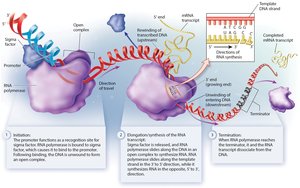
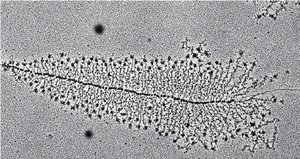
Elongation starts when the sigma factor is released. RNA polymerase synthesizes RNA in the 5' to 3' direction, reading the DNA template 3' to 5'. Multiple RNA polymerases can transcribe a gene simultaneously.
Directionality: RNA is synthesized 5' to 3'; DNA template is read 3' to 5'
Coding strand: Has the same sequence as the RNA (except T replaced by U)
Bond formation: RNA polymerase catalyzes phosphodiester bonds
Energy source: Nucleotide triphosphates provide energy for addition
Termination
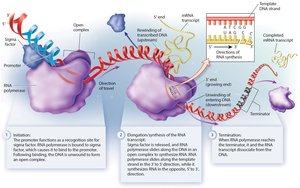
Transcription ends when the terminator sequence causes RNA polymerase to dissociate from DNA, releasing the completed RNA transcript.
Terminator: DNA sequence signaling the end of transcription
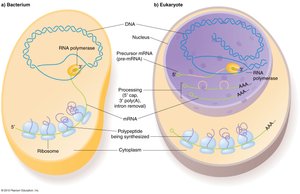
Translation: In bacteria, mRNA can be translated immediately after transcription
Transcription in Eukaryotes
Key Differences from Bacteria
Transcription in eukaryotes is more complex and involves additional steps and regulatory mechanisms.
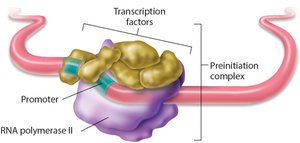
Three RNA polymerases: RNA pol I (rRNA), RNA pol II (mRNA), RNA pol III (tRNA and other RNAs)
Initiation: Requires multiple general transcription factors
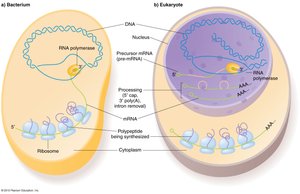
Nuclear envelope: Separates transcription from translation
RNA processing: Eukaryotic transcripts undergo extensive modification
RNA Modification in Eukaryotes
Overview of RNA Processing
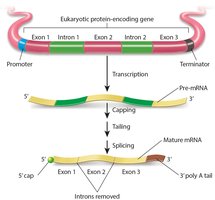
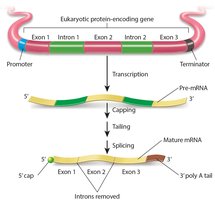
Eukaryotic pre-mRNA undergoes several modifications before becoming mature mRNA:
5' Cap: Addition of a 7-methylguanosine cap
3' Poly A tail: Addition of a string of adenine nucleotides
Splicing: Removal of introns and joining of exons
Introns and Exons
Introns are intervening sequences in eukaryotic genes that are not translated into protein. Exons are expressed regions that remain after introns are removed by splicing.
Introns: Non-coding regions, removed during RNA processing
Exons: Coding regions, joined together to form mature mRNA
Splicing: Performed by spliceosomes, composed of snRNPs
5' Cap Addition
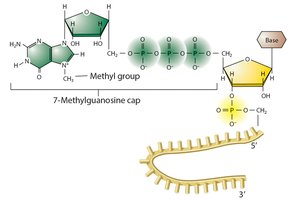
The 5' cap is added to pre-mRNA during transcription. It is a 7-methylguanosine structure that protects mRNA from degradation and is required for export from the nucleus and translation initiation.
Cap-binding proteins: Recognize the cap for nuclear export
Protection: Prevents degradation in the cytosol
Translation: Cap is recognized by ribosome initiation factors
3' Poly A Tail Addition
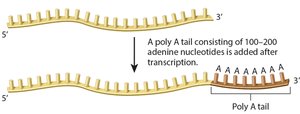
The poly A tail is a string of 100-200 adenine nucleotides added to the 3' end of mRNA after transcription. It is not encoded in the DNA and is added by poly-A polymerase.
Export: Aids in export of mRNA from the nucleus
Protection: Prevents degradation in the cytosol
Timing: Added after transcription is complete
Splicing: Removal of Introns
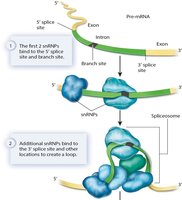
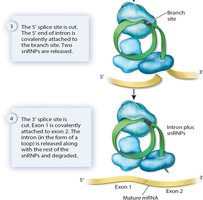
Splicing is the process by which introns are removed from pre-mRNA and exons are joined together. This is performed by the spliceosome, a complex of snRNPs.
Spliceosome: Composed of snRNPs (small nuclear RNA and proteins)
Branch site: Located in the middle of the intron
5' splice site: First site to be cut
3' splice site: Second site to be cut, forms mature mRNA
Summary Table: RNA Processing Steps
Step | Description | Function |
|---|---|---|
5' Cap Addition | 7-methylguanosine cap added to 5' end | Protection, export, translation initiation |
Poly A Tail Addition | 100-200 adenines added to 3' end | Protection, export |
Splicing | Removal of introns, joining of exons | Creates mature mRNA |
Export and Translation of Mature mRNA
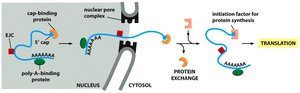
All RNA processing takes place in the nucleus. After processing, mature mRNA is exported to the cytosol, where it is translated into protein.
Nuclear export: Requires cap and poly A tail
Translation: Initiation factors recognize processed mRNA
Key Concepts and Equations
Transcription direction: RNA is synthesized 5' to 3'
Base pairing: (DNA), (RNA), (both)
Phosphodiester bond formation:
Example: The gene for hemoglobin is transcribed into mRNA, which is then translated into the hemoglobin protein, essential for oxygen transport in blood.
Additional info: Eukaryotic RNA processing allows for alternative splicing, increasing protein diversity from a single gene.
