 Back
Transcription and RNA Processing: From DNA to Protein
Study Guide - Smart Notes
 Tailored notes based on your materials, expanded with key definitions, examples, and context.
Transcription and RNA Processing
The Central Dogma of Molecular Biology
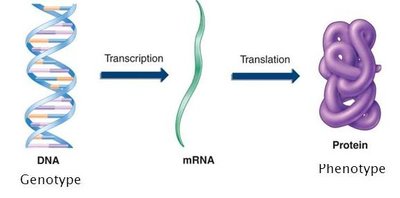
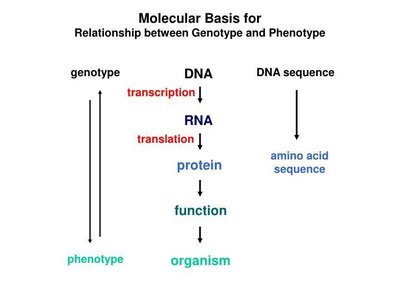
The central dogma describes the flow of genetic information within a biological system. DNA is transcribed into RNA, which is then translated into protein. This process explains how genotype (genetic makeup) determines phenotype (observable traits).
DNA contains the genetic instructions for life.
Transcription is the process by which DNA is copied into messenger RNA (mRNA).
Translation is the process by which mRNA is decoded to synthesize proteins.
Proteins are responsible for the structure and function of living organisms.
Phenotype is the result of protein activity in cells.
Genotype refers to the genetic sequence in DNA.
Example: The gene for hemoglobin is transcribed and translated to produce the hemoglobin protein, which carries oxygen in blood.
DNA vs. RNA: Structure and Function
DNA and RNA are nucleic acids with distinct structural and functional properties. Understanding their differences is essential for grasping transcription and translation.
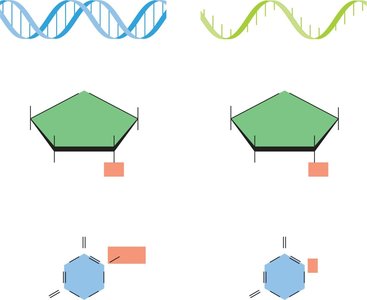
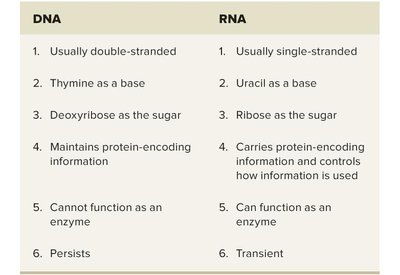
DNA: Usually double-stranded, contains deoxyribose sugar, uses thymine as a base, persists in cells, and maintains genetic information.
RNA: Usually single-stranded, contains ribose sugar, uses uracil instead of thymine, transient in cells, and carries protein-encoding information.
Example: mRNA is a type of RNA that carries genetic information from DNA to the ribosome for protein synthesis.

Transcription: From DNA to RNA
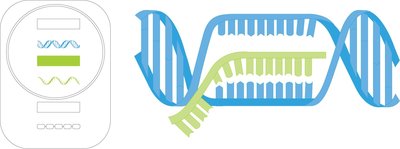
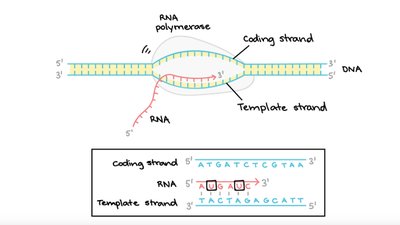
Transcription is the process by which RNA polymerase synthesizes a complementary RNA strand from a DNA template. The template strand is read in the 3' to 5' direction, and the RNA is synthesized in the 5' to 3' direction.
Template strand: The DNA strand used by RNA polymerase to synthesize RNA.
Coding strand: The DNA strand with the same sequence as the RNA (except T is replaced by U).
Base pairing rules: A pairs with U, T with A, C with G, G with C.
Example: If the template DNA is 3'-ACAGTAAGCC-5', the mRNA is 5'-UGUCAUUCGG-3'.
Gene Structure and Promoters
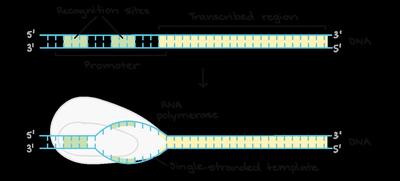
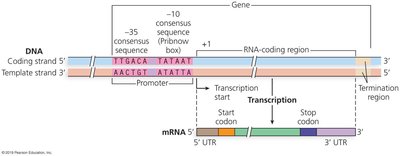
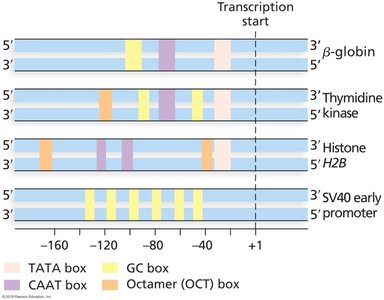
Genes contain segments with distinct functions. The promoter region is crucial for initiating transcription, as it controls the access of RNA polymerase to the gene.
+1 nucleotide: The start of transcription.
Promoter: DNA sequence upstream of the transcription start site; binds RNA polymerase and other proteins.
Consensus sequences: Specific DNA motifs recognized by RNA polymerase.
Bacterial Transcription: Four-Stage Process
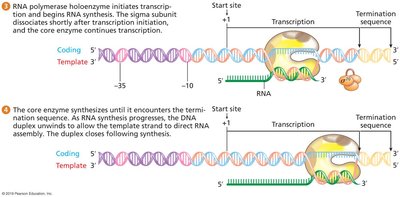
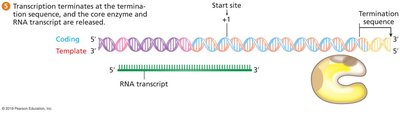
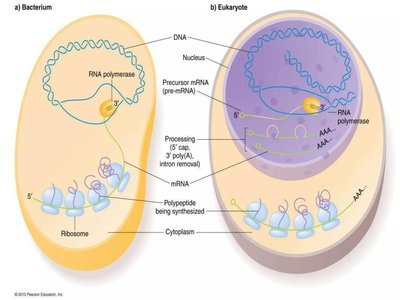
Bacterial transcription involves four main stages: promoter recognition, initiation, chain elongation, and termination.
Promoter recognition: RNA polymerase binds to the promoter region.
Initiation: RNA synthesis begins at the +1 site.
Elongation: RNA polymerase moves along the template strand, synthesizing RNA.
Termination: RNA polymerase releases the completed RNA transcript.
Eukaryotic Transcription: Complexity and Polymerases
Eukaryotic transcription is more complex than bacterial transcription. Eukaryotes have three RNA polymerases, diverse promoter elements, and require extensive RNA processing.
RNA polymerase I: Transcribes ribosomal RNA genes.
RNA polymerase II: Transcribes protein-coding genes and most small nuclear RNA genes.
RNA polymerase III: Transcribes tRNA genes and some other small RNAs.
Promoter elements: TATA box (−25), CAAT box (−80), GC-rich box (−90).
Consensus sequence elements: Important for binding transcription factors.

RNA Processing in Eukaryotes
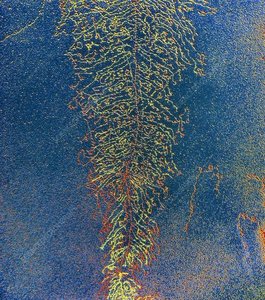
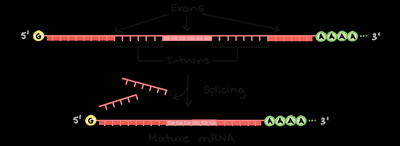
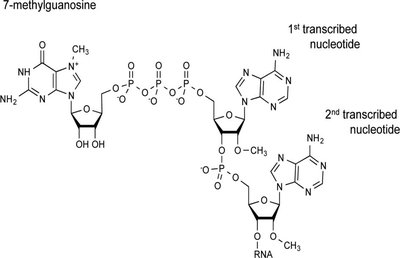
Eukaryotic genes contain introns and exons. The primary RNA transcript undergoes processing to become mature mRNA, including removal of introns (splicing), addition of a 5' cap, and addition of a poly-A tail.
5' cap: Protects mRNA from degradation, facilitates nuclear export, assists in splicing, and enhances translation.
Poly-A tail: Facilitates nuclear export, protects mRNA, enhances translation, and signals transcription termination.
Splicing: Removes introns and joins exons to produce mature mRNA.



Practice Problems and Applications
Understanding transcription and RNA processing is essential for interpreting genetic information and predicting protein synthesis. Practice problems reinforce the concepts of template and coding strands, base pairing, and mRNA processing.
Transcription practice: Given a DNA sequence, transcribe the corresponding mRNA.
Compare mRNA with coding DNA strand: mRNA matches the coding strand except U replaces T.
Gene structure: Identify the size of primary transcript and mature mRNA based on gene schematic.
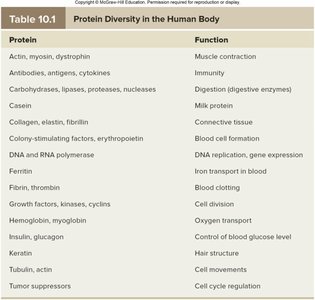
Summary Table: Protein Diversity in the Human Body
Proteins have diverse functions in the human body, ranging from muscle contraction to immunity and cell cycle regulation.
Protein | Function |
|---|---|
Actin, myosin, dystrophin | Muscle contraction |
Antibodies, antigens, cytokines | Immunity |
Carbohydrases, lipases, proteases, nucleases | Digestion (digestive enzymes) |
Casein | Milk protein |
Collagen, elastin, fibrillin | Connective tissue |
Colony-stimulating factors, erythropoietin | Blood cell formation |
DNA and RNA polymerase | DNA replication, gene expression |
Ferritin | Iron transport in blood |
Fibrin, thrombin | Blood clotting |
Growth factors, kinases, cyclins | Cell division |
Hemoglobin, myoglobin | Oxygen transport |
Insulin, glucagon | Control of blood glucose level |
Keratin | Hair structure |
Tubulin, actin | Cell movements |
Tumor suppressors | Cell cycle regulation |
Summary Table: Types of RNA
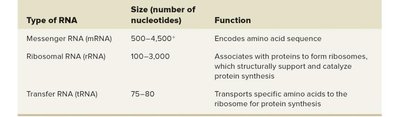
Type of RNA | Size (number of nucleotides) | Function |
|---|---|---|
Messenger RNA (mRNA) | 500–4,500 | Encodes amino acid sequence |
Ribosomal RNA (rRNA) | 100–3,000 | Associates with proteins to form ribosomes, catalyzes protein synthesis |
Transfer RNA (tRNA) | 75–80 | Transports specific amino acids to the ribosome for protein synthesis |
Additional info:
RNA processing in eukaryotes includes capping, polyadenylation, and splicing, which are essential for mRNA stability and translation.
Mutations in promoter regions can affect transcription rates, impacting gene expression and phenotype.
Consensus sequences in promoters are critical for the binding of transcription factors and RNA polymerase.
