 Back
BackTranscription and Translation: Mechanisms and Regulation in Prokaryotes and Eukaryotes
Study Guide - Smart Notes
 Tailored notes based on your materials, expanded with key definitions, examples, and context.
Transcription: The Process of RNA Synthesis
Overview of Transcription
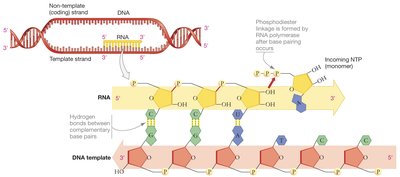
Transcription is the process by which RNA polymerases synthesize an RNA copy of the genetic instructions stored in DNA. This process is essential for gene expression and occurs in both prokaryotic and eukaryotic cells.
RNA polymerases use ribonucleoside triphosphates (NTPs) to build RNA molecules.
Only one strand of DNA serves as the template strand; the other is the non-template (coding) strand, which matches the sequence of the mRNA (except U replaces T).
RNA polymerases synthesize RNA in the 5’ → 3’ direction and do not require a primer.
Bacteria have one RNA polymerase; eukaryotes have at least three (RNA polymerase I, II, III).
Initiation of Transcription in Bacteria
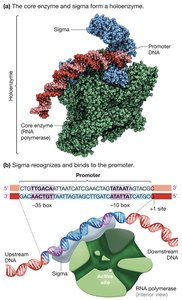
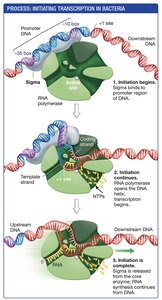
Transcription initiation is the first phase, requiring the assembly of a holoenzyme composed of RNA polymerase and a sigma protein. Sigma recognizes promoter sequences, enabling RNA polymerase to begin transcription at the correct site.
Promoters are DNA sequences where transcription begins, typically 40–50 base pairs long.
The -10 box (TATAAT) and -35 box (TTGACA) are key promoter elements upstream of the transcription start site.
Sigma binds to these boxes, orienting RNA polymerase and determining the template strand and direction of transcription.
Elongation and Termination in Bacteria
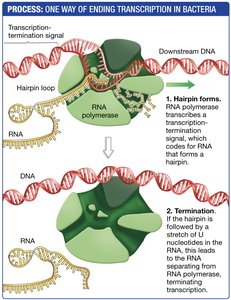
During elongation, RNA polymerase adds nucleotides to the 3’ end of the growing RNA. Termination occurs when a transcription-termination signal is transcribed, resulting in a hairpin structure that causes RNA polymerase to dissociate from the RNA transcript.
Elongation: RNA polymerase reads the DNA template and synthesizes RNA.
Termination: Hairpin loop formation in RNA leads to release of the transcript.
Transcription in Eukaryotes
Eukaryotic transcription differs from bacterial transcription in several ways, including the use of multiple RNA polymerases, larger and more diverse promoters (such as the TATA box), and general transcription factors instead of sigma proteins. Termination involves a poly(A) signal, and transcription occurs in the nucleus.
Three RNA polymerases (I, II, III) with distinct functions.
Promoters recognized by general transcription factors.
Poly(A) signal leads to transcript cleavage and addition of a poly(A) tail.
Transcription and translation are separated spatially.
RNA Processing in Eukaryotes
Unlike bacteria, eukaryotic primary transcripts (pre-mRNA) require processing before translation. This includes splicing, capping, and tail addition.
Splicing: Removal of introns and joining of exons.
5’ cap: Modified guanine nucleotide added to the 5’ end.
Poly(A) tail: 100–250 adenine nucleotides added to the 3’ end.
Mature mRNAs contain untranslated regions (UTRs) at both ends.
Discovery of Split Eukaryotic Genes
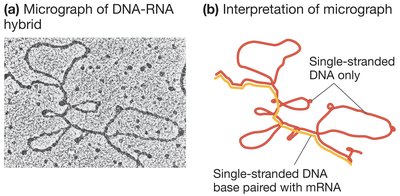
Protein-coding genes in eukaryotes contain noncoding DNA (introns), which are absent in mature mRNA. Exons are retained and encode protein.
Introns: Noncoding regions removed during RNA processing.
Exons: Coding regions retained in mature mRNA.
RNA Splicing
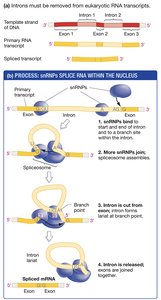
Splicing is catalyzed by small nuclear ribonucleoproteins (snRNPs), which form a spliceosome. This process allows for the production of different mRNAs and proteins from a single gene.
snRNPs bind to exon-intron boundaries and a branch point A.
Spliceosome forms, intron loops (lariat) are cut out, and exons are joined.
Adding Caps and Tails to Transcripts
Pre-mRNAs are processed by the addition of a 5’ cap and a poly(A) tail, which are essential for translation and mRNA stability.
5’ cap enables ribosome binding and protects from degradation.
Poly(A) tail is required for translation and protects from degradation.

Translation: Protein Synthesis from mRNA
Overview of Translation
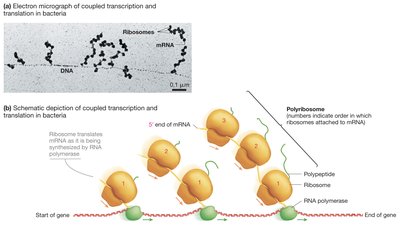
Translation is the process by which ribosomes synthesize proteins using mRNA as a template. In bacteria, transcription and translation can be coupled, while in eukaryotes, they are separated.
Ribosomes attach to mRNA and form polyribosomes for efficient protein synthesis.
Translation occurs in the cytoplasm in eukaryotes.
The Structure and Function of Transfer RNA (tRNA)
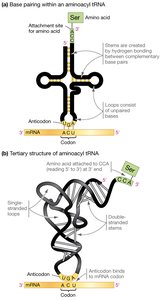
tRNAs are adapter molecules that bring amino acids to the ribosome during translation. Each tRNA has a specific structure and function.
tRNAs are 75–95 nucleotides long and fold into stem-and-loop structures.
CCA sequence at the 3’ end is the amino acid binding site.
The anticodon loop base-pairs with the mRNA codon.
Aminoacyl-tRNA Synthetases
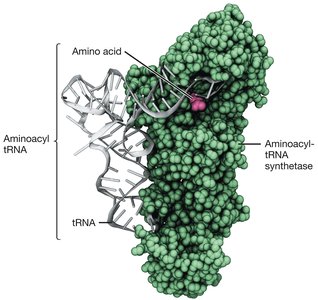
Aminoacyl-tRNA synthetases are enzymes that attach the correct amino acid to its corresponding tRNA, a process requiring ATP.
There are 20 aminoacyl-tRNA synthetases, one for each amino acid.
Each amino acid may have one or more tRNAs.
Wobble Pairing and tRNA Diversity
Although there are 61 codons, most cells have about 40 tRNAs. Wobble pairing allows one tRNA to recognize multiple codons, increasing efficiency.
Wobble occurs at the third position of the anticodon.
Allows flexibility in codon recognition.
Ribosome Structure and Function
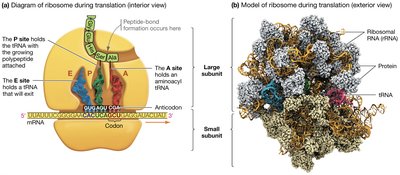
Ribosomes are composed of proteins and ribosomal RNA (rRNA) and consist of two subunits. They facilitate the translation of mRNA into protein.
Small subunit holds mRNA; large subunit forms peptide bonds.
Three tRNA binding sites: A (aminoacyl), P (peptidyl), E (exit).
Proteins are synthesized in a three-step sequence: tRNA entry, peptide bond formation, translocation.
Initiation of Translation
Translation initiation begins near the AUG start codon. In bacteria, the small ribosomal subunit binds to the Shine–Dalgarno sequence, and the initiator tRNA (carrying f-Met) binds to the start codon.
Initiation factors mediate assembly of the ribosome.
Initiator tRNA is positioned in the P site.
Elongation: Extending the Polypeptide
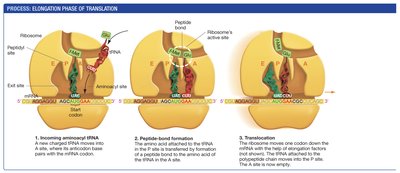
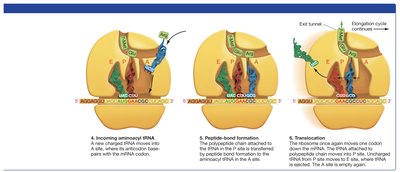
Elongation involves the sequential addition of amino acids to the growing polypeptide chain. The ribosome moves along the mRNA, facilitating tRNA entry, peptide bond formation, and translocation.
Aminoacyl tRNA enters the A site.
Peptide bond forms between amino acids in the P and A sites.
Ribosome translocates, moving tRNAs and exposing a new codon.
Ribosomal RNA catalyzes peptide bond formation, making the ribosome a ribozyme.
Termination of Translation
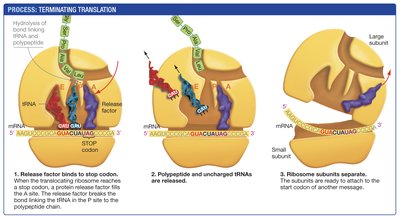
Termination occurs when the ribosome encounters a stop codon. A release factor enters the A site, hydrolyzing the bond between the polypeptide and the tRNA, releasing the completed protein.
Release factor mimics tRNA structure and function.
Ribosomal subunits, tRNAs, and mRNA dissociate.
Post-Translational Modification
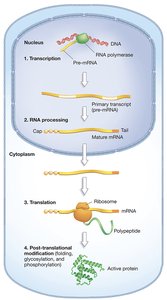
Proteins often undergo post-translational modifications to become fully functional. These modifications include folding, glycosylation, phosphorylation, and others.
Molecular chaperones assist in protein folding.
Sugars, lipids, or phosphate groups may be added to proteins.
Protein shape determines function.
Summary Table: Comparison of Transcription and Translation in Bacteria and Eukaryotes
Feature | Bacteria | Eukaryotes |
|---|---|---|
RNA Polymerases | One | Three (I, II, III) |
Promoter Elements | -10 box, -35 box | TATA box, others |
Initiation Factors | Sigma protein | General transcription factors |
Termination Signal | Hairpin loop | Poly(A) signal |
RNA Processing | None | Splicing, capping, tail addition |
Location | Cytoplasm | Nucleus (transcription), cytoplasm (translation) |
Additional info: Academic context was added to clarify the mechanisms, regulatory elements, and differences between prokaryotic and eukaryotic transcription and translation, as well as the importance of post-translational modifications.
