 Back
Transcription and Translation: Study Notes for General Biology
Study Guide - Smart Notes
 Tailored notes based on your materials, expanded with key definitions, examples, and context.
Transcription
Overview of Transcription
Transcription is the process by which a cell converts DNA into messenger RNA (mRNA), which carries genetic information to the ribosome for protein synthesis. This process is fundamental to gene expression in both prokaryotic and eukaryotic cells.
DNA Template Strand: The strand of DNA used by RNA polymerase to synthesize a complementary RNA strand.
Coding Strand: The DNA strand whose sequence matches the mRNA (except for uracil replacing thymine).
mRNA: Messenger RNA, the transcript that carries genetic information from DNA to the ribosome.
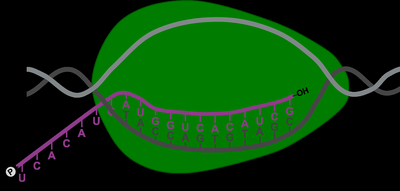
Characteristics of RNA Polymerase
RNA polymerase is the enzyme responsible for synthesizing RNA from a DNA template.
Single Template Strand: Only one DNA strand is used as a template for RNA synthesis.
Directionality: RNA is synthesized in the 5’ → 3’ direction, reading the DNA template from 3’ → 5’.
No Primer Required: Unlike DNA polymerase, RNA polymerase does not require a primer to initiate synthesis.
Types: Bacteria have one RNA polymerase; eukaryotes have three distinct types (RNA polymerase I, II, III).
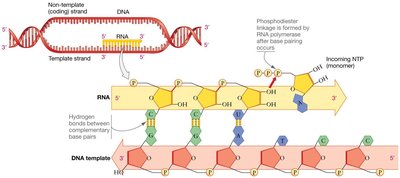
Stages of Transcription
Transcription occurs in three main stages: initiation, elongation, and termination.
Initiation: RNA polymerase binds to a specific DNA sequence called the promoter. The DNA helix is opened to allow access to the template strand.
Elongation: RNA polymerase moves along the DNA template, synthesizing RNA by adding nucleotides to the 3’ end.
Termination: RNA polymerase encounters a terminator sequence, signaling the end of transcription. The RNA transcript and polymerase are released.
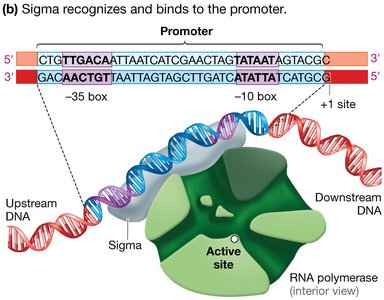


Transcription in Prokaryotes vs. Eukaryotes
While the fundamental features of transcription are similar in both cell types, there are key differences.
Location: In prokaryotes, transcription and translation occur in the cytoplasm. In eukaryotes, transcription occurs in the nucleus, and translation occurs in the cytoplasm.
RNA Processing: Eukaryotic mRNA undergoes extensive processing before translation, including capping, tailing, and splicing.
RNA Processing in Eukaryotes
Post-Transcriptional Modifications
Eukaryotic mRNA is modified after transcription to ensure stability and proper translation.
5’ Cap: A modified guanine nucleotide is added to the 5’ end of the mRNA, protecting it from degradation and aiding in ribosome binding.
Poly-A Tail: A stretch of adenine nucleotides is added to the 3’ end, increasing mRNA stability.
Splicing: Introns (non-coding regions) are removed, and exons (coding regions) are joined together.
Alternative Splicing
Alternative splicing allows a single gene to produce multiple mRNA variants, leading to different protein products.
Mechanism: Different combinations of exons are joined, resulting in diverse proteins from the same gene.
Spliceosome: The complex responsible for splicing consists of proteins and small nuclear RNAs (snRNPs).
Translation
Overview of Translation
Translation is the process by which the sequence of nucleotides in mRNA is converted into a sequence of amino acids, forming a polypeptide (protein).
Genetic Code: The set of rules by which information encoded in mRNA is translated into proteins. Each three-nucleotide codon specifies an amino acid.
Start and Stop Codons: Translation begins at a start codon (AUG) and ends at a stop codon (UAA, UAG, UGA).
Cellular Components Required for Translation
Several cellular components are essential for translation:
Ribosome: The molecular machine that synthesizes proteins by reading mRNA.
tRNA (Transfer RNA): Adaptor molecules that match mRNA codons with their corresponding amino acids.
Aminoacyl tRNA: tRNA molecules with an attached amino acid.
Anticodon: The three-nucleotide sequence on tRNA that pairs with the complementary mRNA codon.
tRNA and Codon Recognition
Wobble Hypothesis: Many amino acids are specified by more than one codon, and flexible base pairing at the third position allows fewer tRNAs to cover all codons.
Specificity: Each tRNA is attached to only one type of amino acid.
Protein Structure and Function
The composition and order of amino acids in a polypeptide determine its three-dimensional shape and function.
Covalent Bonds: Peptide bonds link amino acids together.
Noncovalent Bonds: Hydrogen bonds, ionic bonds, and van der Waals interactions contribute to protein folding.
R Groups: The side chains of amino acids influence protein structure and interactions.
Summary Table: Comparison of Transcription and Translation in Prokaryotes and Eukaryotes
Feature | Prokaryotes | Eukaryotes |
|---|---|---|
Location of Transcription | Cytoplasm | Nucleus |
RNA Processing | Minimal | Capping, tailing, splicing |
Translation Location | Cytoplasm | Cytoplasm |
Number of RNA Polymerases | One | Three |
Example: In eukaryotic cells, the gene for hemoglobin undergoes alternative splicing, resulting in different forms of the protein that are expressed at various developmental stages.
Additional info: The notes above expand on the original content by providing definitions, examples, and a summary table for clarity and completeness.
