Back
Transcription, RNA Processing, and Translation: From DNA to Protein
Study Guide - Smart Notes
 Tailored notes based on your materials, expanded with key definitions, examples, and context.
Transcription, RNA Processing, and Translation
Overview of the Central Dogma
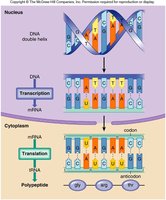
The central dogma of molecular biology describes the flow of genetic information within a biological system. It states that information stored in DNA is transcribed into messenger RNA (mRNA), which is then translated into protein, the active machinery of the cell.
DNA: The hereditary material that stores genetic information.
Transcription: The process of synthesizing mRNA from a DNA template.
Translation: The process by which ribosomes synthesize proteins using the information encoded in mRNA.
Transcription
Mechanism of Transcription
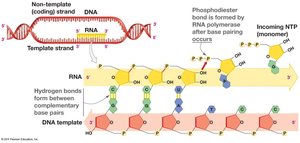
Transcription is the synthesis of RNA from a DNA template. This process is catalyzed by the enzyme RNA polymerase (RNAp), which reads the DNA template strand and matches ribonucleotides to complementary DNA bases, forming a new mRNA strand.
RNA Polymerase: Enzyme that synthesizes mRNA from DNA without the need for a primer.
Directionality: mRNA is synthesized in the 5' to 3' direction.
Ribonucleoside Triphosphates (NTPs): Serve as substrates for RNA synthesis; two phosphates are cleaved off to form a phosphodiester bond.
Template and Coding Strands
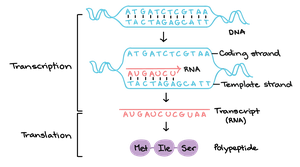
During transcription, only one strand of DNA is used as a template. The other strand, called the coding (or non-template) strand, has the same sequence as the mRNA (except T is replaced by U in RNA).
Template Strand: The DNA strand that is read by RNA polymerase to synthesize RNA.
Coding Strand: The DNA strand with the same sequence as the mRNA (except T/U difference).
Initiation of Transcription in Bacteria
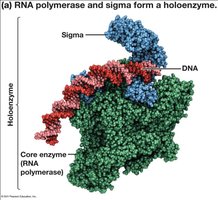
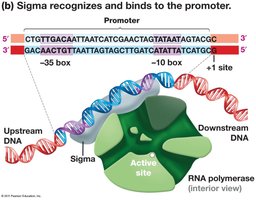
In bacteria, transcription initiation requires the formation of a holoenzyme, which consists of RNA polymerase and a sigma protein. The holoenzyme binds to specific DNA sequences called promoters, located upstream of the gene, at the -10 and -35 boxes.
Holoenzyme: Complex of RNA polymerase and sigma factor.
Sigma Factor: Protein that directs RNA polymerase to the promoter.
Promoter: DNA sequence where transcription begins; contains -10 and -35 elements.
Transcription Initiation and Elongation in Bacteria
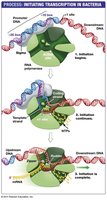
Once the holoenzyme binds to the promoter, RNA polymerase separates the DNA strands, forming a transcription bubble. The template strand enters the active site, and complementary NTPs are added to synthesize mRNA.
Transcription Bubble: Region where DNA strands are separated for RNA synthesis.
Direction: RNA polymerase moves along the DNA template in the 3' to 5' direction, synthesizing mRNA 5' to 3'.
Termination of Transcription in Bacteria
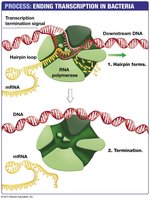
Transcription ends when RNA polymerase encounters a termination signal in the DNA. This often results in the formation of a hairpin loop in the RNA, which disrupts the enzyme and product interaction, releasing the mRNA.
Termination Signal: DNA sequence that causes RNA polymerase to stop transcription.
Hairpin Loop: Secondary structure in RNA that facilitates termination.
Transcription in Eukaryotes
Eukaryotic transcription is more complex, involving three different RNA polymerases (I, II, III). RNA polymerase II transcribes mRNA. Promoters contain TATA boxes, and basal transcription factors (not sigma) are required for initiation. Termination involves a poly(A) signal rather than a hairpin loop.
RNA Polymerase II: Main enzyme for mRNA synthesis in eukaryotes.
TATA Box: Promoter element about 30 bases upstream of the start site.
Basal Transcription Factors: Proteins required for the initiation of transcription in eukaryotes.
Poly(A) Signal: Sequence that signals termination and addition of a poly(A) tail.
RNA Processing in Eukaryotes
Primary Transcript and RNA Processing
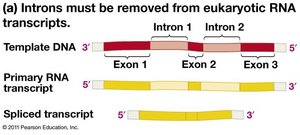
The initial RNA product, called the primary transcript (pre-mRNA), undergoes several modifications to become mature mRNA. These modifications include splicing, capping, and polyadenylation.
RNA Processing: Modifications that convert pre-mRNA into mature mRNA.
RNA Splicing
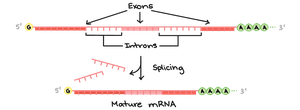
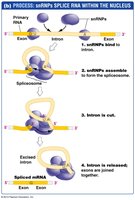
Eukaryotic genes contain noncoding regions called introns and coding regions called exons. During RNA splicing, introns are removed and exons are joined together to form the mature mRNA.
Introns: Noncoding sequences that are removed from pre-mRNA.
Exons: Coding sequences that are expressed in the final mRNA.
Addition of 5' Cap and 3' Poly(A) Tail
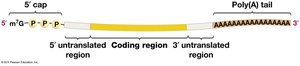
To protect mRNA and facilitate translation, a 5' cap (7-methylguanylate) is added to the beginning of the mRNA, and a poly(A) tail (100-250 adenines) is added to the 3' end.
5' Cap: Modified guanine nucleotide that protects mRNA and aids in ribosome binding.
Poly(A) Tail: String of adenine nucleotides that protects mRNA from degradation.
Translation
Translation Overview
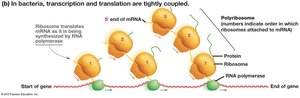
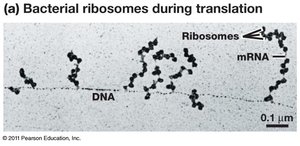
Translation is the process by which ribosomes synthesize proteins using the information encoded in mRNA. In bacteria, transcription and translation are tightly coupled, while in eukaryotes, they are separated by the nuclear envelope.
Ribosomes: Molecular machines that read mRNA and assemble amino acids into polypeptides.
Polyribosomes: Multiple ribosomes translating a single mRNA simultaneously.
Structure and Function of tRNA
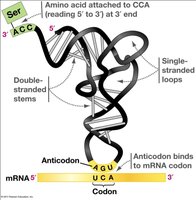
Transfer RNA (tRNA) molecules act as adaptors that match specific amino acids to corresponding mRNA codons. Each tRNA has an anticodon that base pairs with a codon on the mRNA and an amino acid attachment site at the 3' end.
Anticodon: Set of three nucleotides on tRNA that pairs with an mRNA codon.
Amino Acid Attachment Site: 3' end of tRNA where the amino acid is covalently attached.
Wobble Hypothesis
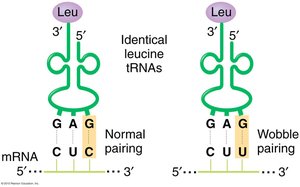
The wobble hypothesis explains how a single tRNA can recognize multiple codons for the same amino acid. This is possible because the third base of the codon-anticodon pairing is flexible, allowing for non-standard base pairing.
Wobble Pairing: Flexibility in base pairing at the third codon position.
Codon Redundancy: 64 codons but only about 40 tRNAs.
Ribosome Structure and Function
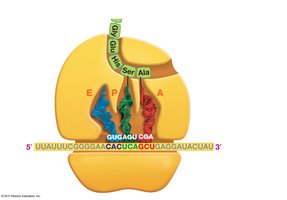
Ribosomes are composed of a large and a small subunit, each made of ribosomal RNA and proteins. They have three binding sites for tRNA: the A site (aminoacyl), P site (peptidyl), and E site (exit).
A Site: Holds the incoming aminoacyl-tRNA.
P Site: Holds the tRNA with the growing polypeptide chain.
E Site: Holds the tRNA that is about to exit the ribosome.
Stages of Translation
Translation occurs in three main stages: initiation, elongation, and termination.
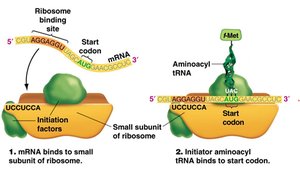
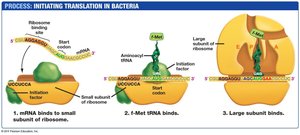
Initiation: The small ribosomal subunit binds to the mRNA at the ribosome binding site, and the initiator tRNA pairs with the start codon (AUG). The large subunit then joins to form the complete ribosome.
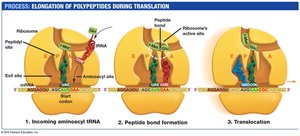
Elongation: Successive aminoacyl-tRNAs enter the A site, peptide bonds form between amino acids, and the ribosome translocates along the mRNA.
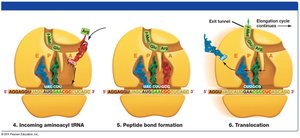
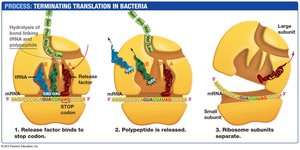
Termination: When a stop codon (UAA, UAG, UGA) is reached, a release factor binds, causing the polypeptide to be released and the ribosome to dissociate.
Post-Translational Modifications
Protein Folding and Processing
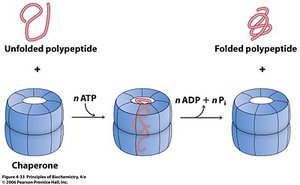
After translation, proteins often undergo modifications such as folding, glycosylation, transport, activation, and degradation. Molecular chaperones assist in proper folding, and further modifications may occur in the endoplasmic reticulum (ER) and Golgi apparatus.
Folding: Achieved with the help of chaperone proteins.
Glycosylation: Addition of carbohydrate groups.
Transport: Proteins are directed to their final destinations.