 Back
Transcription, RNA Processing, and Translation: Structure and Function of tRNA and Ribosomes
Study Guide - Smart Notes
 Tailored notes based on your materials, expanded with key definitions, examples, and context.
Transcription, RNA Processing, and Translation
Overview
This section explores the molecular mechanisms of translation, focusing on the roles of transfer RNA (tRNA), ribosomes, and the processes that ensure accurate protein synthesis in cells. It also highlights differences between bacteria and eukaryotes and the importance of post-translational modifications.
The Structure and Function of Transfer RNA (tRNA)
tRNA as the Adapter Molecule
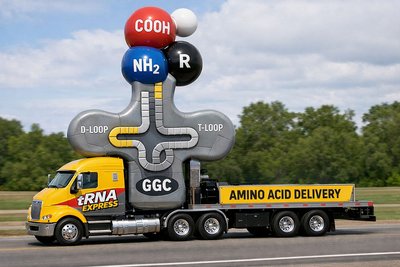
Transfer RNA (tRNA) acts as an adapter that translates the genetic code from messenger RNA (mRNA) into amino acids, forming proteins.
An aminoacyl tRNA is a tRNA molecule covalently linked to its specific amino acid.
Amino acids are transferred from tRNAs to the growing polypeptide chain during translation.
Key Point: tRNAs ensure that the correct amino acid is added for each codon in the mRNA sequence.
Structure of tRNAs
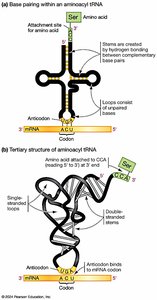
tRNAs are short RNA molecules, typically 75–95 nucleotides long.
They fold into a characteristic stem-and-loop secondary structure due to complementary base pairing.
The 3' end of tRNA always ends with the sequence ACCA, which serves as the amino acid attachment site.
The anticodon loop at the opposite end contains a sequence of three nucleotides (anticodon) that base-pairs with the complementary codon on mRNA.
Attachment of Amino Acids to tRNAs
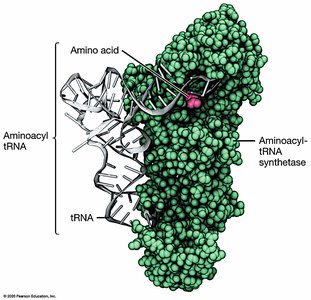
The attachment of an amino acid to its corresponding tRNA requires energy from ATP.
Aminoacyl-tRNA synthetases are enzymes that catalyze the attachment ("charging") of amino acids to their respective tRNAs.
There are 20 different aminoacyl-tRNA synthetases, one for each amino acid.
Some amino acids are recognized by more than one tRNA (isoaccepting tRNAs).
Wobble Pairing and tRNA Diversity
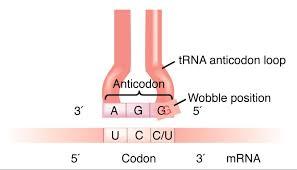
Although there are 61 codons for amino acids, most cells have about 40 different tRNAs.
Wobble pairing allows a single tRNA to recognize multiple codons due to flexible base pairing at the third codon position.
This flexibility increases the efficiency of translation and reduces the number of tRNAs needed.
Ribosome Structure and Function in Translation
Ribosome Composition and Subunits
Ribosomes are large complexes composed of ribosomal RNA (rRNA) and proteins.
They consist of two subunits:
Small subunit: Holds the mRNA in place during translation.
Large subunit: Catalyzes peptide bond formation between amino acids.
During translation, up to three tRNAs can be positioned within the ribosome at once.
tRNA Binding Sites in the Ribosome
There are three binding sites for tRNA within the ribosome:
A site (Aminoacyl site): Accepts incoming aminoacyl-tRNA.
P site (Peptidyl site): Holds the tRNA with the growing polypeptide chain.
E site (Exit site): Where discharged tRNAs exit the ribosome.
Mechanism of Translation
Translation proceeds in a three-step cycle:
An aminoacyl-tRNA enters the A site and pairs with the mRNA codon.
A peptide bond forms between the amino acid in the A site and the polypeptide in the P site.
The ribosome translocates one codon down the mRNA, shifting tRNAs through the sites (A → P → E).
Each cycle adds one amino acid to the carboxyl (C-terminal) end of the growing polypeptide.
Translation is divided into three phases: Initiation, Elongation, and Termination.

Initiation of Translation
Initiation begins near the AUG start codon on the mRNA.
In bacteria, the small ribosomal subunit binds to the Shine–Dalgarno sequence (ribosome binding site) on the mRNA, about 6 bases upstream of the start codon.
Initiation factors help assemble the initiation complex.
The first tRNA, called the initiator tRNA, carries a modified methionine (f-Met) in bacteria.
The large ribosomal subunit then binds, positioning the initiator tRNA in the P site.
Elongation: Extending the Polypeptide
Elongation begins with the initiator tRNA in the P site; the A and E sites are empty.
An incoming aminoacyl-tRNA binds to the A site, and peptide bond formation occurs in the ribosome's active site.
The polypeptide is transferred from the tRNA in the P site to the amino acid on the tRNA in the A site.
The ribosome then translocates, moving the tRNAs through the sites and opening the A site for the next aminoacyl-tRNA.
Ribosome as a Ribozyme
The ribosome's active site is composed entirely of rRNA, which catalyzes peptide bond formation.
This catalytic activity classifies the ribosome as a ribozyme (an RNA enzyme).
This supports the RNA world hypothesis, which proposes that early life used RNA for both genetic information and catalysis.
Translocation and Repetition of Elongation Steps
Translocation is the process by which the ribosome moves one codon down the mRNA, facilitated by elongation factors.
This process:
Moves the uncharged tRNA from the P site to the E site (where it exits).
Moves the tRNA with the growing polypeptide from the A site to the P site.
Opens the A site for the next aminoacyl-tRNA.
These steps repeat for each codon along the mRNA.
Termination of Translation
Termination occurs when a stop codon enters the A site of the ribosome.
A release factor protein binds to the stop codon, mimicking tRNA structure.
The release factor hydrolyzes the bond between the polypeptide and the tRNA in the P site, releasing the completed protein.
The ribosomal subunits, mRNA, and tRNAs dissociate.
Comparison of Transcription, RNA Processing, and Translation in Bacteria and Eukaryotes
Key Differences
Process | Bacteria | Eukaryotes |
|---|---|---|
Transcription | One RNA polymerase; simple promoter structure; sigma factors bind promoters | Three RNA polymerases; complex promoters with TATA box; many transcription factors |
RNA Processing | Rare | Extensive: 5' cap, 3' poly(A) tail, splicing, and other modifications |
Translation | Initiation and termination less complex; elongation similar to eukaryotes | Initiation and termination more complex; elongation similar to bacteria |

Post-Translational Modifications
Protein Folding and Chemical Modifications
Most proteins undergo post-translational modifications before becoming fully functional.
Folding, often assisted by molecular chaperones, determines the protein's final shape and function.
Chemical groups such as sugars (glycosylation), lipids (lipidation), or phosphates (phosphorylation) may be added to proteins, altering their activity, stability, or localization.
Enzymes may also cleave or modify proteins to activate or deactivate them.

Summary of the Central Dogma in Eukaryotes
Gene expression involves transcription (DNA to RNA), RNA processing (in eukaryotes), translation (RNA to protein), and post-translational modification.
Each step is tightly regulated to ensure proper cellular function.

Additional info:
Wobble pairing is essential for the efficiency of the genetic code, allowing fewer tRNAs to cover all codons.
Post-translational modifications are critical for protein diversity and regulation in cells.
