 Back
Transcription, RNA Processing, and Translation: Structure and Function of tRNA and Ribosomes
Study Guide - Smart Notes
 Tailored notes based on your materials, expanded with key definitions, examples, and context.
Transcription, RNA Processing, and Translation
Overview
This section explores the molecular mechanisms of translation, focusing on the roles of transfer RNA (tRNA), ribosomes, and the processes that ensure accurate protein synthesis in cells. It also highlights differences between bacteria and eukaryotes and discusses post-translational modifications that finalize protein function.
The Structure and Function of Transfer RNA (tRNA)
tRNA as the Adapter Molecule
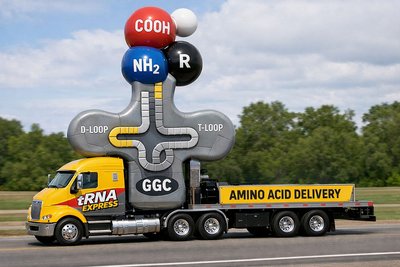
Transfer RNA (tRNA) acts as an adapter molecule in translation, linking specific amino acids to codons in messenger RNA (mRNA).
An aminoacyl tRNA is a tRNA molecule covalently attached to its corresponding amino acid.
Amino acids are transferred from tRNAs to the growing polypeptide chain during translation.
Key Point: tRNAs ensure that the genetic code is translated accurately into proteins.
Example: tRNAMet carries methionine to the start codon (AUG) during initiation of translation.
Structure of tRNAs
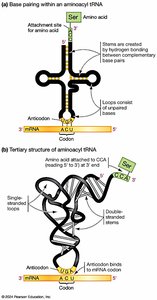
tRNAs are short RNA molecules, typically 75–95 nucleotides in length.
They fold into a secondary structure with stem-and-loop regions due to intramolecular base pairing.
The 3' end of tRNA always ends with the sequence ACCA, which serves as the amino acid attachment site.
The anticodon loop at the opposite end contains a sequence of three nucleotides that base-pair with the complementary mRNA codon.
Charging tRNAs: Aminoacyl-tRNA Synthetases
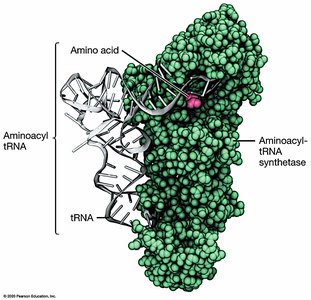
Aminoacyl-tRNA synthetases are enzymes that catalyze the attachment of amino acids to their corresponding tRNAs, a process requiring ATP.
There are 20 different aminoacyl-tRNA synthetases, one for each amino acid.
Each amino acid may have one or more tRNAs (isoacceptors).
Equation:
Wobble Pairing and tRNA Diversity
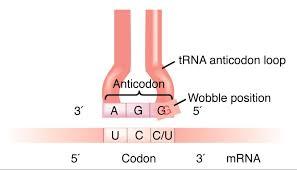
Although there are 61 codons for amino acids, most cells have about 40 different tRNAs.
Wobble pairing allows the third base of the tRNA anticodon to form nonstandard base pairs with the mRNA codon, enabling one tRNA to recognize multiple codons.
This flexibility increases the efficiency of translation and reduces the number of tRNAs needed.
Ribosome Structure and Function in Translation
Ribosome Composition and Subunits
Ribosomes are large complexes of ribosomal RNA (rRNA) and proteins.
They consist of two subunits:
Small subunit: Holds the mRNA in place during translation.
Large subunit: Catalyzes peptide bond formation between amino acids.
During translation, up to three tRNAs can be positioned within the ribosome at once.
tRNA Binding Sites in the Ribosome
There are three binding sites for tRNA within the ribosome:
A site (Aminoacyl site): Accepts incoming aminoacyl-tRNA.
P site (Peptidyl site): Holds the tRNA with the growing polypeptide chain.
E site (Exit site): Where tRNAs, now uncharged, exit the ribosome.
Mechanism of Translation: Three-Step Cycle
Translation proceeds in a repeating three-step cycle:
An aminoacyl-tRNA enters the A site and pairs with the mRNA codon.
A peptide bond forms between the amino acid in the A site and the polypeptide in the P site.
The ribosome translocates one codon down the mRNA, shifting tRNAs through the sites (A → P → E).
With each cycle, the polypeptide grows by one amino acid, always added to the carboxyl (C) terminus.
Translation is divided into three phases: Initiation, Elongation, and Termination.

Initiation of Translation
Initiation begins near the AUG start codon on the mRNA.
In bacteria, the small ribosomal subunit binds to the Shine–Dalgarno sequence (ribosome binding site) on the mRNA, about 6 bases upstream of the start codon.
Initiation factors mediate this process.
The first tRNA, called the initiator tRNA, carries a modified methionine (f-Met) in bacteria.
Initiation involves three steps:
mRNA binds to the small ribosomal subunit.
Initiator tRNA binds to the start codon.
Large ribosomal subunit binds, positioning the initiator tRNA in the P site.
Elongation: Extending the Polypeptide
At the start of elongation, the initiator tRNA is in the P site; the A and E sites are empty.
An incoming aminoacyl-tRNA binds to the codon in the A site.
Peptide bond formation occurs in the ribosome's active site, transferring the polypeptide to the amino acid on the A-site tRNA.
The ribosome is a ribozyme because its catalytic activity is due to rRNA, not protein.
This supports the RNA world hypothesis, which proposes that early life used RNA for both genetic information and catalysis.
Translocation
Translocation is the process by which the ribosome moves one codon down the mRNA, facilitated by elongation factors.
This process:
Moves the uncharged tRNA from the P site to the E site (where it exits).
Moves the tRNA with the growing polypeptide from the A site to the P site.
Opens the A site for the next aminoacyl-tRNA.
These steps repeat for each codon along the mRNA.
Termination of Translation
Termination occurs when a stop codon enters the A site.
A release factor protein, which mimics tRNA, binds to the stop codon.
The release factor hydrolyzes the bond linking the polypeptide to the tRNA in the P site, releasing the completed protein.
The ribosomal subunits, mRNA, and tRNAs dissociate.
Comparison of Transcription, RNA Processing, and Translation in Bacteria and Eukaryotes
Key Differences
Process | Bacteria | Eukaryotes |
|---|---|---|
Transcription | One RNA polymerase; simple promoter structure; sigma factors for promoter recognition | Three RNA polymerases; complex promoters (TATA box); many transcription factors |
RNA Processing | Rare | Extensive: 5' cap, 3' poly(A) tail, splicing, and other modifications |
Translation | Initiation and termination less complex; elongation similar to eukaryotes | Initiation and termination more complex; elongation similar to bacteria |

Post-Translational Modification of Proteins
Protein Folding and Chemical Modifications
Most proteins undergo post-translational modifications before becoming fully functional.
Folding, often assisted by molecular chaperones, determines the protein's final shape and function.
Chemical groups such as sugars, lipids, or phosphates may be added to proteins, altering their activity, localization, or stability.
Enzymes may add a phosphate group (phosphorylation) to regulate protein activity.

Summary of the Central Dogma in Eukaryotes
Gene expression involves transcription (DNA to pre-mRNA), RNA processing (to mature mRNA), translation (mRNA to polypeptide), and post-translational modification (to active protein).

Additional info:
The RNA world hypothesis is supported by the ribozyme activity of the ribosome, suggesting ancient RNA molecules could have catalyzed reactions before proteins evolved.
Post-translational modifications are critical for protein diversity and regulation in cells.
