 Back
BackTranscription, RNA Processing, and Translation: Structure and Function
Study Guide - Smart Notes
 Tailored notes based on your materials, expanded with key definitions, examples, and context.
Transcription, RNA Processing, and Translation
An Overview of Translation
Translation is the process by which proteins are synthesized from messenger RNA (mRNA) templates. The mechanisms differ between bacteria and eukaryotes:
Bacteria: Ribosomes begin translating mRNA before transcription is complete, allowing for simultaneous transcription and translation. Multiple ribosomes can attach to a single mRNA, forming a polyribosome, which enables the production of many protein copies from one mRNA.
Eukaryotes: Transcription and translation are separated spatially and temporally. mRNAs are synthesized and processed in the nucleus, then transported to the cytoplasm for translation. Translation occurs on ribosomes, and polyribosomes also form.
The Structure and Function of Transfer RNA (tRNA)
Transfer RNA (tRNA) acts as an adapter molecule in translation, linking amino acids to the growing polypeptide chain. An aminoacyl tRNA is a tRNA bound to its specific amino acid.
Function: tRNAs transfer amino acids to the ribosome during protein synthesis.
Structure: tRNAs are short (75–95 nucleotides) and fold into a stem-and-loop secondary structure. The 3' end contains an ACCA sequence, which is the amino acid binding site. The opposite loop contains the anticodon, a three-nucleotide sequence that base-pairs with the mRNA codon.
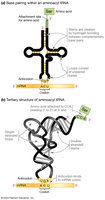
How Are Amino Acids Attached to tRNAs?
The attachment of amino acids to tRNAs requires ATP and is catalyzed by aminoacyl-tRNA synthetases. There are 20 amino acids, each with a specific synthetase. For each amino acid, there is one or more corresponding tRNAs.
Charging: Aminoacyl-tRNA synthetases "charge" tRNAs by catalyzing the addition of the correct amino acid.
Specificity: Each synthetase recognizes its amino acid and the appropriate tRNA(s).
How Many tRNAs Are There?
Although there are 61 codons, most cells have about 40 tRNAs. Wobble pairing allows one tRNA to recognize multiple codons, as the third position of the anticodon can form nonstandard base pairs.
Wobble Hypothesis: Proposed by Crick, this explains how fewer tRNAs can accommodate all codons.
Ribosome Structure and Function in Translation
Ribosomes are complex molecular machines composed of proteins and ribosomal RNA (rRNA). They are divided into two subunits:
Small subunit: Holds the mRNA in place.
Large subunit: Site of peptide bond formation.
During translation, three tRNAs align within the ribosome at specific sites:
A site (Aminoacyl): Entry point for tRNA carrying an amino acid.
P site (Peptidyl): Holds the tRNA with the growing polypeptide chain.
E site (Exit): Where tRNAs without amino acids exit the ribosome.
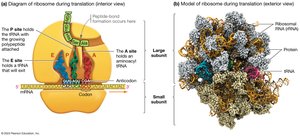
Ribosome Structure and Function in Translation: Mechanism
The ribosome synthesizes proteins in a three-step sequence:
An aminoacyl tRNA enters the A site and remains if its anticodon matches the mRNA codon.
A peptide bond forms between the amino acid on the A-site tRNA and the polypeptide on the P-site tRNA.
The ribosome moves down the mRNA by one codon, shifting all tRNAs one position. The tRNA in the E site exits, and the A site becomes available for the next tRNA.
With each cycle, the protein grows by one amino acid, always added to the carboxyl end (C-terminus) of the polypeptide.
Translation Phases
Initiation: Begins near the AUG start codon. In bacteria, the small ribosomal subunit binds to the Shine–Dalgarno sequence on the mRNA, mediated by initiation factors. The initiator tRNA carries a modified methionine (f-Met).
Elongation: The initiator tRNA is in the P site, and aminoacyl tRNAs enter the A site. Peptide bond formation occurs in the ribosome's active site, which is composed entirely of rRNA, making the ribosome a ribozyme.
Translocation: The ribosome slides one codon along the mRNA, facilitated by elongation factors. This process repeats for each codon.
Termination: Occurs when the A site encounters a stop codon. A release factor enters the A site, hydrolyzing the bond between the P-site tRNA and the polypeptide, releasing the newly synthesized protein.
Polypeptide Modification after Translation
Most proteins undergo extensive post-translational modification before becoming functional. These modifications occur in various cellular locations and are essential for proper protein function.
Folding: Determines the protein's shape and function. Molecular chaperones assist in proper folding.
Chemical modifications: Proteins may be modified by the addition of sugars, lipids, or phosphate groups, which can alter their activity and localization.
Key Terms and Concepts
Polyribosome: A complex of multiple ribosomes translating a single mRNA.
Aminoacyl-tRNA synthetase: Enzyme that attaches the correct amino acid to its tRNA.
Wobble pairing: Nonstandard base pairing at the third position of the tRNA anticodon.
Ribozyme: An RNA molecule capable of catalyzing chemical reactions, such as peptide bond formation.
Post-translational modification: Chemical changes to a protein after translation, affecting its function.
Example: Translation in Bacteria vs. Eukaryotes
Bacteria: Coupled transcription and translation, rapid protein synthesis.
Eukaryotes: Spatial separation of transcription (nucleus) and translation (cytoplasm), more complex regulation.
