 Back
Transcription, RNA Processing, and Translation: Study Notes for Chapter 17
Study Guide - Smart Notes
 Tailored notes based on your materials, expanded with key definitions, examples, and context.
Transcription, RNA Processing, and Translation
Overview of Gene Expression
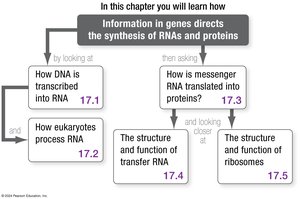
Gene expression is the process by which information encoded in DNA is used to direct the synthesis of proteins, the functional molecules of the cell. This chapter covers the mechanisms of transcription, RNA processing, and translation, focusing on both prokaryotic and eukaryotic systems.
Transcription: DNA is transcribed into RNA by RNA polymerase.
RNA Processing: Eukaryotic RNA undergoes modifications before translation.
Translation: mRNA is translated into protein by ribosomes.
Transcription: Synthesis of RNA from DNA
Basic Mechanism
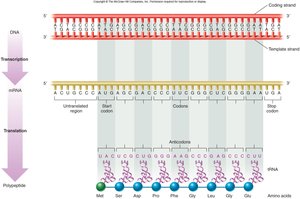
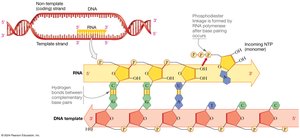
Transcription is the process by which RNA polymerase synthesizes an RNA strand complementary to the DNA template strand. The RNA is synthesized in the 5′ → 3′ direction, using ribonucleotide triphosphates (NTPs).
Template strand: The DNA strand used for RNA synthesis (3′ → 5′).
Coding strand: Matches the sequence of the mRNA (except U replaces T).
Antiparallel: RNA and DNA strands run in opposite directions.
RNA Polymerase Function
Unlike DNA polymerases, RNA polymerases do not require a primer or helicase to begin transcription. In bacteria, there is only one RNA polymerase, while eukaryotes have three.
Stages of Transcription
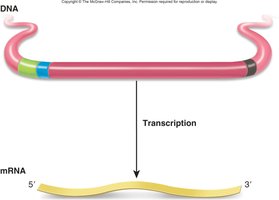
Transcription occurs in three stages: initiation, elongation, and termination.
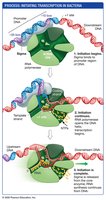
Initiation: RNA polymerase binds to the promoter region, often with the help of sigma proteins (in bacteria) or basal transcription factors (in eukaryotes).
Elongation: RNA polymerase moves along the DNA template, synthesizing RNA.
Termination: Transcription ends when a termination signal is reached.
Initiation in Bacteria
In bacteria, the sigma protein binds to the promoter, orienting RNA polymerase and determining the template strand and direction of transcription. The holoenzyme opens the DNA double helix, forming a transcription bubble.
Termination in Bacteria
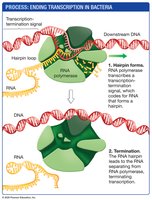
Termination occurs when RNA polymerase transcribes a termination signal, resulting in an RNA hairpin that causes the polymerase to dissociate from the DNA.
Transcription in Eukaryotes
Eukaryotic transcription differs from bacterial transcription in several ways:
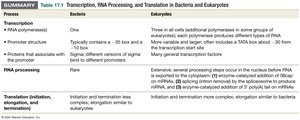
Three RNA polymerases (I, II, III)
Promoters often contain a TATA box
Basal transcription factors replace sigma proteins
Termination involves a poly(A) signal and RNA cleavage
Transcription occurs in the nucleus; translation occurs in the cytoplasm
RNA Processing in Eukaryotes
Splicing: Removal of Introns
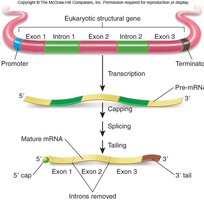
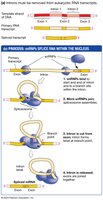
Primary RNA transcripts in eukaryotes contain exons (coding regions) and introns (noncoding regions). Introns are removed by a spliceosome, a complex macromolecular machine. Alternative splicing allows for the production of different proteins from a single gene.
Adding Caps and Tails
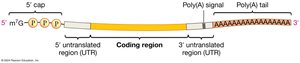
Additional processing includes the addition of a 5′ cap (modified guanine nucleotide) and a 3′ poly(A) tail (100–250 adenine nucleotides). These modifications protect the mRNA from degradation and are necessary for translation.
Translation: Protein Synthesis
Ribosomes and tRNA
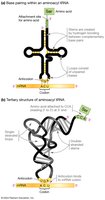
Translation occurs at ribosomes, which catalyze the assembly of amino acids into polypeptides. Transfer RNAs (tRNAs) bring amino acids to the ribosome, matching their anticodon to the mRNA codon.
Aminoacyl tRNA: tRNA linked to its amino acid, charged using ATP.
Anticodon: Region of tRNA that base-pairs with the mRNA codon.
Ribosome Structure and Function
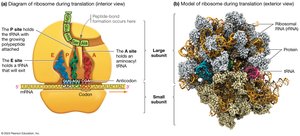
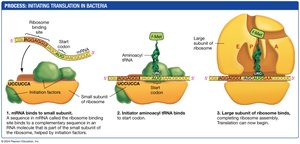
Ribosomes consist of a small and large subunit, each composed of proteins and rRNA. The small subunit holds the mRNA, while the large subunit forms peptide bonds. tRNAs fit into three sites:
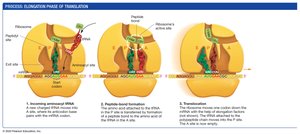
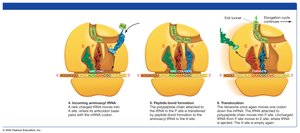
A site: Acceptor site for aminoacyl tRNA
P site: Peptidyl site where peptide bonds form
E site: Exit site for tRNAs without amino acids
Translation Phases
Translation proceeds in three phases: initiation, elongation, and termination.
Initiation: Begins near the AUG start codon; the small subunit binds mRNA, followed by the initiator tRNA and the large subunit.
Elongation: Aminoacyl tRNAs enter the A site, peptide bonds form, and the ribosome moves along the mRNA.
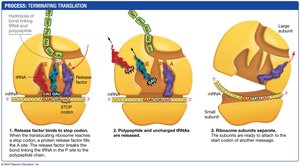
Termination: Occurs when a stop codon is encountered; a release factor causes the ribosome to dissociate.
Post-Translational Modifications
Protein Processing
After translation, proteins often undergo post-translational modifications, such as folding (assisted by molecular chaperones) and the addition of sugar, lipid, or phosphate groups. These modifications are essential for proper protein function.
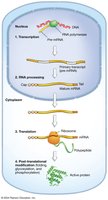
Summary Table: Transcription, RNA Processing, and Translation
Process | Bacteria | Eukaryotes |
|---|---|---|
Transcription | One RNA polymerase; sigma proteins; simple promoters | Three RNA polymerases; basal transcription factors; TATA box promoters |
RNA Processing | Rare | Extensive: capping, splicing, tailing |
Translation | Initiation and termination less complex | Initiation and termination more complex |
Key Equations and Concepts
Direction of RNA synthesis: 5′ → 3′
Peptide bond formation: Catalyzed by ribozyme activity in the ribosome
ATP and GTP: Required for tRNA charging and translation steps
Peptide bond formation equation:
Transcription equation:
Translation equation:
Additional info: Alternative splicing and post-translational modifications greatly increase the diversity of proteins produced by eukaryotic cells.
