 Back
Transcription, RNA Processing, and Translation: Study Notes for General Biology
Study Guide - Smart Notes
 Tailored notes based on your materials, expanded with key definitions, examples, and context.
Transcription, RNA Processing, and Translation
Chapter Overview
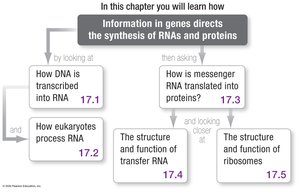
This chapter explores how genetic information in DNA is transcribed into RNA, processed in eukaryotes, and translated into proteins. It covers the mechanisms and molecular players involved in gene expression, focusing on transcription, RNA processing, and translation.
Transcription: Synthesis of RNA from DNA
Overview of Transcription
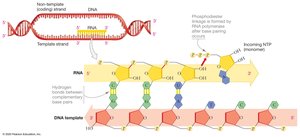
Transcription is the process by which RNA polymerases synthesize an RNA copy of a DNA template. This process is essential for gene expression and occurs in both prokaryotes and eukaryotes.
RNA polymerases use ribonucleoside triphosphates (NTPs) to build RNA.
Only one DNA strand serves as the template strand; the other is the coding strand, which matches the RNA sequence (except U replaces T).
RNA synthesis occurs in the 5′ → 3′ direction.
Unlike DNA polymerases, RNA polymerases do not require a primer.
Initiation of Transcription in Bacteria
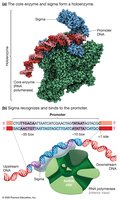
Transcription initiation requires the assembly of a holoenzyme, consisting of RNA polymerase and a sigma factor, which recognizes promoter sequences.
Promoters are DNA sequences where transcription begins, typically containing a −10 box (TATAAT) and a −35 box (TTGACA).
Sigma binds to these boxes, orienting RNA polymerase and determining the template strand and direction of transcription.
Events Inside the Holoenzyme
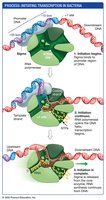
Transcription starts when sigma binds to the promoter, and RNA polymerase opens the DNA double helix, forming a transcription bubble. NTPs enter the active site and pair with complementary DNA bases, initiating RNA synthesis.
Elongation and Termination in Bacteria
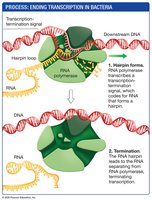
During elongation, RNA polymerase adds nucleotides to the 3′ end of the RNA. Termination occurs when a transcription-termination signal is transcribed, forming a hairpin structure in the RNA that causes RNA polymerase to detach.
Hairpin structure in RNA triggers termination.
Transcription in Eukaryotes
Eukaryotic transcription differs from bacterial transcription in several ways:
Three distinct RNA polymerases (I, II, III).
Promoters are larger and more diverse, often containing a TATA box.
General transcription factors replace sigma proteins.
Termination involves a poly(A) signal and cleavage of RNA.
Transcription occurs in the nucleus; translation occurs in the cytoplasm.
RNA Processing in Eukaryotes
Primary Transcript and RNA Processing
In eukaryotes, the initial RNA product (pre-mRNA) must be processed before translation. This includes splicing, capping, and tail addition.
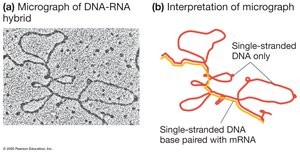
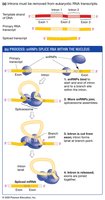
Introns (noncoding regions) are removed; exons (coding regions) are retained.
Splicing is catalyzed by small nuclear ribonucleoproteins (snRNPs), forming a spliceosome.
RNA Splicing
Splicing involves four steps:
snRNPs bind to exon-intron boundaries and an A near the intron end.
Additional snRNPs join to form a spliceosome.
The intron forms a lariat structure and is cut out.
Exons are linked; the intron is degraded.
Adding Caps and Tails to Transcripts
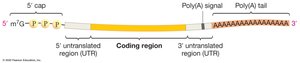
Pre-mRNAs are further processed by the addition of a 5′ cap and a poly(A) tail:
5′ cap: Modified guanine nucleotide that facilitates ribosome binding and protects RNA from degradation.
Poly(A) tail: 100–250 adenine nucleotides added to the 3′ end, necessary for translation and stability.
Mature mRNAs contain untranslated regions (UTRs) at both ends.
Translation: Protein Synthesis
Introduction to Translation
Translation converts the sequence of mRNA bases into an amino acid sequence, producing proteins. This process involves ribosomes, mRNA, and tRNAs.
Ribosomes are the site of protein synthesis.
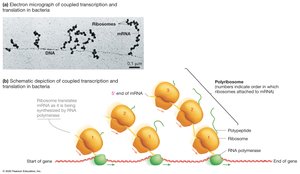
In bacteria, transcription and translation can occur simultaneously.
How Does mRNA Specify Amino Acids?
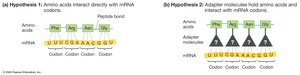
Two hypotheses were proposed:
Direct interaction between mRNA codons and amino acids.
Adapter molecules (tRNAs) hold amino acids and interact with codons.
Structure and Function of Transfer RNA (tRNA)
tRNA Structure
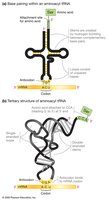
tRNAs are short RNA molecules (75–95 nucleotides) that fold into stem-and-loop structures. The 3′ end (ACCA sequence) binds the amino acid, and the anticodon loop base-pairs with the mRNA codon.
Aminoacyl-tRNA Synthetases
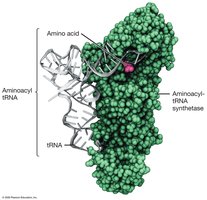
These enzymes "charge" tRNAs by attaching the correct amino acid, using ATP. There are 20 synthetases, one for each amino acid.
Wobble Pairing
Although there are 61 codons, most cells have about 40 tRNAs. Wobble pairing allows one tRNA to recognize multiple codons due to flexible base pairing at the third position of the anticodon.
Ribosome Structure and Function in Translation
Ribosome Structure
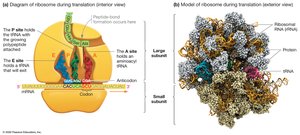
Ribosomes consist of a small subunit (holds mRNA) and a large subunit (forms peptide bonds). Three tRNA binding sites exist:
A site: Accepts aminoacyl tRNA.
P site: Holds the growing peptide chain.
E site: Exit site for uncharged tRNA.
Translation Phases
Translation occurs in three phases: initiation, elongation, and termination.
Initiation of Translation
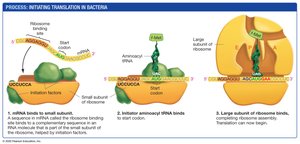
Initiation begins near the AUG start codon. In bacteria, the small ribosomal subunit binds to the Shine–Dalgarno sequence. The initiator tRNA (carrying f-Met) binds to the start codon, and the large subunit assembles.
Elongation: Extending the Polypeptide
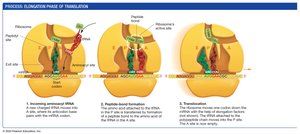
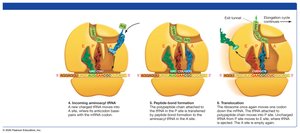
Elongation involves:
Aminoacyl tRNA enters the A site.
Peptide bond forms between amino acids at the A and P sites.
Ribosome translocates, moving tRNAs and opening the A site for the next tRNA.
Termination of Translation
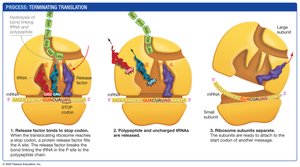
Termination occurs when the A site encounters a stop codon. A release factor binds, hydrolyzing the bond between the polypeptide and tRNA, releasing the protein and dissociating the ribosome.
Post-Translational Modification
Polypeptide Folding and Chemical Modifications
Proteins undergo folding and chemical modifications after translation to become functional. Molecular chaperones assist folding, and enzymes may add sugars, lipids, or phosphate groups to regulate activity.
Summary Table: Transcription, RNA Processing, and Translation in Bacteria and Eukaryotes
Process | Bacteria | Eukaryotes |
|---|---|---|
Transcription | One RNA polymerase; sigma factor; occurs in cytoplasm | Three RNA polymerases; general transcription factors; occurs in nucleus |
RNA Processing | Rare; mRNA is functional after transcription | Splicing, capping, tail addition required |
Translation | Can occur simultaneously with transcription | Occurs in cytoplasm after mRNA export |
Major Steps of Gene Expression in Eukaryotic Cells
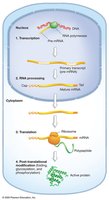
Gene expression involves transcription, RNA processing, translation, and post-translational modification.
Additional info: These notes expand on the original content by providing definitions, context, and examples for each step of gene expression, making them suitable for exam preparation in General Biology.
