 Back
Transcription, Translation, and Bacterial Transformation: Linking Genotype to Phenotype
Study Guide - Smart Notes
 Tailored notes based on your materials, expanded with key definitions, examples, and context.
Transcription and Translation: From Genotype to Phenotype
Overview of Genotype and Phenotype
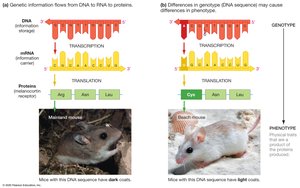
The genotype of an organism is determined by the sequence of bases in its DNA, while the phenotype is the observable characteristics resulting from the proteins produced. The flow of genetic information follows the central dogma: DNA is transcribed into mRNA, which is then translated into proteins that determine phenotype.
Genotype: The genetic makeup (e.g., sequence of the GFP gene).
Phenotype: Observable traits (e.g., fluorescence from GFP protein).
Central Dogma: DNA → mRNA → Protein → Phenotype
Gene Expression: Transcription and Translation
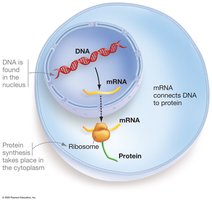
Gene expression involves two main processes: transcription and translation. During transcription, DNA serves as a template to synthesize messenger RNA (mRNA). During translation, ribosomes use the information in mRNA to assemble amino acids into a polypeptide chain, forming a protein.
Transcription: DNA → mRNA (in the nucleus for eukaryotes)
Translation: mRNA → Protein (in the cytoplasm at ribosomes)
mRNA: Carries genetic instructions from DNA to ribosomes.
rRNA: Forms the core of ribosome structure and catalyzes protein synthesis.
tRNA: Delivers amino acids to the ribosome, matching codons in mRNA with anticodons.
Linking Genotypes to Phenotypes
Genes are segments of DNA that code for proteins. The sequence of nucleotides in a gene determines the sequence of amino acids in a protein, which in turn determines the protein's structure and function. Changes in the DNA sequence (mutations) can alter the protein produced, leading to different phenotypes.
Example: A mutation in a gene may change a single amino acid in a protein, potentially altering its function and the organism's phenotype.
Stages of Transcription
Transcription is the process by which the information in a DNA sequence is copied into a complementary mRNA sequence.
Initiation: RNA polymerase binds to the promoter region of the gene.
Elongation: RNA polymerase synthesizes the mRNA strand by adding complementary RNA nucleotides.
Termination: Transcription ends when RNA polymerase reaches a terminator sequence.
Stages of Translation
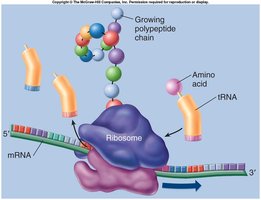
Translation is the process by which ribosomes read the mRNA sequence and assemble the corresponding amino acids into a polypeptide chain.
Initiation: The ribosome, mRNA, and initiator tRNA assemble at the start codon (AUG).
Elongation: tRNAs bring amino acids to the ribosome, where they are joined by peptide bonds.
Termination: When a stop codon is reached, the polypeptide is released and the ribosome disassembles.
Bacterial Transformation and GFP Expression
Bacterial Transformation: Introduction
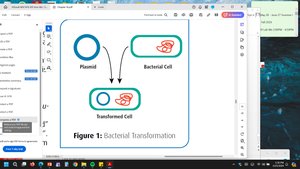
Bacterial transformation is a technique used to introduce foreign DNA (such as a plasmid) into a bacterial cell. In this lab, a plasmid containing the gene for Green Fluorescent Protein (GFP) is introduced into bacteria, allowing them to express the GFP protein and fluoresce under UV light.
Plasmid: A small, circular DNA molecule separate from the bacterial chromosome.
Transformation: The process of bacteria taking up foreign DNA from their environment.
GFP: Green Fluorescent Protein, used as a visible reporter gene.
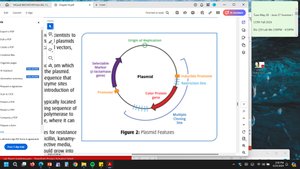
Plasmid Features
Plasmids used in transformation experiments contain several important features:
Feature | Function |
|---|---|
Origin of replication | Allows the plasmid to be copied inside the cell |
Selectable marker (e.g., β-lactamase gene) | Provides antibiotic resistance (e.g., ampicillin), allowing selection of transformed cells |
Promoter | DNA sequence where RNA polymerase initiates transcription of a gene |
Color protein gene (e.g., GFP) | Encodes a visible reporter protein |
Inducible Gene Expression
Some genes on plasmids are under the control of an inducible promoter. In this experiment, the addition of IPTG (isopropyl β-D-1-thiogalactopyranoside) induces the expression of the GFP gene, allowing visualization of transformed bacteria under UV light.
IPTG: A chemical that induces gene expression by mimicking allolactose, removing the repressor from the promoter.
Bacterial Transformation Protocol
The following steps outline the protocol for transforming bacteria with a GFP plasmid:
Suspend ~5 bacterial colonies in 250 µL transformation solution; divide into +DNA and −DNA tubes.
Add 10 µL pGFP plasmid to the +DNA tube only.
Chill on ice for 10 minutes, heat shock at 42°C for 45 seconds, then return to ice for 2 minutes.
Add 250 µL recovery broth to each tube; incubate at 37°C for 10 minutes.
Spread 250 µL onto each corresponding plate: −DNA (without and with ampicillin), +DNA (with ampicillin and with ampicillin + IPTG).
Cover plates, wait 5 minutes, and incubate inverted at 37°C.
Examine growth and green fluorescence under UV light, wearing UV safety goggles.
Summary Table: Key Steps and Outcomes in Bacterial Transformation
Tube/Plate | DNA Added? | Ampicillin? | IPTG? | Expected Result |
|---|---|---|---|---|
−DNA, no amp | No | No | No | Growth (no selection) |
−DNA, +amp | No | Yes | No | No growth (no resistance) |
+DNA, +amp | Yes | Yes | No | Growth (transformed cells only) |
+DNA, +amp, +IPTG | Yes | Yes | Yes | Growth and green fluorescence |
Key Terms and Concepts
Transcription: Synthesis of mRNA from a DNA template.
Translation: Synthesis of a protein from an mRNA template.
Plasmid: Circular DNA used as a vector for gene transfer.
Selectable marker: Gene (e.g., antibiotic resistance) used to identify transformed cells.
Inducible expression: Gene expression controlled by an external inducer (e.g., IPTG).
Additional info: The genetic code is composed of triplet codons in mRNA, each specifying a particular amino acid. Mutations in DNA can lead to changes in protein structure and function, which may alter phenotype. The use of GFP as a reporter gene allows for easy visualization of gene expression in living cells.
