 Back
Transcription, Translation, and Mutations: Molecular Biology Study Guide
Study Guide - Smart Notes
 Tailored notes based on your materials, expanded with key definitions, examples, and context.
Transcription and Translation
Location of Transcription and Translation
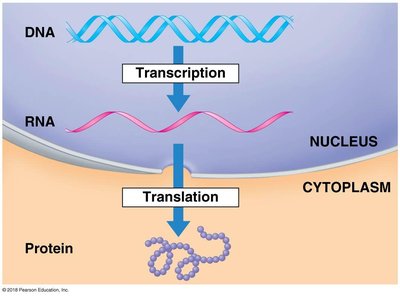
Transcription and translation are the two main processes by which genetic information is expressed as proteins. Their location differs between prokaryotic and eukaryotic cells:
Prokaryotic cells: Both transcription and translation occur in the cytoplasm, as prokaryotes lack a nucleus.
Eukaryotic cells: Transcription occurs in the nucleus, where DNA is located. The resulting mRNA is processed and then transported to the cytoplasm for translation.
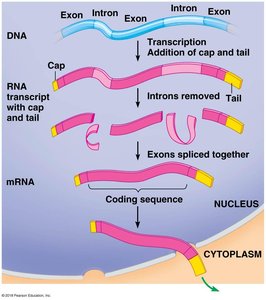
mRNA Processing in Eukaryotes
Before mRNA can be translated, it undergoes several modifications:
5' Cap: A modified guanine nucleotide is added to the 5' end, aiding in mRNA export and ribosome binding.
Poly-A Tail: A long chain of adenine nucleotides (50-250) is added to the 3' end, protecting mRNA from degradation.
RNA Splicing: Noncoding regions called introns are removed, and coding regions called exons are joined together.
Translation: From mRNA to Protein
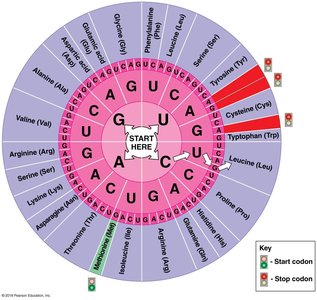
Genetic Code and Codons
The genetic code is the set of rules by which information encoded in mRNA is translated into proteins:
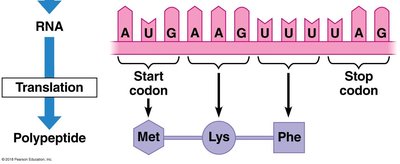
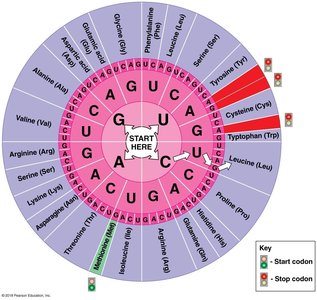
Codon: A sequence of three RNA nucleotides (triplet) that specifies a particular amino acid.
There are 64 possible codons (), but only 20 amino acids, so the code is redundant (multiple codons per amino acid).
Start codon: AUG (methionine), signals the beginning of translation.
Stop codons: UAA, UAG, UGA, signal the end of translation.
Universality of the Genetic Code
The genetic code is nearly universal among all living organisms, highlighting the unity of life and enabling modern biotechnology, such as gene transfer between species.
Key Molecules in Translation
mRNA: Carries the genetic message from DNA.
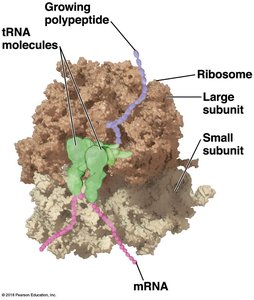
Ribosomes: The cellular machinery for protein synthesis, composed of protein and ribosomal RNA (rRNA).
tRNA: Transfer RNA, acts as an interpreter between codons and amino acids.
Enzymes: Facilitate the attachment of amino acids to tRNA.
ATP/GTP: Provide energy for translation.
tRNA Structure and Function
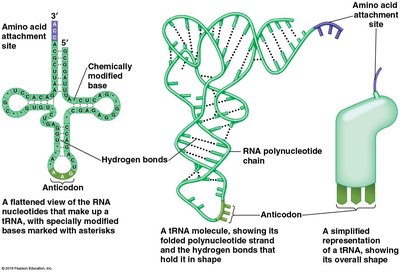
tRNA molecules recognize specific codons in mRNA and deliver the corresponding amino acids:
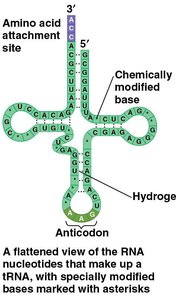
Anticodon: A triplet of bases complementary to the mRNA codon.
Amino acid attachment site: The site where the correct amino acid is attached by an enzyme.
tRNA has a cloverleaf structure stabilized by hydrogen bonds.
Ribosome Structure and Function
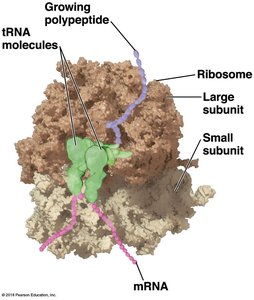
Ribosomes coordinate the interaction between mRNA and tRNA, catalyzing the formation of polypeptides:
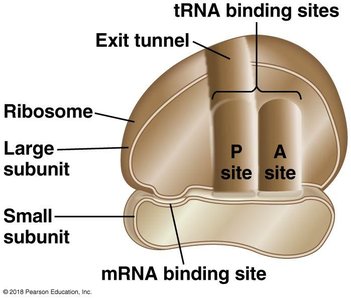
Consist of a small subunit and a large subunit.
Contain binding sites for mRNA and tRNA.
Steps of Translation
Initiation
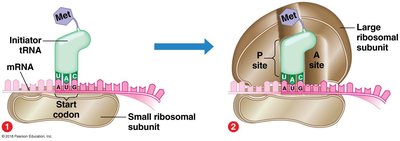
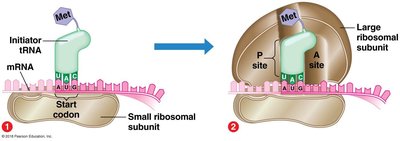
Initiation brings together the mRNA, the first tRNA (carrying methionine), and the ribosomal subunits:
mRNA binds to the small ribosomal subunit.
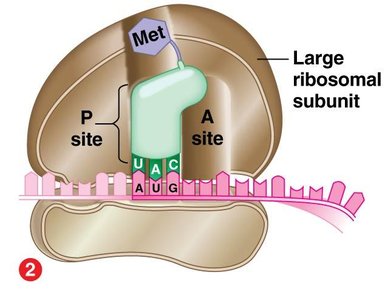
Initiator tRNA pairs with the start codon (AUG).
The large ribosomal subunit joins, forming a complete ribosome.
Elongation
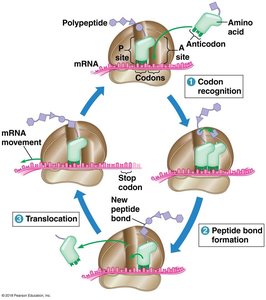
Elongation is the process by which amino acids are added to the growing polypeptide chain in three steps:
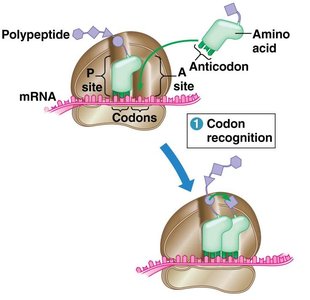
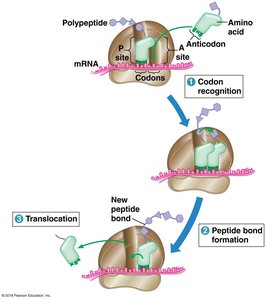
Codon recognition: The tRNA anticodon pairs with the mRNA codon in the A site.
Peptide bond formation: The amino acid from the tRNA in the P site is transferred to the amino acid in the A site, forming a peptide bond.
Translocation: The tRNA in the P site exits, and the tRNA in the A site moves to the P site.
Termination
Termination occurs when a stop codon enters the A site:
No tRNA matches the stop codon.
The completed polypeptide is released.
The ribosome dissociates into its subunits.
Translation Efficiency
Translation is rapid; a ribosome can synthesize a polypeptide in less than a minute.
Multiple ribosomes can translate a single mRNA simultaneously.
Polypeptides fold into their functional structures as they exit the ribosome.
Mutations
Definition and Types
A mutation is any change to the genetic information in a cell. Mutations can affect protein structure and function, and are classified as follows:
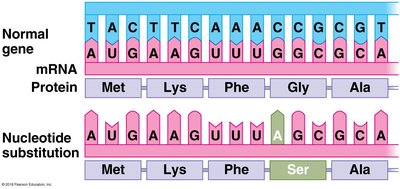
Nucleotide substitution: Replacement of one nucleotide base pair with another.
Silent mutation: Does not change the amino acid coded for.
Missense mutation: Changes the amino acid coded for, potentially altering protein function.
Nonsense mutation: Changes an amino acid codon into a stop codon, resulting in a truncated, nonfunctional protein.
Frameshift mutation: Addition or deletion of a nucleotide alters the reading frame, usually producing a nonfunctional polypeptide.
Causes of Mutations
Spontaneous mutations: Errors during DNA replication or recombination.
Mutagens: Physical or chemical agents that cause mutations (e.g., UV light, X-rays, chemicals like AZT).
While most mutations are harmful, some can be beneficial and are essential for evolution by natural selection.
Summary Table: Types of Mutations
Type | Description | Effect |
|---|---|---|
Silent | Codon change does not alter amino acid | No effect on protein |
Missense | Codon change alters amino acid | Minor or major effect on protein |
Nonsense | Codon change creates stop codon | Truncated, nonfunctional protein |
Frameshift | Insertion/deletion alters reading frame | Usually nonfunctional protein |
Additional info: The notes cover the molecular basis of gene expression, including transcription, translation, mRNA processing, the genetic code, and mutations, which are central to General Biology topics such as gene expression and regulation.
