 Back
Transcription, Translation, and Mutations: Study Notes for General Biology
Study Guide - Smart Notes
 Tailored notes based on your materials, expanded with key definitions, examples, and context.
Transcription and Translation
Overview of Gene Expression
Gene expression is the process by which information from a gene is used to synthesize functional gene products, typically proteins. This process involves two main stages: transcription and translation.
Transcription: DNA serves as a template to produce messenger RNA (mRNA).
Translation: mRNA provides instructions for the ribosome to assemble a protein.
Genotype: The genetic makeup of an organism, determined by the sequence of bases in DNA.
Phenotype: The observable traits of an organism, resulting from the proteins it produces.
DNA (genotype) → mRNA → Proteins → Phenotype
Types of RNA and Their Functions
mRNA (messenger RNA): Carries genetic instructions from DNA to the ribosome.
rRNA (ribosomal RNA): Forms the core of the ribosome's structure and catalyzes protein synthesis.
tRNA (transfer RNA): Delivers amino acids to the ribosome during translation.
Translation: The Role of Ribosomes
Translation occurs in the ribosome, where mRNA is decoded to build a polypeptide chain. Ribosomes guide the translation process by facilitating the binding of tRNA and the formation of peptide bonds between amino acids. 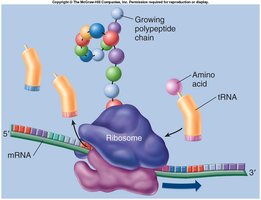
Stages of Translation
Translation is divided into three main stages:
Initiation: The ribosome, mRNA, and initiator tRNA assemble at the start codon (AUG).
Elongation: tRNAs deliver amino acids, which are joined together by peptide bonds to form a growing polypeptide chain.
Termination: A stop codon triggers the release of the polypeptide and the dissociation of the ribosome.
Initiation of Translation
The small ribosomal subunit binds to mRNA and an initiator tRNA carrying methionine.
The complex locates the AUG start codon, pairing it with the tRNA anticodon and establishing the reading frame.
The large ribosomal subunit joins, completing the initiation complex.
Genetic Code
The genetic code consists of 64 different RNA codons, each specifying an amino acid or a stop signal.
Mutations and Their Effects
DNA Replication Mistakes
During DNA replication, errors can occur, leading to mutations. DNA repair mechanisms compare the daughter strand to the parent template to correct mistakes, but proofreading is not perfect, so mutations can still arise.
Mutation: Heritable alteration in the DNA sequence.
Mutations provide the raw material for evolution.
Types of Mutations
Base Substitution: Changes the identity of one or more bases.
Frameshift Mutation: Insertion or deletion of bases, altering the reading frame.
Base Substitution Mutations
Silent Mutation: Substitution results in the same amino acid due to redundancy in the genetic code.
Missense Mutation: Substitution results in a different amino acid, potentially altering protein function.
Nonsense Mutation: Substitution creates a stop codon, resulting in a truncated protein.
Summary Table: Base Substitution Mutations
Position | Type | Effect |
|---|---|---|
2 | Outside coding region | No effect |
3 | Silent mutation | Same amino acid |
4 | Missense mutation | Different amino acid |
5 | Nonsense mutation | Premature stop codon |
Frameshift Mutations
Frameshift mutations occur when base pairs are inserted or deleted from DNA. If the change is not a multiple of three, the reading frame shifts, altering all subsequent codons and amino acids.
Insertions or deletions in multiples of three add or remove amino acids without shifting the reading frame.
Insertions or deletions not in multiples of three change the reading frame, leading to incorrect amino acids and potentially a nonfunctional protein.
Summary Table: Frameshift Mutations
Position | Type | Effect |
|---|---|---|
2 | Outside coding region | No effect |
5 | Missense mutation | Incorrect amino acids after insertion |
3 | Nonsense mutation | Premature stop codon |
Three consecutive deletions | Reading frame restored | Proper reading frame re-established after third deletion |
Mutagens and Evolution
Mutagens are chemicals that cause mutations and are often linked to cancer (e.g., chemicals in cigarette smoke).
Mutation and recombination provide the raw materials for evolutionary change.
Bacterial Transformation and GFP Expression
Overview
Bacterial transformation is a process in which bacteria take up foreign DNA, such as the gene for Green Fluorescent Protein (GFP). The expression of GFP in transformed bacteria demonstrates gene expression and the link between genotype and phenotype.
Bacteria expressing GFP will fluoresce, showing successful transformation and protein production.
This experiment illustrates the central dogma: DNA → RNA → Protein → Phenotype.
Additional info: The notes have been expanded to provide context for each mutation type, the stages of translation, and the significance of bacterial transformation in gene expression.
