 Back
CH 17 pt 3 Translation and Mutations: From Genetic Code to Protein Function
Study Guide - Smart Notes
 Tailored notes based on your materials, expanded with key definitions, examples, and context.
Translation and the Genetic Code
The Genetic Code: Connecting Transcription to Translation
The genetic code is the set of rules by which information encoded in mRNA sequences is translated into the amino acid sequences of proteins. It is considered degenerate (or redundant) because most amino acids are specified by more than one codon, but it is not ambiguous—each codon specifies only one amino acid.
Codons are triplets of nucleotides in mRNA, each coding for a specific amino acid.
There are 64 possible codons (43), with 61 coding for amino acids and 3 serving as stop signals.
Start codon: AUG (codes for methionine and signals the start of translation).
Stop codons: UAA, UAG, UGA (signal termination of translation).
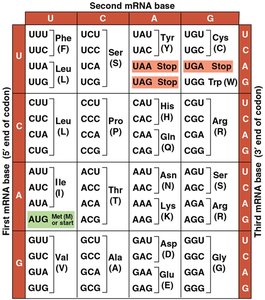
Example: The codons GGU, GGC, GGA, and GGG all code for glycine, illustrating the degeneracy of the code.
Amino Acids and Their Properties
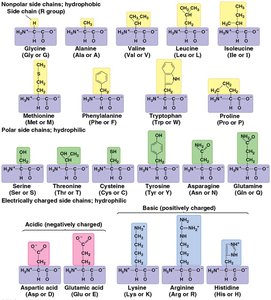
Proteins are composed of 20 different amino acids, each with a common backbone and a unique R group (side chain) that determines its properties.
Nonpolar (hydrophobic): e.g., valine, leucine
Polar (hydrophilic): e.g., serine, threonine
Electrically charged: acidic (negative, e.g., glutamic acid), basic (positive, e.g., lysine)
Translating the Code: From mRNA to Protein
Reading the Code: Predicting Amino Acid Sequences
To translate an mRNA sequence into a protein:
Find the start codon (AUG) in the 5' to 3' direction.
Read the sequence in groups of three nucleotides (codons).
Continue until a stop codon (UAA, UAG, UGA) is reached.
Example: For mRNA 5'-AAAAUGGGUCCCCCACUCUAA-3', the polypeptide sequence is Met–Gly–Pro–Pro–Leu.
Peptide Bond Formation
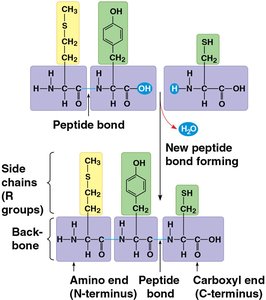
Amino acids are joined by peptide bonds through a dehydration reaction, linking the carboxyl group of one amino acid to the amino group of the next. The polypeptide grows from the N-terminus to the C-terminus.
Mechanism of Translation
Overview: The Players in Translation
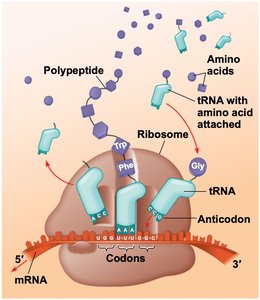
Translation occurs at the ribosome and involves:
mRNA: Carries the codon sequence.
tRNA: Brings specific amino acids, matching codons with its anticodon.
Ribosome: Composed of rRNA and proteins, it facilitates the assembly of amino acids into a polypeptide.
Structure and Function of tRNA
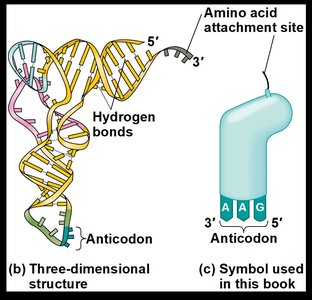
tRNA molecules have a three-dimensional structure stabilized by hydrogen bonds. Each tRNA has:
An anticodon that pairs with a complementary mRNA codon.
An amino acid attachment site at the 3' end.
Translation Initiation
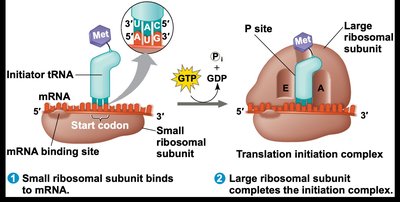
Initiation brings together the mRNA, the initiator tRNA (carrying methionine), and the ribosomal subunits to form the initiation complex.
The small ribosomal subunit binds to the mRNA and the initiator tRNA pairs with the start codon (AUG).
The large subunit joins, completing the initiation complex. The initiator tRNA occupies the P site.
Translation Elongation
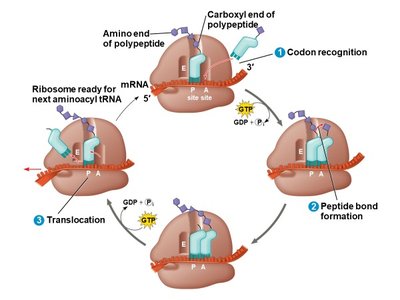
Elongation is a cyclic process that adds amino acids to the growing polypeptide chain.
Codon recognition: A tRNA with the correct anticodon enters the A site.
Peptide bond formation: The polypeptide in the P site is transferred to the amino acid in the A site.
Translocation: The ribosome moves one codon along the mRNA, shifting tRNAs from A to P to E sites.
Translation Termination
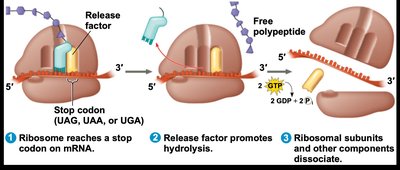
Termination occurs when a stop codon is reached. A release factor binds to the A site, hydrolyzing the bond between the polypeptide and tRNA, releasing the completed protein and dissociating the ribosomal subunits.
Mutations and Their Effects on Proteins
Point Mutations: Small Changes, Big Effects
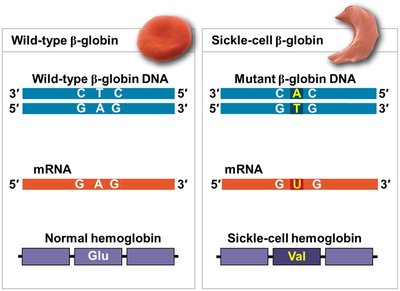
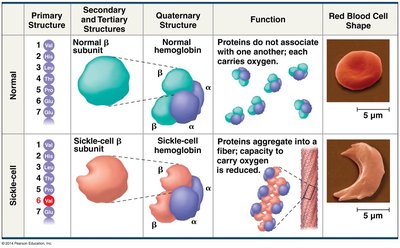
A point mutation is a change in a single nucleotide pair. This can have significant effects on protein structure and function, as seen in sickle-cell disease.
Sickle-cell disease: A single base change (A to T) in the β-globin gene changes the codon from GAG (glutamic acid) to GUG (valine), altering hemoglobin structure and function.
Types of Small-Scale Mutations
Substitutions: One nucleotide is replaced by another.
Silent: No change in amino acid (due to code redundancy).
Missense: Changes one amino acid to another.
Nonsense: Changes an amino acid codon to a stop codon, truncating the protein.
Insertions and Deletions: Addition or loss of nucleotides.
Can cause frameshift mutations, altering the reading frame and usually resulting in a nonfunctional protein.
Insertion or deletion of three nucleotides adds or removes one amino acid but does not shift the reading frame.
Summary Table: Types of Point Mutations
Type | mRNA | Protein | Effect |
|---|---|---|---|
Wild type | 5' AUG AAG UUU GGC UAA 3' | Met–Lys–Phe–Gly–Stop | Normal protein |
Silent | 5' AUG AAG UUU GGU UAA 3' | Met–Lys–Phe–Gly–Stop | No change |
Missense | 5' AUG AAG UUU AGC UAA 3' | Met–Lys–Phe–Ser–Stop | Wrong amino acid |
Nonsense | 5' AUG UAG UUU GGC UAA 3' | Met–Stop | Cut short |
Summary Table: Insertions and Deletions
Type | mRNA | Protein | Effect |
|---|---|---|---|
Wild type | 5' AUG AAG UUU GGC UAA 3' | Met–Lys–Phe–Gly–Stop | Normal protein |
1-base deletion (U) | 5' AUG AAG UUG GCU AA… 3' | Met–Lys–Leu–Ala… | Frameshift: missense |
1-base insertion | 5' AUG UAA GUU UGG … 3' | Met–Stop | Frameshift: nonsense |
3-base deletion | 5' AUG UUU GGC UAA 3' | Met–Phe–Gly–Stop | No frameshift; Lys missing |
Additional info: Mutations in gametes can be inherited and may cause genetic disorders if they alter protein function. The redundancy of the genetic code often protects against some mutations (silent mutations), but others can have significant phenotypic effects.
