 Back
Translation and Point Mutations: Molecular Mechanisms of Protein Synthesis
Study Guide - Smart Notes
 Tailored notes based on your materials, expanded with key definitions, examples, and context.
Translation: The Molecular Mechanism of Protein Synthesis
Overview of Information Flow in Gene Expression
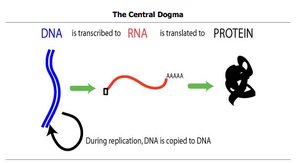
The central dogma of molecular biology describes the flow of genetic information from DNA to RNA to protein. This process involves two main steps: transcription (DNA to RNA) and translation (RNA to protein). During replication, DNA is also copied to DNA, ensuring genetic continuity.
Key Molecules in Translation
Ribosome: A complex of proteins and rRNA that catalyzes peptide bond formation and coordinates the translation process.
mRNA (messenger RNA): Carries the genetic code from DNA, specifying the amino acid sequence of the protein.
tRNA (transfer RNA): Serves as an adaptor, matching specific amino acids to codons in the mRNA via its anticodon region.
rRNA (ribosomal RNA): Structural and catalytic component of the ribosome, acting as a ribozyme.
Accessory proteins: Initiation, elongation, and termination factors that regulate translation.
Transfer RNA (tRNA): Structure and Function
tRNA as the Adapter Molecule
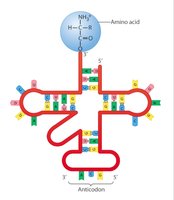
tRNAs are small RNA molecules that bring specific amino acids to the ribosome during translation. Each tRNA has a unique anticodon that base-pairs with a complementary codon on the mRNA, ensuring the correct amino acid is incorporated into the growing polypeptide chain.
Each tRNA is charged with a specific amino acid at its 3' end (CCA sequence).
tRNAs have a characteristic cloverleaf secondary structure and a three-dimensional L-shaped tertiary structure.
tRNAs are used repeatedly in translation, cycling between the cytosol and the ribosome.
Aminoacyl-tRNA Synthetases: The Second Genetic Code
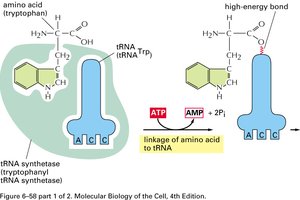
Aminoacyl-tRNA synthetases are enzymes that attach the correct amino acid to its corresponding tRNA, a process called "charging." There are 20 different synthetases, one for each amino acid. This step is critical for translation fidelity, as there is no further proofreading after charging.
The reaction uses ATP and forms a high-energy bond between the amino acid and tRNA.
The amino acid is attached via its carboxyl group, leaving the amino group free for peptide bond formation.
Ribosome Structure and Function
Ribosome Composition and Sites
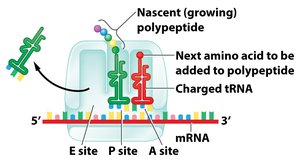
Ribosomes are composed of two subunits (large and small), each containing rRNA and proteins. They have three binding sites for tRNA:
A site (Aminoacyl): Entry site for charged tRNA.
P site (Peptidyl): Holds the tRNA with the growing polypeptide chain.
E site (Exit): Where empty tRNAs leave the ribosome.
rRNA as a Ribozyme
Recent advances show that rRNA, not protein, catalyzes peptide bond formation, making the ribosome a ribozyme. This is a key example of RNA's catalytic capabilities.
The Process of Translation
Initiation
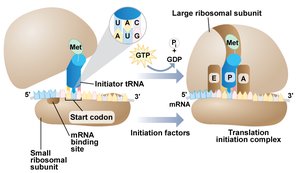
Translation initiation involves the assembly of the ribosome on the mRNA at the start codon (AUG). In prokaryotes, the Shine-Dalgarno sequence helps position the ribosome, while in eukaryotes, the small subunit scans from the 5' cap to the first AUG.
Initiator tRNA (tRNAMet) pairs with the start codon.
Large ribosomal subunit joins, forming the complete initiation complex.
GTP hydrolysis provides energy for assembly.
Elongation
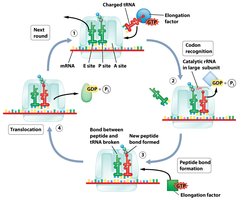
Elongation is a cyclic process in which amino acids are added one by one to the growing polypeptide chain. Each cycle involves:
Codon recognition: Incoming charged tRNA binds to the A site.
Peptide bond formation: rRNA catalyzes the transfer of the polypeptide from the P site tRNA to the amino acid on the A site tRNA.
Translocation: The ribosome moves along the mRNA, shifting tRNAs from A to P to E sites.
tRNA exit: The empty tRNA leaves from the E site.
Termination
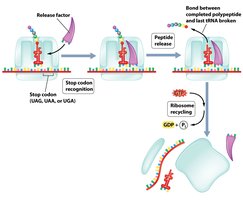
Termination occurs when a stop codon (UAA, UAG, UGA) is encountered. Release factors bind to the stop codon, prompting the release of the completed polypeptide and disassembly of the ribosome.
Polyribosomes
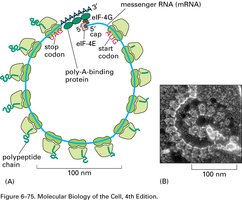
Multiple ribosomes can simultaneously translate a single mRNA, forming a polyribosome (polysome). This increases the efficiency of protein synthesis.
Differences in Translation: Prokaryotes vs. Eukaryotes
In prokaryotes, transcription and translation are coupled; translation can begin before transcription is complete.
Eukaryotes separate these processes spatially and temporally (nucleus vs. cytoplasm).
Prokaryotic mRNAs are often polycistronic (encode multiple proteins), while eukaryotic mRNAs are typically monocistronic.
Mutations and Their Effects on Proteins
Types of Mutations
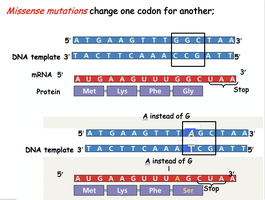
Point mutations: Single base pair changes, including substitutions, insertions, and deletions.
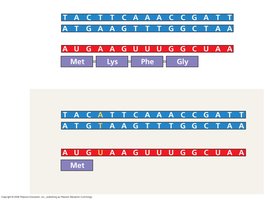
Substitutions: May result in silent, missense, or nonsense mutations.
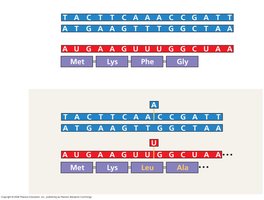
Insertions/Deletions: Can cause frameshift mutations, altering the reading frame and potentially leading to nonfunctional proteins.
Missense Mutation Example: Sickle Cell Anemia
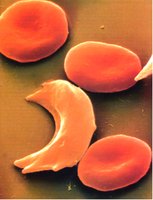
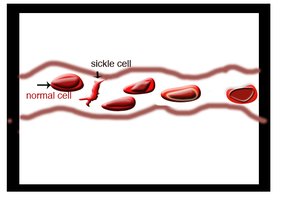
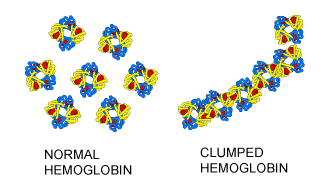
A single nucleotide substitution in the hemoglobin gene changes a glutamic acid (E) to valine (V), causing hemoglobin to polymerize and distort red blood cells into a sickle shape. This leads to anemia and multiple organ effects.
Silent and Nonsense Mutations
Silent mutations: Do not change the amino acid sequence but may affect translation efficiency due to codon bias.
Nonsense mutations: Introduce a premature stop codon, truncating the protein.
Frameshift Mutations
Insertions or deletions that are not multiples of three nucleotides shift the reading frame, often resulting in nonfunctional proteins.
Protein Targeting and Post-Translational Modifications
Protein Folding and Modifications
After translation, polypeptides fold into their functional three-dimensional structures. Some proteins undergo post-translational modifications such as cleavage, addition of chemical groups (e.g., sugars, phosphates), or assembly into multi-subunit complexes.
Targeting Proteins to the Endoplasmic Reticulum (ER)
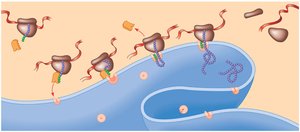
Proteins destined for secretion or for the endomembrane system are synthesized on ribosomes bound to the ER. These proteins have an N-terminal signal peptide that directs the ribosome to the ER via the signal recognition particle (SRP).
Summary Table: Types of RNA and Their Functions
Type of RNA | Functions |
|---|---|
Messenger RNA (mRNA) | Carries information specifying amino acid sequences of proteins from DNA to ribosomes |
Transfer RNA (tRNA) | Serves as adaptor molecule in protein synthesis; translates mRNA codons into amino acids |
Ribosomal RNA (rRNA) | Plays catalytic (ribozyme) roles and structural roles in ribosomes |
Primary transcript | Precursor to mRNA, rRNA, or tRNA; before being processed |
Small nuclear RNA (snRNA) | Plays structural and catalytic roles in spliceosomes, complexes that splice pre-mRNA |
Key Equations and Concepts
Directionality of Translation: mRNA is read 5' to 3'; proteins are synthesized from N-terminus to C-terminus.
Peptide Bond Formation: Catalyzed by rRNA in the ribosome.
Summary
Translation is a highly regulated, energy-intensive process that ensures the accurate synthesis of proteins from genetic information. Mutations in DNA can have diverse effects on protein structure and function, with significant implications for cellular physiology and disease.
