 Back
Translation: Decoding mRNA into Protein
Study Guide - Smart Notes
 Tailored notes based on your materials, expanded with key definitions, examples, and context.
Translation: mRNA to Protein
Overview of Translation
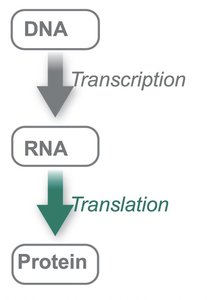
Translation is the process by which messenger RNA (mRNA) is decoded by ribosomes to produce a polypeptide, or protein. This process is fundamental to gene expression and occurs in the cytoplasm of cells. The genetic information stored in DNA is first transcribed into mRNA, which is then translated into a sequence of amino acids.
Translation converts the nucleotide sequence of mRNA into the amino acid sequence of a protein.
Occurs in the 5' to 3' direction along the mRNA.
Proteins are synthesized from the N-terminus to the C-terminus.
The Genetic Code and Codons
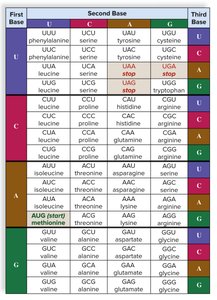
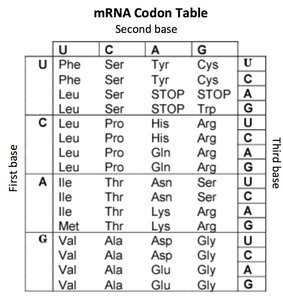
The genetic code consists of triplet codons, each made up of three nucleotides. Each codon specifies a particular amino acid or a stop signal. The code is redundant, meaning multiple codons can code for the same amino acid.
Codon: A sequence of three mRNA nucleotides that codes for an amino acid.
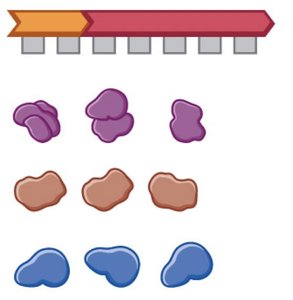
There are 64 possible codons (43), but only 20 amino acids.
Start codon: AUG (codes for methionine, marks the beginning of translation).
Stop codons: UAA, UAG, UGA (signal the end of translation).
Example: Decoding a DNA Sequence
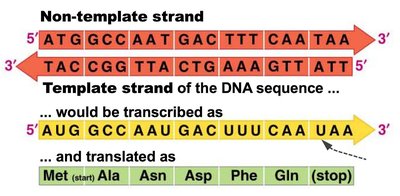
To translate a DNA sequence, the non-template strand is transcribed into mRNA, which is then read in triplets to determine the amino acid sequence.
Non-template DNA: 5' ATG GCC AAT GAC TTT CAA TAA 3'
Template DNA: 3' TAC CGG TTA CTG AAA GTT ATT 5'
mRNA: 5' AUG GCC AAU GAC UUU CAA UAA 3'
Protein: Met-Ala-Asn-Asp-Phe-Gln-(stop)
Components Required for Translation
Several molecular components are essential for translation, including different types of RNA and proteins.
mRNA: Carries the genetic code from DNA.
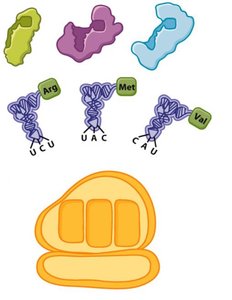
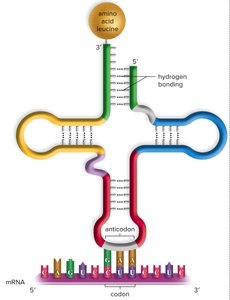
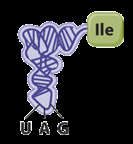
tRNA: Brings amino acids to the ribosome; each tRNA has an anticodon complementary to the mRNA codon.
rRNA: Forms the core of the ribosome and catalyzes peptide bond formation.
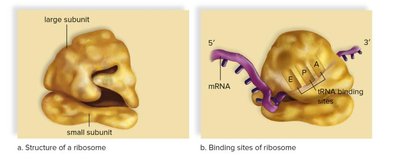
Ribosome: The molecular machine that facilitates translation, composed of rRNA and proteins.
Aminoacyl-tRNA synthetases: Enzymes that attach the correct amino acid to its tRNA.
Initiation, elongation, and release factors: Proteins that assist in the different stages of translation.
Stages of Translation
Initiation
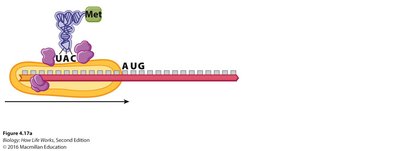
Initiation begins when the small ribosomal subunit, initiation factors, and the initiator tRNA (carrying methionine) assemble at the mRNA's 5' cap and scan for the start codon (AUG).
At AUG, the large ribosomal subunit joins, and the initiator tRNA occupies the P site.
Initiation factors are released, and translation begins.
Elongation
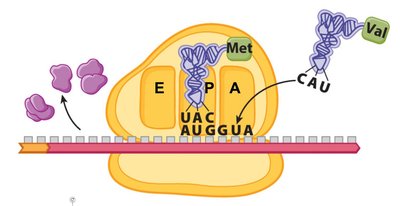
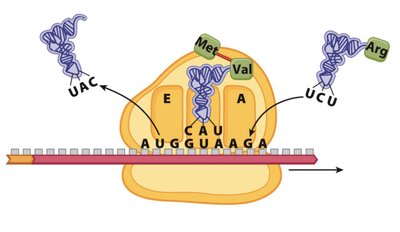
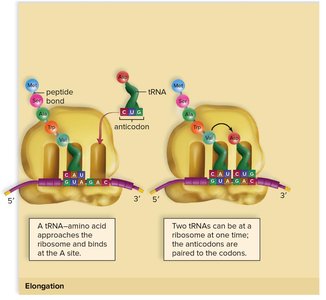
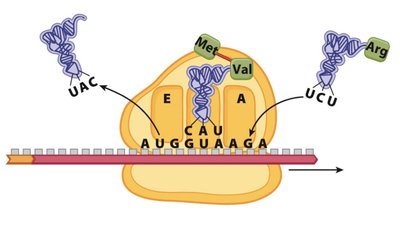
Elongation is the process by which the ribosome moves along the mRNA, adding amino acids to the growing polypeptide chain.
A charged tRNA enters the A site, matching its anticodon to the mRNA codon.
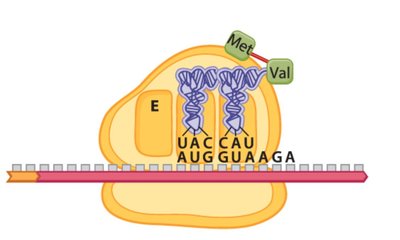
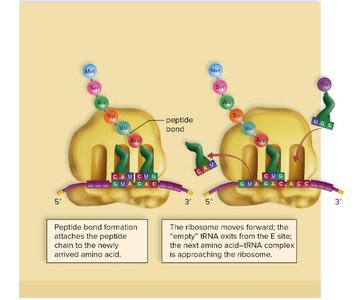
The ribosome catalyzes the formation of a peptide bond between the amino acid in the A site and the polypeptide in the P site.
The ribosome shifts one codon to the right, moving the tRNA to the E site for exit, and the next tRNA enters the A site.
Peptide Bond Formation
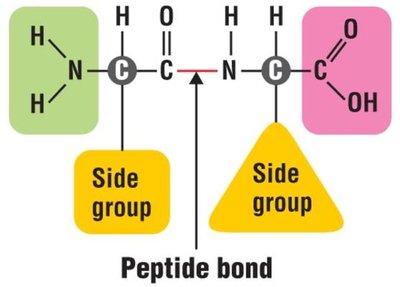
The ribosome catalyzes the formation of peptide bonds between adjacent amino acids, creating a polypeptide chain.
Peptide bond: A covalent bond formed between the carboxyl group of one amino acid and the amino group of another.
Termination
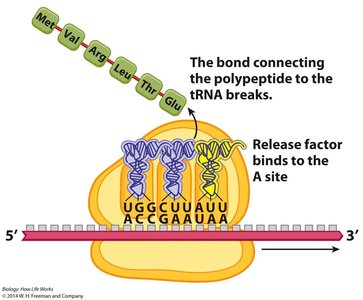
Termination occurs when a stop codon enters the A site. A release factor binds, causing the polypeptide to be released from the tRNA and the ribosome to disassemble.
Stop codons: UAA, UAG, UGA
Release factor triggers the release of the completed polypeptide.
Polyribosomes (Polysomes)
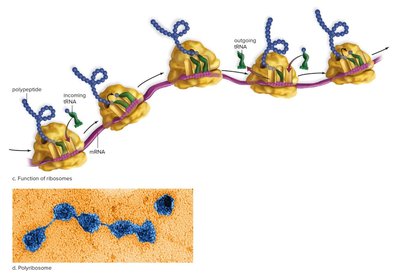
Multiple ribosomes can translate a single mRNA simultaneously, forming a polyribosome or polysome. This increases the efficiency of protein synthesis.
Each ribosome independently synthesizes a copy of the protein.
Summary Table: Codons and Amino Acids
The following table summarizes the relationship between mRNA codons and their corresponding amino acids:
First Base | Second Base | Third Base | Amino Acid |
|---|---|---|---|
U | U | U | Phenylalanine |
A | U | G | Methionine (Start) |
U | A | A | Stop |
C | A | A | Glutamine |
C | A | C | Glutamine |
A | A | C | Asparagine |
G | G | C | Glycine |
U | G | G | Tryptophan |
U | A | G | Stop |
U | A | A | Stop |
U | A | U | Tyrosine |
U | A | C | Tyrosine |
C | A | U | Histidine |
C | A | C | Histidine |
A | A | U | Asparagine |
A | A | C | Asparagine |
G | A | U | Aspartic acid |
G | A | C | Aspartic acid |
Key Concepts and Review Questions
Each of the 20 common amino acids is specified by one or more codons.
The tRNA anticodon is antiparallel and base pairs with the mRNA codon via hydrogen bonding.
mRNA is read and made in the 5' to 3' direction.
Summary
Translation decodes mRNA's triplet code (codons) to amino acids, resulting in the synthesis of proteins. This process is central to the flow of genetic information from nucleic acids to functional proteins in all living organisms.
