 Back
Translation: Decoding mRNA into Protein
Study Guide - Smart Notes
 Tailored notes based on your materials, expanded with key definitions, examples, and context.
Translation: mRNA to Protein
Overview of Translation
Translation is the process by which messenger RNA (mRNA) is decoded by ribosomes to synthesize proteins. This process occurs in the cytoplasm and involves converting the nucleotide sequence of mRNA into the amino acid sequence of a polypeptide.
Key Point 1: Translation is the second major step in gene expression, following transcription.
Key Point 2: The genetic code is read in triplets called codons, each specifying an amino acid or a stop signal.
Key Point 3: The process proceeds in the 5' to 3' direction along the mRNA, producing a polypeptide from the N-terminus to the C-terminus.
Example: The codon 5' AUG 3' codes for methionine and serves as the start codon.
Genetic Code and Codons
Codon Structure and Redundancy
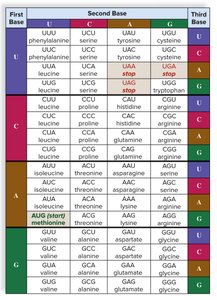
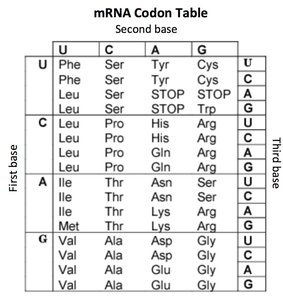
The genetic code consists of 64 codons, each made up of three nucleotides. Codons are read by the ribosome and matched to their corresponding amino acids via transfer RNA (tRNA).
Key Point 1: There are four bases in RNA (A, U, G, C) and 20 amino acids.
Key Point 2: The code is redundant; multiple codons can specify the same amino acid.
Key Point 3: Three codons (UAA, UAG, UGA) are stop signals, ending translation.
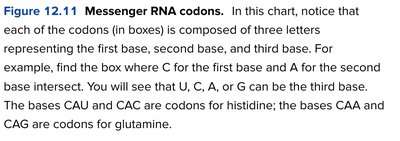
Example: Codons CAU and CAC both code for histidine; CAA and CAG code for glutamine.
Transcription and Translation Relationship
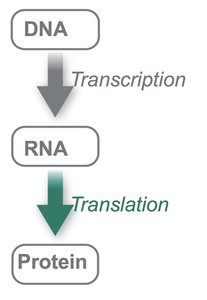
From DNA to Protein
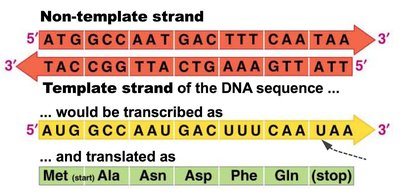
Transcription produces mRNA from a DNA template, which is then translated into protein. The non-template strand of DNA corresponds to the mRNA sequence, while the template strand is used for transcription.
Key Point 1: mRNA is synthesized in the 5' to 3' direction.
Key Point 2: The mRNA sequence is translated into a sequence of amino acids.
Example: DNA sequence 5' ATG GCC AAT GAC TTT CAA TAA 3' is transcribed to mRNA 5' AUG GCC AAU GAC UUU CAA UAA 3' and translated as Met-Ala-Asn-Asp-Phe-Gln-(stop).
Components of Translation
Key Molecules and Structures
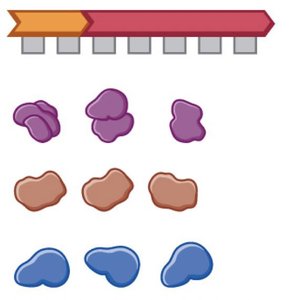
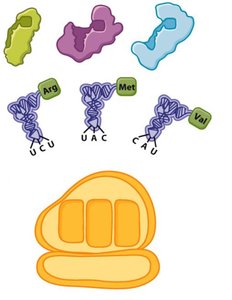
Translation requires several molecular components, including mRNA, tRNA, ribosomes, and various protein factors.
Key Point 1: mRNA serves as the template for translation.
Key Point 2: tRNA molecules carry amino acids and have anticodons complementary to mRNA codons.
Key Point 3: Ribosomes are complexes of rRNA and proteins that catalyze peptide bond formation.
Key Point 4: Aminoacyl-tRNA synthetases are enzymes that attach the correct amino acid to its tRNA.
Ribosome Structure and Function
Binding Sites and Polysomes
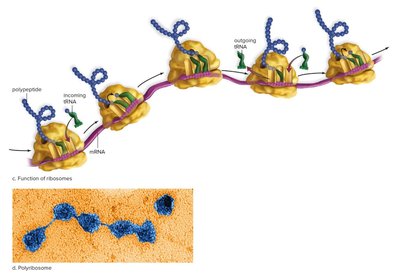
Ribosomes have three binding sites for tRNA: the A (aminoacyl), P (peptidyl), and E (exit) sites. Multiple ribosomes can translate a single mRNA simultaneously, forming a polysome.
Key Point 1: The A site binds incoming charged tRNA.
Key Point 2: The P site holds the tRNA with the growing polypeptide chain.
Key Point 3: The E site releases uncharged tRNA after amino acid transfer.
Example: Polysomes increase the efficiency of protein synthesis.

Translation Initiation
Formation of the Initiation Complex
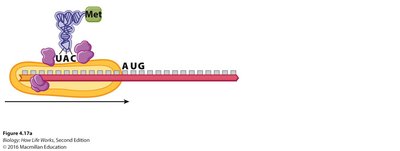
Translation begins when the small ribosomal subunit, initiation factors, and initiator tRNA assemble at the mRNA's start codon (AUG). The large subunit then joins, and the initiator tRNA occupies the P site.
Key Point 1: The start codon (AUG) signals the beginning of translation.
Key Point 2: Initiation factors help assemble the ribosome and tRNA at the correct site.
Key Point 3: The initiator tRNA carries methionine (Met).
Example: In eukaryotes, the ribosome scans the mRNA for the AUG codon.
Translation Elongation
Polypeptide Chain Growth
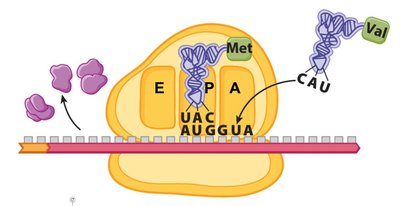
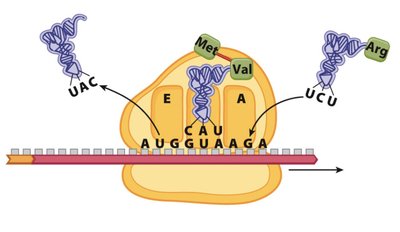
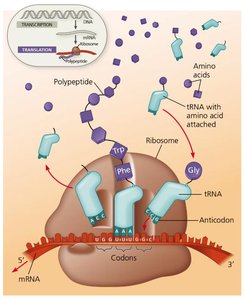
During elongation, the ribosome moves along the mRNA, matching codons with tRNA anticodons and catalyzing peptide bond formation between amino acids.
Key Point 1: Charged tRNA enters the A site, and the polypeptide is transferred from the P site tRNA to the A site tRNA.
Key Point 2: The ribosome shifts, moving tRNAs through the E, P, and A sites.
Key Point 3: Peptide bonds are formed between amino acids, growing the polypeptide chain.
Example: The sequence of codons determines the sequence of amino acids in the protein.
Translation Termination
Release of the Polypeptide
Translation ends when a stop codon enters the A site. Release factors bind, causing the ribosome to release the completed polypeptide and dissociate from the mRNA.
Key Point 1: Stop codons (UAA, UAG, UGA) do not code for amino acids.
Key Point 2: Release factors trigger the release of the polypeptide from the ribosome.
Example: The completed protein may undergo further processing or folding.
Summary Table: Codons and Amino Acids
Codon-to-Amino Acid Mapping
The following table summarizes the relationship between mRNA codons and their corresponding amino acids.
First Base | Second Base | Third Base | Amino Acid |
|---|---|---|---|
U | U | U | Phenylalanine (Phe) |
A | U | G | Start (Methionine, Met) |
C | A | U | Histidine (His) |
C | A | C | Histidine (His) |
C | A | A | Glutamine (Gln) |
C | A | G | Glutamine (Gln) |
U | A | A | Stop |
U | A | G | Stop |
U | G | A | Stop |
Peptide Bond Formation
Chemical Structure of Peptide Bonds
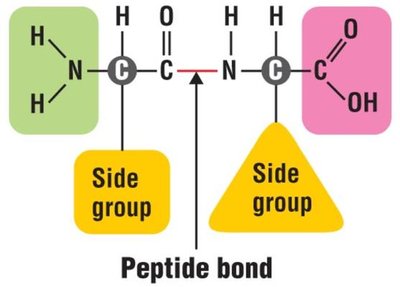
Peptide bonds link amino acids together in a polypeptide chain. The bond forms between the carboxyl group of one amino acid and the amino group of another, releasing water.
Key Point 1: Peptide bond formation is catalyzed by the ribosome.
Key Point 2: The reaction is a dehydration synthesis.
Formula:
Example: The growing polypeptide chain is extended by one amino acid at each step.
Polysomes and Protein Synthesis Efficiency
Multiple Ribosomes on a Single mRNA
Polysomes are structures where multiple ribosomes simultaneously translate a single mRNA molecule, increasing the rate of protein synthesis.
Key Point 1: Polysomes allow for rapid and efficient protein production.
Key Point 2: Each ribosome independently synthesizes a polypeptide.
Example: Polysomes are commonly observed in cells with high protein synthesis demands.
Summary
Translation Decodes mRNA into Protein
Translation is a fundamental process in biology, converting the genetic information in mRNA into functional proteins. It involves the coordinated action of mRNA, tRNA, ribosomes, and various protein factors, following the rules of the genetic code.
Key Point 1: The process is highly regulated and essential for cellular function.
Key Point 2: Understanding translation is crucial for fields such as genetics, molecular biology, and biotechnology.
