 Back
Translation of the Genetic Code: From mRNA to Protein
Study Guide - Smart Notes
 Tailored notes based on your materials, expanded with key definitions, examples, and context.
Translation of the Genetic Code
Overview of Translation
Translation is the process by which the genetic information encoded in messenger RNA (mRNA) is used to synthesize a specific polypeptide (protein). This process is a key step in the central dogma of molecular biology, which describes the flow of genetic information from DNA to RNA to protein. Translation occurs in the cytoplasm and involves several essential components, including mRNA, transfer RNA (tRNA), ribosomes, and various protein factors.
The Central Dogma of Biology
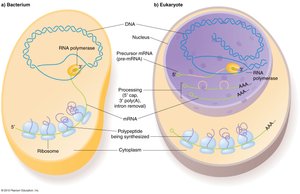
The central dogma describes the directional flow of genetic information:
DNA is transcribed into mRNA.
mRNA is translated into a polypeptide (protein).
Not all RNA molecules are translated; for example, ribosomal RNA (rRNA) and transfer RNA (tRNA) function as structural or catalytic RNAs.
The Genetic Code
Properties of the Genetic Code
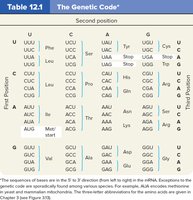
The genetic code specifies the relationship between the sequence of nucleotides in mRNA and the sequence of amino acids in a polypeptide. It is nearly universal among all organisms and is read in non-overlapping triplets called codons.
Codon: A sequence of three nucleotides in mRNA that specifies a particular amino acid or a stop signal.
Degeneracy: More than one codon can specify the same amino acid.
There are 64 codons: 61 code for amino acids, 1 is a start codon (AUG), and 3 are stop codons (UAA, UAG, UGA).
Reading Frame and the Importance of the Start Codon
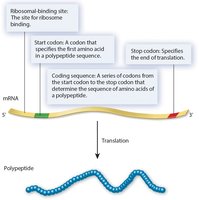
The reading frame is defined by the start codon (AUG), which sets the order in which codons are read. If the reading frame is shifted, the resulting polypeptide will be incorrect, which can have significant biological consequences.
Start codon (AUG): Specifies the first amino acid (methionine) in the polypeptide sequence.
Stop codons: Signal the end of translation.
Translation Machinery
Key Components
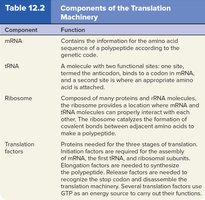
Translation requires the coordinated action of several macromolecules:
Component | Function |
|---|---|
mRNA | Contains the information for the amino acid sequence of a polypeptide according to the genetic code. |
tRNA | Acts as an adaptor, matching an mRNA codon with the correct amino acid. |
Ribosome | Site of protein synthesis; catalyzes peptide bond formation. |
Translation factors | Proteins that assist in the initiation, elongation, and termination of translation. |
tRNA Structure and Function
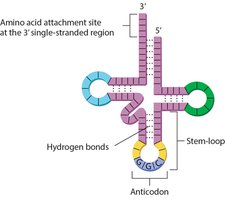
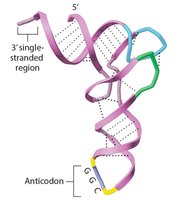
Transfer RNA (tRNA) molecules are single-stranded RNAs that fold into a characteristic cloverleaf structure with several important features:
Anticodon: A set of three nucleotides that base-pair with a complementary codon in mRNA.
3' end: The site where the appropriate amino acid is attached.
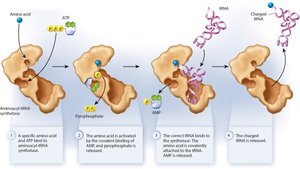
tRNAs are "charged" by specific enzymes called aminoacyl-tRNA synthetases, which attach the correct amino acid to the tRNA.
Aminoacyl-tRNA Synthetase
Each amino acid has its own aminoacyl-tRNA synthetase, which ensures the correct pairing of tRNA and amino acid. This process is highly specific and essential for accurate translation.
Ribosome Structure and Function
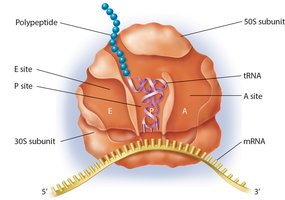
The ribosome is a complex molecular machine composed of rRNA and proteins. It consists of two subunits (large and small) and contains three binding sites for tRNA:
A site (Aminoacyl site): Where charged tRNA enters.
P site (Peptidyl site): Holds the tRNA with the growing polypeptide chain.
E site (Exit site): Where uncharged tRNA exits the ribosome.
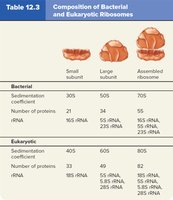
Comparison of Bacterial and Eukaryotic Ribosomes
Small Subunit | Large Subunit | Assembled Ribosome | |
|---|---|---|---|
Bacterial | 30S | 50S | 70S |
Eukaryotic | 40S | 60S | 80S |
Stages of Translation
Initiation
During initiation, the ribosome assembles around the target mRNA. In bacteria, the ribosomal binding site (RBS) aligns the mRNA with the small ribosomal subunit. In eukaryotes, the 5' cap structure of mRNA facilitates ribosome binding.
Elongation
Elongation involves the sequential addition of amino acids to the growing polypeptide chain. The ribosome moves along the mRNA, and peptide bonds are formed between adjacent amino acids.
Termination
Termination occurs when a stop codon is encountered. Release factors bind to the stop codon, causing the release of the newly synthesized polypeptide and the disassembly of the translation complex.
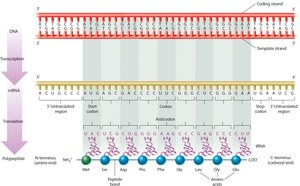
Relationship Between DNA, mRNA, tRNA, and Amino Acids
The flow of genetic information from DNA to protein involves several steps:
Transcription: DNA is transcribed into mRNA.
Translation: mRNA codons are read by tRNA anticodons, and the corresponding amino acids are linked to form a polypeptide.
Summary Table: Components of the Translation Machinery
Component | Function |
|---|---|
mRNA | Contains the genetic code for protein synthesis |
tRNA | Transfers amino acids to the ribosome |
Ribosome | Site of protein synthesis |
Translation factors | Assist in initiation, elongation, and termination |
Key Points and Additional Information
Translation is energy-intensive, requiring GTP hydrolysis at multiple steps.
Polysomes (multiple ribosomes on a single mRNA) increase the efficiency of protein synthesis.
Antibiotics can target bacterial ribosomes due to structural differences from eukaryotic ribosomes.
Additional info: The accuracy of translation is ensured by the specificity of aminoacyl-tRNA synthetases and the correct pairing of codons and anticodons. Errors in translation can lead to nonfunctional or harmful proteins, highlighting the importance of fidelity in this process.
