 Back
Translation of the Genetic Code: Mechanisms and Machinery
Study Guide - Smart Notes
 Tailored notes based on your materials, expanded with key definitions, examples, and context.
Translation of the Genetic Code
Overview of Translation
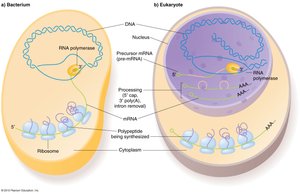
Translation is the process by which the genetic information encoded in messenger RNA (mRNA) is used to synthesize a polypeptide (protein). This process is central to the flow of genetic information, as described by the Central Dogma of Biology: DNA → RNA → Protein. Translation occurs in both prokaryotic and eukaryotic cells, but with some differences in the machinery and regulation.
Key Points:
DNA is transcribed into mRNA, which is then translated into protein.
In bacteria, transcription and translation are coupled; in eukaryotes, transcription occurs in the nucleus and translation in the cytoplasm.
Not all RNA molecules are translated; examples include rRNA and tRNA.
The Genetic Code
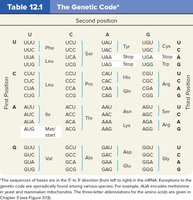
The genetic code specifies the relationship between the sequence of nucleotides in mRNA and the sequence of amino acids in a polypeptide. The code is read in groups of three nucleotides called codons, which are non-overlapping and universal across organisms.
Key Points:
The code is degenerate: multiple codons can specify the same amino acid.
There are 20 amino acids and 61 codons coding for amino acids, plus 1 start codon (AUG) and 3 stop codons (UAA, UAG, UGA).
Codons are read in a specific reading frame defined by the start codon.
Translation Machinery
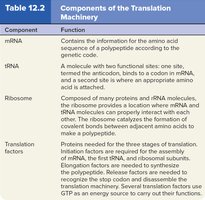
Translation requires several key components: mRNA, tRNA, ribosomes, and protein factors. Each plays a distinct role in decoding the genetic information and synthesizing proteins.
Component | Function |
|---|---|
mRNA | Contains the information for the amino acid sequence of a polypeptide according to the genetic code. |
tRNA | A molecule with two functional sites: one binds to a codon in mRNA, and a second site is where an appropriate amino acid is attached. |
Ribosome | Catalyzes the formation of covalent bonds between adjacent amino acids to make a polypeptide. |
Translation factors | Proteins needed for the three stages of translation: initiation, elongation, and termination. Several translation factors use GTP as an energy source. |
tRNA Structure and Function
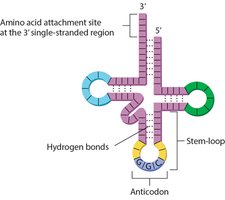
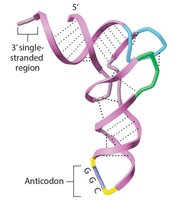
Transfer RNA (tRNA) acts as the "translator" between the nucleic acid code and the amino acid code. tRNA molecules have a characteristic stem-loop structure formed by hydrogen bonds between complementary bases, and a three-dimensional shape that allows them to interact with both mRNA and aminoacyl-tRNA synthetases.
Key Points:
The anticodon in tRNA recognizes the codon in mRNA via Watson-Crick base pairing.
The appropriate amino acid is attached to the 3' end of the tRNA.
Each tRNA is charged with its specific amino acid by a corresponding aminoacyl-tRNA synthetase.
Aminoacyl-tRNA Synthetase
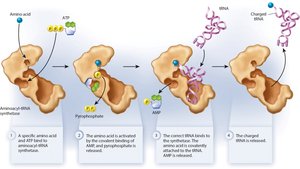
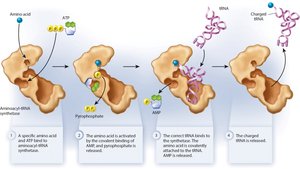
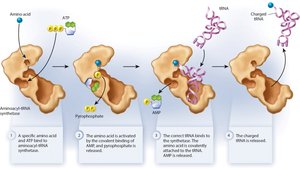
Aminoacyl-tRNA synthetases are enzymes that "charge" tRNAs with their correct amino acids. This process is highly specific and requires energy, usually from ATP.
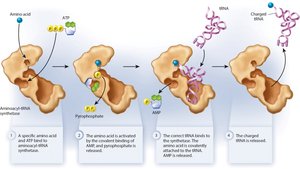
Key Points:
There are 20 different aminoacyl-tRNA synthetases, one for each amino acid.
The enzyme binds the amino acid, ATP, and the correct tRNA.
The amino acid is activated by attachment of AMP, then covalently linked to the tRNA's 3' end.
Accuracy is critical; errors can lead to incorrect protein synthesis.
Example: Alanyl-tRNA synthetase attaches alanine to tRNAs with anticodons for alanine codons.
Ribosome Structure and Function
The ribosome is the site of translation. It is composed of proteins and rRNA, organized into two subunits (small and large). In bacteria, these are the 30S and 50S subunits, which combine to form the 70S ribosome. In eukaryotes, the subunits are 40S and 60S, forming the 80S ribosome.
Type | Small Subunit | Large Subunit | Assembled Ribosome |
|---|---|---|---|
Bacterial | 30S | 50S | 70S |
Eukaryotic | 40S | 60S | 80S |
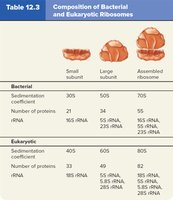
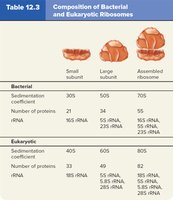
Key Points:
Ribosomes catalyze peptide bond formation between amino acids.
Ribosomes have three sites for tRNA binding: A (aminoacyl), P (peptidyl), and E (exit).
Ribosome structure differs between bacteria and eukaryotes, which is important for antibiotic specificity.
Stages of Translation
Translation occurs in three main stages: Initiation, Elongation, and Termination. Each stage requires specific protein factors and energy, usually from GTP hydrolysis.
Initiation: The ribosome assembles at the start codon of the mRNA. In bacteria, the ribosomal binding site aligns the mRNA and small ribosomal subunit via base pairing with 16S rRNA. In eukaryotes, the 5' cap promotes binding to the small subunit.
Elongation: Charged tRNAs enter the A site, peptide bonds are formed, and the ribosome translocates along the mRNA.
Termination: When a stop codon enters the A site, a release factor binds, causing the polypeptide and tRNA to be released and the ribosome to dissociate.
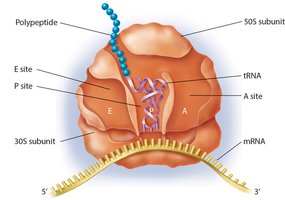
Example: The sequence 5’-AUAAGGAGGUUACG(AUG)(CAG)(CAG)(GGC)(UUU)(ACC)-3’ translates to Met-Gln-Gln-Gly-Phe-Thr.
Polysomes and Coupled Transcription-Translation
In bacteria, multiple ribosomes can translate a single mRNA simultaneously, forming a polysome. Transcription and translation are often coupled, allowing rapid protein synthesis.
Key Points:
Polysomes are also found in the cytosol of eukaryotes.
Translation is an energy-intensive process, primarily using GTP as the energy currency.
Importance of Ribosome Structure
Understanding ribosome structure is crucial because differences between bacterial and eukaryotic ribosomes allow antibiotics to selectively inhibit bacterial translation without affecting eukaryotic cells.
Key Points:
Some antibiotics target the bacterial ribosome.
This specificity is important for treating bacterial infections.
Summary Table: The Genetic Code
First Position | Second Position | Third Position | Amino Acid |
|---|---|---|---|
U | U | U | Phe |
A | U | G | Met (start) |
U | A | A | Stop |
G | G | C | Gly |
Summary Table: Components of the Translation Machinery
Component | Function |
|---|---|
mRNA | Contains amino acid sequence information |
tRNA | Transfers amino acids to ribosome |
Ribosome | Catalyzes peptide bond formation |
Translation factors | Facilitate translation stages |
Summary Table: Composition of Bacterial and Eukaryotic Ribosomes
Type | Small Subunit | Large Subunit | Assembled Ribosome |
|---|---|---|---|
Bacterial | 30S | 50S | 70S |
Eukaryotic | 40S | 60S | 80S |
Key Equations
Peptide Bond Formation:
Energy for tRNA Charging:
Energy for Translation:
Additional info: The notes have been expanded with academic context to ensure completeness and clarity for exam preparation.
