 Back
BackLEC 22:Translation: The Molecular Mechanism of Protein Synthesis
Study Guide - Smart Notes
 Tailored notes based on your materials, expanded with key definitions, examples, and context.
Translation: The Molecular Mechanism of Protein Synthesis
Introduction to Translation
Translation is the biological process by which the genetic code carried by messenger RNA (mRNA) is decoded to produce a specific sequence of amino acids, resulting in the synthesis of a polypeptide or protein. This process is fundamental to gene expression and is highly conserved across all domains of life.
Genetic Code: The genetic code is read in triplets (codons), each specifying a particular amino acid.
Key Experiment: Early experiments, such as those by Marshall Nirenberg, established the codon-to-amino acid relationships.
Central Dogma: Translation is the second major step in the central dogma of molecular biology: DNA → RNA → Protein.
Key Components of Translation
tRNAs (Transfer RNAs)
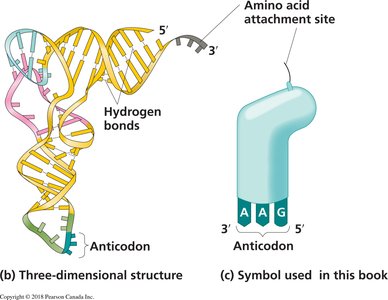
Transfer RNAs are adaptor molecules that interpret the genetic code in mRNA and bring the appropriate amino acids for protein synthesis. Each tRNA has a specific three-nucleotide anticodon that pairs with a complementary codon on the mRNA.
Structure: tRNAs are about 80 nucleotides long, fold into a cloverleaf secondary structure, and further into an L-shaped tertiary structure due to hydrogen bonding.
Amino Acid Attachment: Each tRNA has an amino acid attachment site at its 3' end.
Anticodon: The anticodon loop contains a sequence complementary and antiparallel to the mRNA codon, ensuring specificity in translation.
Aminoacyl-tRNA Synthetases
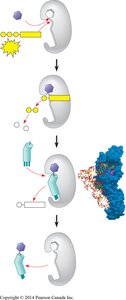
Aminoacyl-tRNA synthetases are enzymes that catalyze the attachment of amino acids to their corresponding tRNAs, a process known as tRNA charging. There are 20 different synthetases, one for each amino acid.
Specificity: Each synthetase recognizes a specific amino acid and its compatible tRNAs.
Reaction: The attachment of an amino acid to tRNA is an endergonic process, coupled to ATP hydrolysis.
Equation:
Ribosomes: The Enzymes of Translation
Ribosomes are large ribonucleoprotein complexes that facilitate the coupling of tRNA anticodons with mRNA codons and catalyze peptide bond formation. They consist of a large and a small subunit, each composed of ribosomal RNA (rRNA) and proteins.
Subunits: Eukaryotic ribosomes are 80S (60S + 40S), while prokaryotic ribosomes are 70S (50S + 30S).
Function: The small subunit binds mRNA, and the large subunit catalyzes peptide bond formation.
Antibiotic Target: Some antibiotics, such as streptomycin, specifically inhibit bacterial ribosomes.

Ribosome Binding Sites
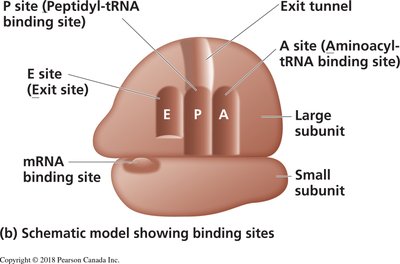
The ribosome has three binding sites for tRNA:
A site (Aminoacyl-tRNA site): Entry point for charged tRNA.
P site (Peptidyl-tRNA site): Holds the tRNA with the growing polypeptide chain.
E site (Exit site): Where discharged tRNAs leave the ribosome.
Mechanism of Translation
Initiation
Translation initiation involves the assembly of the ribosome, mRNA, and initiator tRNA. In prokaryotes, the small subunit binds to the Shine-Dalgarno sequence; in eukaryotes, it binds to the 5' cap and scans for the start codon (AUG).
Initiator tRNA: Carries methionine (Met) and pairs with the start codon.
Initiation Factors: Proteins and GTP hydrolysis are required for assembly.

Elongation
During elongation, amino acids are sequentially added to the growing polypeptide chain. This process involves codon recognition, peptide bond formation, and translocation.
Codon Recognition: Incoming aminoacyl-tRNA pairs with the mRNA codon in the A site.
Peptide Bond Formation: The ribosome's rRNA catalyzes the formation of a peptide bond between the amino group of the new amino acid and the carboxyl end of the growing chain.
Translocation: The ribosome moves along the mRNA, shifting tRNAs from A to P to E sites.
Equation for Peptide Bond Formation:

Termination
Termination occurs when a stop codon is encountered. A release factor binds to the A site, promoting hydrolysis of the bond between the polypeptide and the tRNA in the P site, releasing the completed protein.
Release Factor: Protein that mimics tRNA and triggers release of the polypeptide.
Disassembly: Ribosomal subunits and other components dissociate, ready for another round of translation.

Polyribosomes (Polysomes)
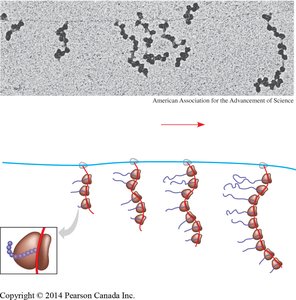
Multiple ribosomes can simultaneously translate a single mRNA molecule, forming a polyribosome. This increases the efficiency of protein synthesis.
Efficiency: Enables rapid production of many copies of a protein from a single mRNA.
Special Features and Regulation
Coupling of Transcription and Translation in Prokaryotes
In prokaryotes, transcription and translation are coupled, meaning translation can begin on an mRNA while it is still being transcribed. In eukaryotes, these processes are separated by the nuclear envelope.
Prokaryotes: Simultaneous transcription and translation.
Eukaryotes: Transcription in the nucleus, translation in the cytoplasm.
Protein Folding and Post-Translational Modifications
After synthesis, proteins fold into their functional three-dimensional shapes. Some require chaperone proteins for proper folding. Proteins may also undergo post-translational modifications, such as phosphorylation, glycosylation, or proteolytic cleavage, which regulate their activity, localization, or stability.
Chaperones: Assist in proper protein folding.
Phosphorylation: Addition of phosphate groups can activate or deactivate proteins.
Glycosylation: Addition of carbohydrate groups, important for protein targeting and function.
Proteolytic Processing: Cleavage of peptide bonds to activate or mature proteins (e.g., insulin activation).
Protein Targeting and Sorting
Proteins synthesized in the cytosol may contain signal peptides that direct them to specific cellular locations, such as the endoplasmic reticulum (ER), mitochondria, chloroplasts, or nucleus. The signal recognition particle (SRP) guides ribosomes to the ER for co-translational import of proteins into the endomembrane system.
Signal Peptides: Short amino acid sequences that determine the protein's destination.
SRP: Recognizes signal peptides and directs ribosome-mRNA complexes to the ER membrane.
Post-Translational Import: Some proteins are fully synthesized in the cytosol and then imported into organelles.
Summary Table: Key Steps and Components of Translation
Step | Main Components | Key Events |
|---|---|---|
Initiation | mRNA, small ribosomal subunit, initiator tRNA, initiation factors, GTP | Assembly of initiation complex, start codon recognition |
Elongation | Ribosome, charged tRNAs, elongation factors, GTP | Codon recognition, peptide bond formation, translocation |
Termination | Stop codon, release factor, ribosome, GTP | Release of polypeptide, disassembly of complex |
Additional info:
Ribozymes: The ribosome's peptidyl transferase activity is due to rRNA, not protein, classifying it as a ribozyme.
Wobble Position: Flexibility in base pairing at the third codon position allows some tRNAs to recognize multiple codons.
Antibiotic Sensitivity: Differences in ribosomal RNA between prokaryotes and eukaryotes are exploited by antibiotics to selectively inhibit bacterial translation.
