 Back
BackTranslation: The RNA-Directed Synthesis of Polypeptides
Study Guide - Smart Notes
 Tailored notes based on your materials, expanded with key definitions, examples, and context.
Translation: The RNA-Directed Synthesis of Polypeptides
Overview of Translation
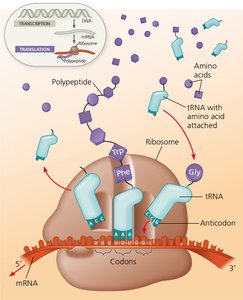
Translation is the process by which the genetic information encoded in messenger RNA (mRNA) is used to assemble a specific sequence of amino acids, forming a polypeptide. This process occurs in both prokaryotic and eukaryotic cells and is fundamental to gene expression.
Translation involves decoding the sequence of codons in mRNA to synthesize a polypeptide chain.
The main molecular players are mRNA, transfer RNA (tRNA), ribosomes, and various protein factors.
Each tRNA molecule carries a specific amino acid and recognizes specific codons on the mRNA through its anticodon.
Ribosomes facilitate the coupling of tRNA anticodons with mRNA codons and catalyze peptide bond formation.
Molecular Components of Translation
The translation machinery consists of several key components that work together to ensure accurate protein synthesis.
mRNA: Contains the codon sequence that determines the amino acid order.
tRNA: Acts as an adaptor, matching amino acids to their corresponding codons via its anticodon region.
Ribosome: Composed of rRNA and proteins, it has binding sites for mRNA and tRNAs and catalyzes peptide bond formation.
The Structure and Function of Transfer RNA (tRNA)
tRNA Structure and Function
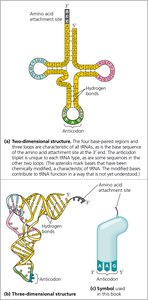
tRNA molecules are essential for translating the nucleotide language of mRNA into the amino acid language of proteins. Each tRNA has a specific three-dimensional structure that enables its function.
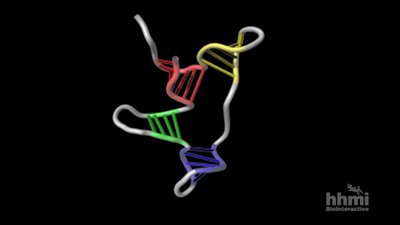
tRNA is a single RNA strand (~80 nucleotides) that folds into a cloverleaf structure with complementary base pairing.
The anticodon loop contains a triplet of bases that pairs with the complementary mRNA codon.
The 3' end of the tRNA is the attachment site for a specific amino acid.
tRNAs are transcribed from DNA and are reused multiple times during translation.
Aminoacyl-tRNA Synthetases: Charging tRNA
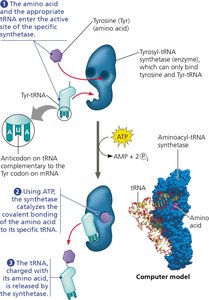
The correct matching of tRNA and amino acid is catalyzed by enzymes called aminoacyl-tRNA synthetases. There are 20 different synthetases, one for each amino acid.
The enzyme binds a specific amino acid and its corresponding tRNA.
Using ATP, the enzyme catalyzes the covalent attachment of the amino acid to the tRNA, forming an aminoacyl-tRNA (charged tRNA).
This process ensures the fidelity of translation.
Wobble and Codon Recognition
Some tRNAs can recognize more than one codon due to flexible base pairing at the third codon position, a phenomenon known as wobble.
Wobble allows a single tRNA to pair with multiple codons that code for the same amino acid.
This explains why there are fewer tRNAs than codons.
The Structure and Function of Ribosomes
Ribosome Structure and Function
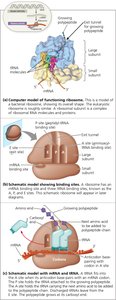
Ribosomes are the molecular machines that coordinate the interaction between mRNA and tRNA during protein synthesis.
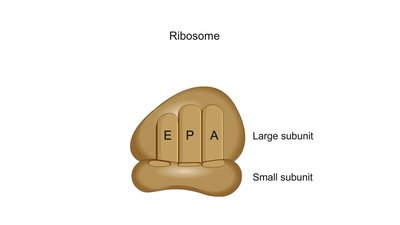
Each ribosome consists of a large and a small subunit, each made of rRNA and proteins.
Ribosomes have three binding sites for tRNA: the A (aminoacyl), P (peptidyl), and E (exit) sites.
rRNA is the main catalytic component, acting as a ribozyme to form peptide bonds.
Ribosome Binding Sites on mRNA
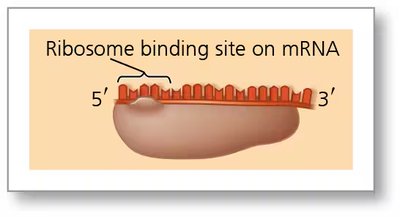
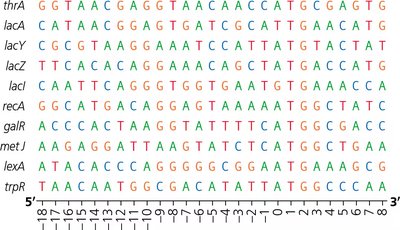
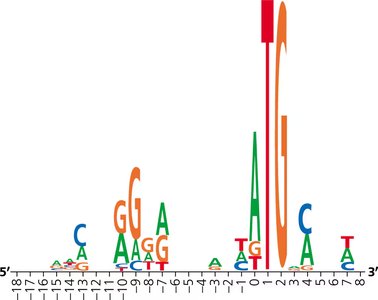
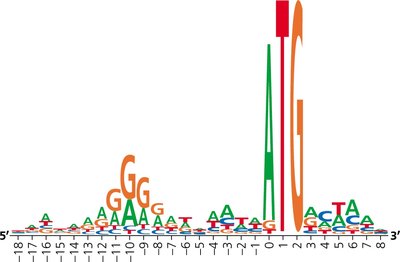
Ribosomes recognize and bind to specific sequences on mRNA to initiate translation. In bacteria, this is often a conserved sequence upstream of the start codon.
Sequence logos can be used to visualize conserved ribosome binding sites across multiple genes.
Stages of Translation
Initiation
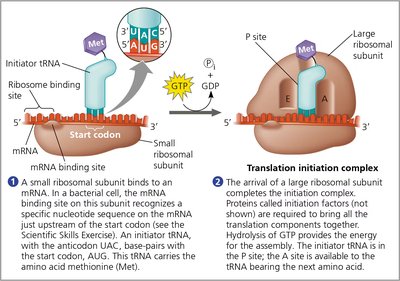
Translation initiation brings together mRNA, a tRNA carrying the first amino acid (methionine), and the ribosomal subunits.
In bacteria, the small subunit binds to the mRNA and initiator tRNA at a specific sequence near the start codon (AUG).
In eukaryotes, the small subunit binds to the 5' cap and scans for the start codon.
Initiation factors and GTP hydrolysis are required for assembly of the initiation complex.
Elongation
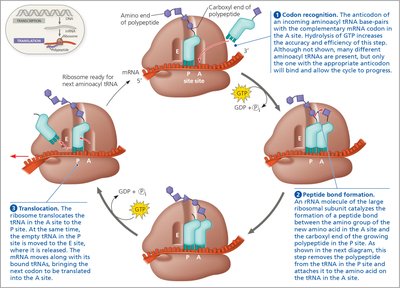
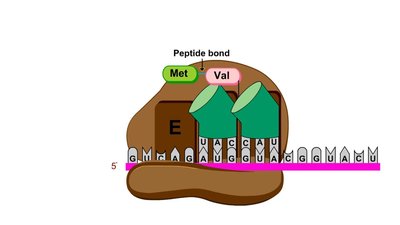
During elongation, amino acids are added one by one to the growing polypeptide chain. This process involves three main steps: codon recognition, peptide bond formation, and translocation.
Codon recognition: The tRNA anticodon pairs with the mRNA codon in the A site.
Peptide bond formation: The ribosome catalyzes the formation of a peptide bond between the new amino acid and the growing chain.
Translocation: The ribosome moves along the mRNA, shifting the tRNAs from the A to P to E sites.
Energy from GTP hydrolysis is used in codon recognition and translocation.
Termination
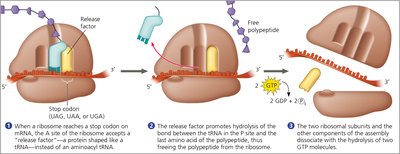
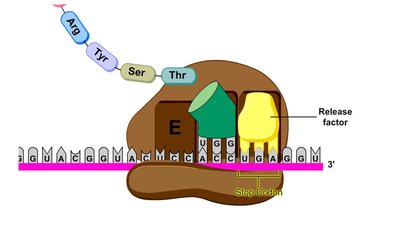
Termination occurs when a stop codon (UAG, UAA, or UGA) is encountered in the mRNA. A release factor binds to the stop codon, causing the addition of a water molecule and releasing the completed polypeptide.
The translation complex disassembles, requiring additional GTP hydrolysis.
Protein Folding and Post-Translational Modifications
Protein Folding
As the polypeptide is synthesized, it folds into its functional three-dimensional structure, determined by its amino acid sequence.
Folding may occur spontaneously or with the help of chaperone proteins.
Post-Translational Modifications
After translation, proteins may undergo modifications such as cleavage, addition of chemical groups (e.g., sugars, phosphates), or assembly into multi-subunit complexes.
These modifications are essential for the protein's final function and localization.
Targeting Polypeptides to Specific Locations
Protein Targeting and the Signal Peptide
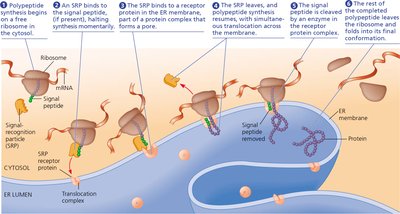
Proteins destined for specific cellular locations contain signal peptides that direct them to the appropriate compartment, such as the endoplasmic reticulum (ER) in eukaryotes.
The signal-recognition particle (SRP) binds the signal peptide and directs the ribosome to the ER membrane.
Proteins are then translocated into the ER lumen or membrane for further processing and sorting.
Polyribosomes and Coupled Transcription-Translation
Polyribosomes (Polysomes)
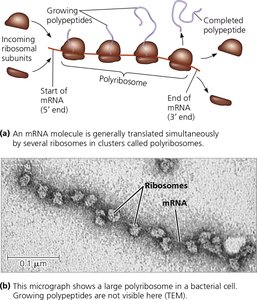
Multiple ribosomes can simultaneously translate a single mRNA molecule, forming a structure called a polyribosome or polysome. This increases the efficiency of protein synthesis.
Polyribosomes can be free in the cytosol or bound to the ER.
Coupled Transcription and Translation in Bacteria
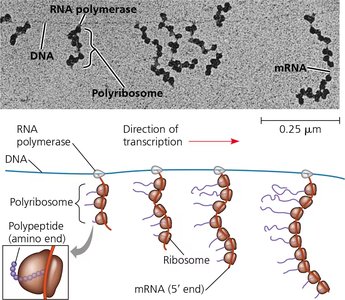
In prokaryotes, transcription and translation are coupled, meaning translation can begin on an mRNA while it is still being transcribed. This is possible due to the lack of a nuclear envelope.
This allows for rapid protein production in response to environmental changes.
Summary of Transcription and Translation in Eukaryotes
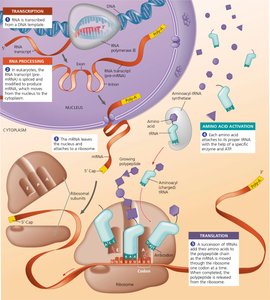
In eukaryotic cells, transcription occurs in the nucleus, and the resulting pre-mRNA undergoes processing before being exported to the cytoplasm for translation.
RNA processing includes capping, polyadenylation, and splicing.
Translation occurs in the cytoplasm, separated from transcription by the nuclear envelope.
Key Concepts and Review Questions
What two processes ensure that the correct amino acid is added to a growing polypeptide chain?
How does rRNA structure contribute to ribosomal function?
Describe how a polypeptide destined for secretion is transported to the endomembrane system.
Given the anticodon 3'-CGU-5', what codons could it bind to, considering wobble?
