 Back
BackTransport Systems in Vascular Plants: Xylem, Phloem, and Stomatal Regulation
Study Guide - Smart Notes
 Tailored notes based on your materials, expanded with key definitions, examples, and context.
Vascular Tissue Systems in Plants
Xylem Structure and Function
The xylem is a vascular tissue responsible for the long-distance transport of water and dissolved minerals from roots to shoots. It consists of specialized cells adapted for efficient water conduction and structural support.
Vessels: Continuous tubes formed by dead, cylindrical vessel elements arranged end-to-end. They are generally shorter and wider than tracheids, with perforation plates at their ends to facilitate water flow.
Tracheids: Elongated, dead cells that taper at the ends and overlap. Water moves through pits in their cell walls, allowing lateral movement between cells.
Both cell types are reinforced with lignin, providing mechanical strength.
Additional xylem components include fibers (for support) and parenchyma cells (for storage and lateral transport).
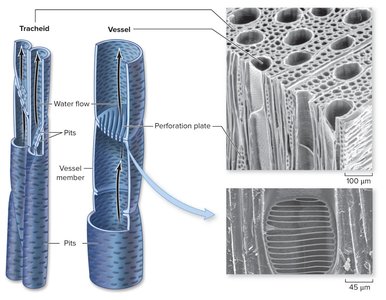
Example: Angiosperms typically have both vessels and tracheids, while gymnosperms mainly have tracheids.
Phloem Structure and Function
The phloem is responsible for transporting organic nutrients, primarily sucrose, throughout the plant. It consists of living cells specialized for efficient translocation of food substances.
Sieve cells: Found in seedless vascular plants and gymnosperms; elongated cells with sieve areas for transport.
Sieve tube members: Found in angiosperms; more specialized and efficient, connected end-to-end by sieve plates.
Companion cells: Associated with sieve tube members, performing metabolic functions necessary for sieve tube maintenance.
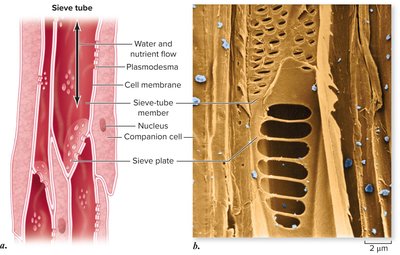
Example: Sieve tube members lack nuclei at maturity and rely on companion cells for essential functions.
Stem Cross-Section: Vascular Bundle Organization
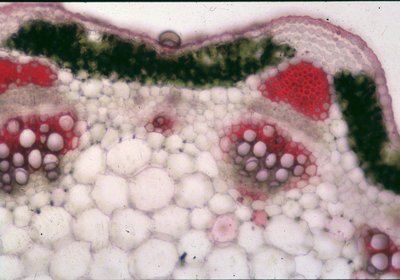
In a typical stem cross-section, vascular bundles contain both xylem and phloem tissues, surrounded by ground tissue (cortex and pith) and covered by the epidermis.
Xylem: Located toward the center of the stem.
Phloem: Located toward the outside, near the cortex.
Pith: Central region composed of parenchyma cells.
Cortex: Region between the vascular bundles and the epidermis.
Stomatal Regulation and Water Loss
Stomata: Structure and Function
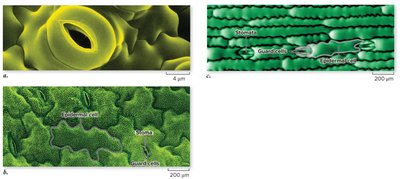
Stomata are microscopic pores on the leaf surface, flanked by two guard cells. They regulate gas exchange (CO2 in, O2 out) and water vapor loss (transpiration).
Guard cells change shape to open or close the pore, controlling transpiration and gas exchange.
Stomatal density and distribution vary among plant species and environments.
Mechanism of Stomatal Opening and Closing
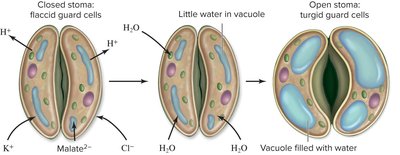
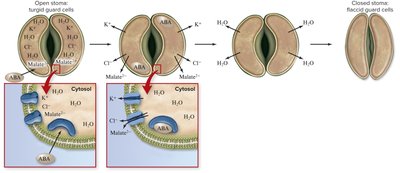
Stomatal movement is driven by changes in guard cell turgor pressure, regulated by ion transport and water movement.
Opening: Blue light stimulates K+ uptake by guard cells, water follows by osmosis, and cells become turgid, opening the pore.
Closing: Abscisic acid (ABA) triggers ion efflux (K+, Cl-, malate2-), water exits, and guard cells become flaccid, closing the pore.
Stomata close under high CO2 concentration, high temperature, or water stress.
Example: CAM plants open stomata at night to minimize water loss in arid environments.
Long-Distance Transport in Plants
Water Transport: Cohesion-Tension Mechanism
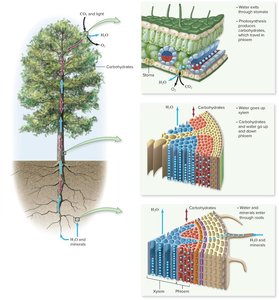
Water and dissolved minerals move from roots to leaves through the xylem, primarily driven by transpiration and the cohesion-tension mechanism.
Transpiration pull: Evaporation of water from leaf surfaces creates negative pressure, pulling water upward.
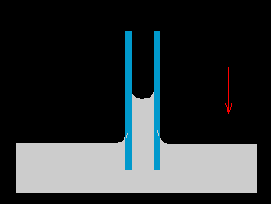
Cohesion: Water molecules stick together via hydrogen bonds.
Adhesion: Water molecules adhere to xylem walls, aiding upward movement.
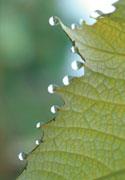
Root Pressure: At night, osmotic pressure can push water up the xylem, resulting in guttation (exudation of water droplets from leaf margins).
Phloem Transport: Pressure-Flow Hypothesis
The pressure-flow hypothesis explains the movement of sugars in the phloem from sources (e.g., leaves) to sinks (e.g., roots, fruits, growing tissues).
Phloem loading: Sucrose is actively transported into sieve tubes at the source, lowering water potential and causing water to enter by osmosis, generating turgor pressure.
Translocation: The pressure difference drives the flow of phloem sap toward sinks, where sucrose is unloaded and water exits.
Direction of flow is variable, depending on source-sink relationships.
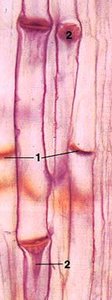
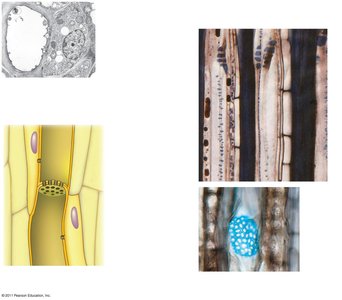
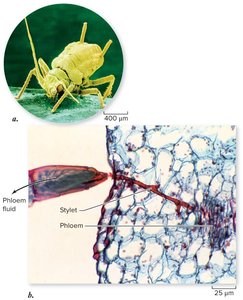
Table: Main Components of Phloem Sap (Ricinus communis)
Component | Concentration (mg/ml or mM) |
|---|---|
Sugars | 80–106 mg/ml |
Amino acids | 5.2 mg/ml |
Organic acids | 2.0–3.2 mg/ml |
Protein | 1.45–2.20 mg/ml |
K+ | 2.3–4.4 mM |
Cl- | 0.355–0.675 mM |
H2PO4- | 0.350–0.550 mM |
Mg2+ | 0.109–0.122 mM |
Example: Aphids are used experimentally to collect and analyze phloem sap, confirming the composition and flow direction.
Summary Table: Comparison of Xylem and Phloem
Feature | Xylem | Phloem |
|---|---|---|
Main Function | Water and mineral transport | Transport of organic nutrients |
Main Cell Types | Tracheids, vessel elements | Sieve tube members, companion cells |
Cell Status | Dead at maturity | Living at maturity |
Direction of Flow | Unidirectional (roots to shoots) | Bidirectional (source to sink) |
Driving Force | Transpiration pull, root pressure | Pressure-flow (turgor pressure) |
Key Equations
Water Potential (\( \Psi \)): where is solute potential and is pressure potential.
Pressure-Flow Model: Flow rate () is proportional to the pressure difference () divided by resistance ():
Additional info: This guide covers core concepts from "Ch. 36 - Resource Acquisition and Transport in Vascular Plants" and integrates relevant details from plant physiology and anatomy.
