Back
Triglycerides, Lipids, and Phospholipids: Structure and Properties
Study Guide - Smart Notes
 Tailored notes based on your materials, expanded with key definitions, examples, and context.
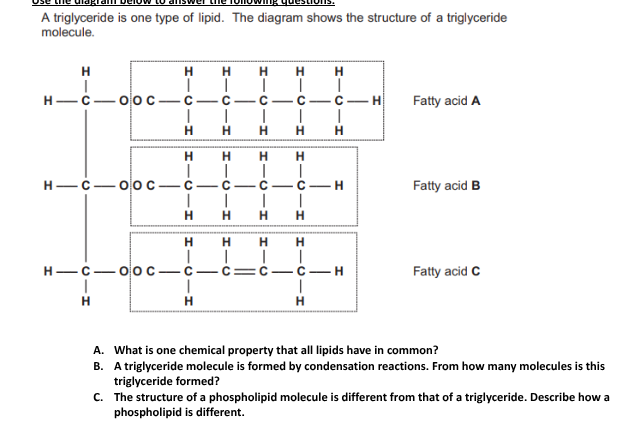
Q1. What is one chemical property that all lipids have in common?
Background
Topic: Lipid Chemistry
This question is testing your understanding of the general chemical properties that define lipids as a class of biological molecules.
Key Terms:
Lipid: A diverse group of hydrophobic or amphipathic molecules, including fats, oils, waxes, and certain vitamins.
Hydrophobic: Repelled by water; does not dissolve in water.
Step-by-Step Guidance
Recall the main characteristic that unites all lipids, despite their structural diversity.
Think about how lipids interact with water and why this property is important for their biological function.
Consider the molecular structure of lipids and what feature makes them behave this way in aqueous environments.
Try solving on your own before revealing the answer!
Final Answer:
All lipids are hydrophobic, meaning they do not dissolve in water. This is due to their long hydrocarbon chains or nonpolar regions, which make them insoluble in polar solvents like water.
Q2. A triglyceride molecule is formed by condensation reactions. From how many molecules is this triglyceride formed?
Background
Topic: Lipid Synthesis (Triglyceride Formation)
This question is about the process by which triglycerides are synthesized from their building blocks through condensation (dehydration synthesis) reactions.
Key Terms and Concepts:
Triglyceride: A lipid molecule made from one glycerol and three fatty acids.
Condensation Reaction: A chemical reaction where two molecules combine, releasing a small molecule (often water).
Step-by-Step Guidance
Identify the two types of molecules that combine to form a triglyceride.
Count how many of each type are needed to build one triglyceride molecule.
Remember that each fatty acid attaches to the glycerol backbone via a condensation reaction, releasing water.
Add up the total number of molecules (glycerol + fatty acids) that are required as reactants to form one triglyceride.
Try solving on your own before revealing the answer!
Final Answer:
A triglyceride is formed from four molecules: one glycerol molecule and three fatty acid molecules. Each fatty acid joins to the glycerol by a condensation reaction, releasing water.
Q3. The structure of a phospholipid molecule is different from that of a triglyceride. Describe how a phospholipid is different.
Background
Topic: Lipid Structure (Triglycerides vs. Phospholipids)
This question asks you to compare the structure of triglycerides and phospholipids, two important classes of lipids, and identify the key structural difference.
Key Terms and Concepts:
Triglyceride: Composed of one glycerol and three fatty acids.
Phospholipid: Composed of one glycerol, two fatty acids, and a phosphate group (often with an additional polar group attached).
Step-by-Step Guidance
Recall the basic structure of a triglyceride (glycerol + 3 fatty acids).
Think about what is replaced or added in a phospholipid compared to a triglyceride.
Consider the functional significance of this structural difference, especially in terms of polarity and biological function.
Describe the main structural change that distinguishes a phospholipid from a triglyceride.
Try solving on your own before revealing the answer!
Final Answer:
In a phospholipid, one of the three fatty acids of a triglyceride is replaced by a phosphate group (which is often linked to another polar group). This gives phospholipids a hydrophilic (water-attracting) head and two hydrophobic (water-repelling) tails, making them essential for forming cell membranes.