 Back
Unit 1: Chemistry of Life – General Biology Study Notes
Study Guide - Smart Notes
 Tailored notes based on your materials, expanded with key definitions, examples, and context.
Chemistry of Life
Properties of Water
Water is a unique molecule essential for life, exhibiting several important properties due to its polarity and hydrogen bonding.
Polarity: Water molecules have a partial positive charge on hydrogen and a partial negative charge on oxygen, leading to hydrogen bonding.
Cohesion: Water molecules stick to each other, enabling surface tension.
Adhesion: Water molecules stick to other substances, aiding capillary action.
Evaporative Cooling: As water evaporates, it removes heat, helping organisms regulate temperature.
Resistance to Temperature Change: Water has a high specific heat, stabilizing environmental and cellular temperatures.
Less Dense as Solid: Ice floats because hydrogen bonds form a lattice, making it less dense than liquid water.
Characteristics of Life
All living organisms share fundamental characteristics:
Growth and Development
Cellular Organization: Made of one or more cells
Reproduction
Homeostasis: Maintaining internal balance
Biomolecules
Dehydration Synthesis and Hydrolysis
Biomolecules are assembled and broken down through two key reactions:
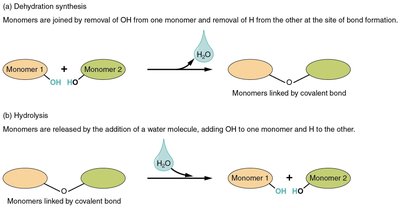
Dehydration Synthesis: Monomers are joined by removing water, forming covalent bonds. This is an anabolic, endergonic process.
Hydrolysis: Polymers are broken down by adding water, splitting covalent bonds. This is a catabolic, exergonic process.
Carbohydrates
Carbohydrates are energy sources and structural molecules, composed of carbon, hydrogen, and oxygen.
Monomers: Monosaccharides (e.g., glucose, galactose, fructose)
Dimers: Disaccharides (e.g., lactose, sucrose, maltose)
Polymers: Polysaccharides (e.g., amylose/starch, chitin, cellulose)
Bonds: Glycosidic bonds (covalent)
Structure: May be linear or branched
Proteins
Proteins are diverse biomolecules made of amino acids, performing structural, enzymatic, and regulatory functions.
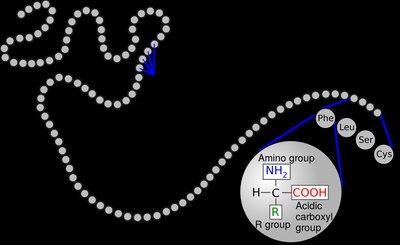
Monomer: Amino acid (20 types)
Polymer: Polypeptide chain
Bonds: Peptide bonds (covalent)
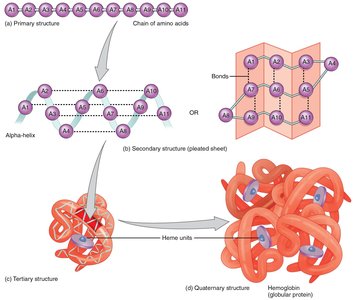
Structure Levels:
Primary: Sequence of amino acids, determined by DNA
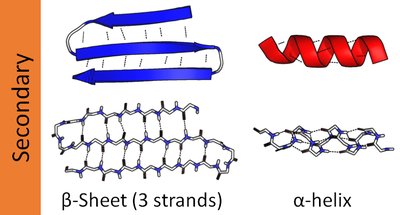
Secondary: Hydrogen bonding forms α-helices and β-sheets
Tertiary: R-group interactions create 3D structure, functional for many proteins
Quaternary: Multiple polypeptides combine, forming larger functional proteins
Lipids
Lipids are nonpolar molecules important for energy storage, membrane structure, and signaling.
Composition: Carbon, hydrogen, oxygen
No true monomers: Large molecules (fats, oils, phospholipids, sterols)
Fats and Oils:
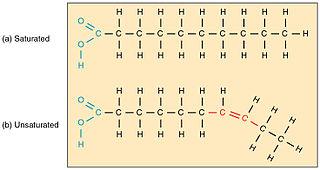
Saturated: All single bonds between carbons
Unsaturated: One or more double bonds between carbons
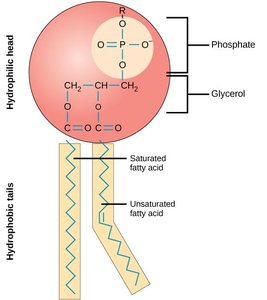
Phospholipids: Amphipathic (hydrophilic head, hydrophobic tails), major component of cell membranes
Sterols: Cholesterol, steroids, lipid hormones
Nucleic Acids
Nucleic acids store and transmit genetic information. They are polymers of nucleotides.
Composition: Phosphorus, oxygen, nitrogen, carbon, hydrogen
Bonds: Phosphodiester bonds (covalent)
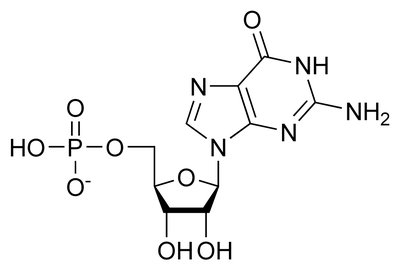
Monomer: Nucleotide (sugar, phosphate group, nitrogenous base)
Polymer: DNA or RNA
Directionality: 5' to 3'; DNA is antiparallel
Types:
DNA: Deoxyribose sugar, bases: adenine, guanine, thymine, cytosine, double-stranded
RNA: Ribose sugar, bases: adenine, guanine, uracil, cytosine, single-stranded
Enzymes
Structure and Function
Enzymes are proteins that act as biological catalysts, speeding up chemical reactions by lowering activation energy.
Active Site: Specific region where substrate binds
Denaturation: Loss of structure and function due to heat, pH, or salinity changes
Reaction Rate: Influenced by temperature, pH, enzyme concentration, substrate concentration, and inhibitors
Inhibitors:
Competitive: Bind to active site, blocking substrate
Noncompetitive (Allosteric): Bind elsewhere, changing enzyme shape
Cell (Plasma) Membrane
Structure and Function
The cell membrane is a selectively permeable barrier composed mainly of phospholipids, proteins, and other molecules.
Phospholipid Bilayer: Hydrophilic heads face outward, hydrophobic tails inward
Transport:
Small polar and nonpolar molecules: Can diffuse through membrane
Larger polar molecules and ions: Require specific transport proteins
Other Components:
Glycoproteins and glycolipids: Cell recognition
Cholesterol: Membrane fluidity
Receptor proteins: Cell signaling
Membrane Transport
Cells move substances across membranes via passive and active transport.
Passive Transport: No energy required
Simple Diffusion: Molecules move from high to low concentration
Facilitated Diffusion: Uses membrane proteins, still high to low concentration
Osmosis: Water moves from high to low concentration (toward higher solute)
Active Transport: Requires ATP
Pumping: Molecules move from low to high concentration
Endocytosis: Bulk transport into cell (phagocytosis: "cell eating", pinocytosis: "cell drinking")
Exocytosis: Bulk transport out of cell
Osmosis and Water Potential
Osmosis is the movement of water across membranes, driven by differences in solute concentration.
Hypertonic: Higher solute, less water
Hypotonic: Lower solute, more water
Isotonic: Equal solute and water
Water Potential: Calculated using formulas (see formula sheet)
Laboratory Applications
Enzyme Lab
Factors affecting enzyme activity include:
Temperature
pH
Salinity
Enzyme concentration
Substrate concentration
Inhibitors (competitive and non-competitive)
Osmosis/Diffusion Lab
Key concepts:
Calculating water potential
Molecules move from high to low concentration without energy
Key Equations
Dehydration Synthesis:
Hydrolysis:
Summary Table: Biomolecule Comparison
Biomolecule | Monomer | Bond Type | Main Function |
|---|---|---|---|
Carbohydrate | Monosaccharide | Glycosidic | Energy, structure |
Protein | Amino acid | Peptide | Structure, enzymes |
Lipid | None (fatty acids, glycerol) | None (ester) | Energy, membranes |
Nucleic Acid | Nucleotide | Phosphodiester | Genetic info |
Additional info: Academic context was added to clarify and expand brief points, ensuring completeness and self-contained explanations for exam preparation.
