 Back
Unit 1: Introduction to Biology and Basic Chemistry
Study Guide - Smart Notes
 Tailored notes based on your materials, expanded with key definitions, examples, and context.
Defining Biology and Properties of Life
What is Biology?
Biology is the scientific study of life. Biologists seek to understand what distinguishes living things from nonliving matter by examining the properties common to all life forms.
Order: Living things exhibit complex but ordered organization.
Reproduction: Organisms reproduce their own kind.
Growth & Development: Inherited information carried by genes controls the pattern of growth and development.
Energy Processing: Organisms take in energy and use it to power all their activities.
Maintaining Homeostasis: Living things regulate their internal environment to maintain a stable, constant condition.
Response to Environment: Organisms respond to environmental stimuli.
Evolutionary Adaptations: Traits that enhance survival and reproductive success are passed on to future generations.

Example: A Venus flytrap closing on a fly demonstrates response to environment, a property of life.

Example: Animals growing thicker fur in winter and shedding in summer is an adaptation to environmental changes (evolutionary adaptation and response to environment).
Levels of Biological Organization
Life is organized in a hierarchy, from the smallest chemical building blocks to the entire biosphere. Each level has emergent properties that arise from the interactions among components at the lower levels.
Atom → Molecule → Macromolecule → Organelle → Cell → Tissue → Organ → Organ System → Organism → Population → Community → Ecosystem → Biosphere
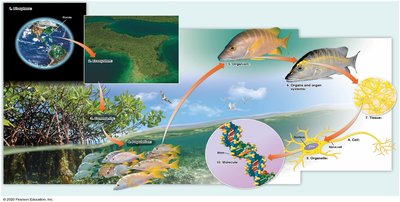
Emergent Properties: New characteristics that arise at each level due to the arrangement and interactions of parts as complexity increases. For example, the movement of a fish’s fins results from the coordinated action of nerves and muscles.
Biotic vs. Abiotic
Biotic factors are living or once-living components in an environment, while abiotic factors are nonliving physical and chemical elements.
Biotic: Plants, animals, fungi, bacteria
Abiotic: Water, sunlight, minerals, temperature
Viruses: Are They Alive?
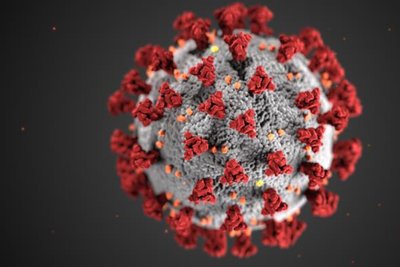
Viruses, such as SARS-CoV-2 (the virus that causes COVID-19), challenge the definition of life. They possess genetic material and evolve but lack cellular structure and cannot reproduce independently, so they are generally not considered alive.
Controlled Experiments and Scientific Method
A controlled experiment compares an experimental group with a control group. Only one independent variable is tested at a time, while dependent variables (data) are measured. This approach helps isolate the effect of the variable being tested.
Hypothesis: A testable explanation for an observation.
Scientific Theory: A broad explanation supported by a large body of evidence.
The Three Domains of Life
All living organisms are classified into three domains:
Bacteria
Archaea
Eukarya (includes kingdoms: Plantae, Fungi, Animalia, and Protists)
Evolution: The Core Theme of Biology
Evolution explains both the unity and diversity of life. It is the process of change that has transformed life on Earth, resulting in the adaptation of organisms to their environments over time. Natural selection is the mechanism by which evolution occurs.
Natural Selection: Individuals with traits best suited to their environment are more likely to survive and reproduce.
Information Flow: DNA and Heredity
DNA (deoxyribonucleic acid) is the molecule responsible for heredity and for programming the activities of a cell by providing instructions for making proteins. The flow of genetic information is central to all life processes.
Structure and Function in Biology
There is a close relationship between structure and function at all levels of biological organization. For example, the shape of a protein determines its function, and the structure of nerve cells enables them to transmit signals over long distances.
Basic Chemistry for Biology
Elements, Compounds, and Atoms
All matter is composed of chemical elements. Living organisms are primarily made of a few key elements, with CHNOPS (carbon, hydrogen, nitrogen, oxygen, phosphorus, sulfur) making up 99% of the human body. The remaining elements are called trace elements.
Element: A substance that cannot be broken down into other substances by chemical means.
Compound: A substance consisting of two or more different elements in a fixed ratio (e.g., NaCl).
Atomic Structure
An atom is the smallest unit of matter that retains the properties of an element. Atoms are composed of three subatomic particles:
Protons: Positively charged, found in the nucleus
Neutrons: Neutral, found in the nucleus
Electrons: Negatively charged, orbit the nucleus
The atomic number is the number of protons, and the mass number is the sum of protons and neutrons.
Isotopes
Isotopes are atoms of the same element with different numbers of neutrons. Some isotopes are radioactive and can be used in biological research and medicine.
Electron Shells and Chemical Bonds
Electrons occupy specific energy levels called shells. Atoms with incomplete outer shells tend to form chemical bonds to achieve stability.
Covalent Bonds: Atoms share electrons. Can be nonpolar (equal sharing) or polar (unequal sharing).
Ionic Bonds: Atoms transfer electrons, resulting in oppositely charged ions that attract each other.
Hydrogen Bonds: Weak attractions between a hydrogen atom in one molecule and an electronegative atom in another (important in water and DNA structure).
Chemical Reactions
Chemical reactions involve the making and breaking of chemical bonds, resulting in the rearrangement of atoms. Reactants are transformed into products. Matter is neither created nor destroyed in chemical reactions (Law of Conservation of Mass).
Properties of Water
Unique Properties of Water
Water is essential for life due to its unique properties, which arise from its polar covalent bonds and ability to form hydrogen bonds.
Cohesion: Water molecules stick to each other (important for transport in plants).
Adhesion: Water molecules stick to other substances.
Surface Tension: The measure of how difficult it is to break the surface of a liquid.
High Heat Capacity: Water can absorb a lot of heat before changing temperature.
Evaporative Cooling: As water evaporates, it cools the surface left behind.
Density: Water is less dense as a solid (ice) than as a liquid, allowing ice to float.
Solutions, Solutes, and Solvents
A solution is a homogeneous mixture of two or more substances. The solvent is the dissolving agent (water is the universal solvent), and the solute is the substance being dissolved. Water’s polarity allows it to dissolve many substances, forming aqueous solutions.
Acids, Bases, and pH
The pH scale measures how acidic or basic a solution is (0-6 acidic, 7 neutral, 8-14 basic). A buffer is a substance that minimizes changes in pH. In water, a small fraction of molecules dissociate into ions, affecting pH.
Ocean Acidification
Rising atmospheric CO2 from fossil fuel combustion is absorbed by oceans, lowering pH in a process called ocean acidification. This threatens coral reefs and marine life by altering the chemistry of seawater.
Summary Table: Types of Chemical Bonds
Bond Type | Description | Relative Strength | Example |
|---|---|---|---|
Covalent | Atoms share electrons | Strongest | H2O, O2 |
Ionic | Atoms transfer electrons, forming ions | Strong (in dry conditions) | NaCl |
Hydrogen | Attraction between H and electronegative atom | Weak | Between water molecules, DNA strands |
Key Concepts to Master
Seven properties common to all life
Levels of biological organization and emergent properties
Difference between hypothesis and scientific theory
Structure of a controlled experiment
Process and products of natural selection
How DNA determines structure and function
Relationship between structure and function in biology
Importance of chemical elements and compounds
Structure of an atom and types of chemical bonds
Properties of water and their biological significance
pH scale and effects of acid/base solutions
Impact of rising CO2 on coral reefs
