 Back
Unit 2 General Biology Vocabulary & Study Guide
Study Guide - Smart Notes
 Tailored notes based on your materials, expanded with key definitions, examples, and context.
Chapter 1: Levels of Biological Organization & Scientific Method
Levels of Organization
The biological world is organized into hierarchic
al levels, each with distinct characteristics and functions.
Cell: The basic unit of life; all living organisms are composed of cells.
Tissues: Groups of similar cells working together to perform a specific function.
Organs: Structures composed of multiple tissue types that carry out particular tasks.
Organ Systems: Groups of organs that work together to perform complex functions.
Population: All members of a species living in a given area.
Community: All populations of different species living and interacting in an area.
Ecosystem: The community plus the nonliving environmental factors.
Producers, Consumers, and Homeostasis
Producer: Organisms (like plants) that make their own food via photosynthesis.
Consumer: Organisms that obtain energy by eating other organisms.
Homeostasis: The maintenance of stable internal conditions despite external changes.
Domains of Life
Bacteria: Single-celled prokaryotes with simple cell structure.
Archaea: Prokaryotes distinct from bacteria, often found in extreme environments.
Prokaryote: Cells lacking a nucleus (includes Bacteria and Archaea).
Eukaryote: Cells with a nucleus and membrane-bound organelles (includes protists, plants, fungi, animals).
Protist: Mostly single-celled eukaryotes.
Plant: Multicellular, photosynthetic eukaryotes.
Fungus/Fungi: Eukaryotes that absorb nutrients from their environment.
Animal: Multicellular eukaryotes that consume other organisms.
Scientific Method & Experimental Design
The scientific method is a systematic approach to inquiry in biology.
Hypothesis: A testable explanation for an observation.
Experiment: A controlled procedure to test a hypothesis.
Theory: A well-supported explanation of natural phenomena.
Control Group: The group in an experiment that does not receive the experimental treatment.
Experimental Group: The group that receives the treatment.
Sampling Error: The difference between results from a sample and the population.
Independent Variable: The factor manipulated by the experimenter.
Dependent Variable: The factor measured in response to changes in the independent variable.
Chapter 2: Chemistry of Life
Atoms and Elements
Atoms are the fundamental units of matter, composed of subatomic particles.
Atom: The smallest unit of an element.
Protons: Positively charged particles in the nucleus.
Neutrons: Neutral particles in the nucleus.
Electrons: Negatively charged particles orbiting the nucleus.
Nucleus: The central part of the atom containing protons and neutrons.
Atomic Number: Number of protons in an atom.
Elements: Pure substances consisting of only one type of atom.
Isotopes: Atoms of the same element with different numbers of neutrons.
Mass Number: Sum of protons and neutrons in an atom.
Radioactive Decay: The process by which unstable isotopes lose energy.
Bonding and Molecules
Shell Model (Bohr Model): Describes electron arrangement in energy levels.
Ion: Atom or molecule with a net charge due to loss or gain of electrons.
Molecule: Two or more atoms bonded together.
Ionic Bond: Attraction between oppositely charged ions.
Covalent Bond: Sharing of electron pairs between atoms.
Nonpolar Covalent Bond: Equal sharing of electrons.
Polar Covalent Bond: Unequal sharing of electrons, creating partial charges.
Polarity: Distribution of electrical charge over a molecule.
Hydrogen Bond: Weak attraction between a hydrogen atom and another electronegative atom.
Properties of Water
Solvent: Substance that dissolves other substances (water is the universal solvent).
Solutes: Substances dissolved in a solvent.
Hydrophilic: Water-loving; dissolves easily in water.
Hydrophobic: Water-fearing; does not dissolve in water.
Cohesion: Attraction between molecules of the same substance (water molecules stick together).
Acids, Bases, and pH
Hydrogen Ions (H+): Increase acidity.
Hydroxide Ions (OH-): Increase basicity.
pH: Measure of hydrogen ion concentration; scale from 0 (acidic) to 14 (basic).
Acids/Acidic: Substances with pH less than 7.
Bases/Basic: Substances with pH greater than 7.
Salt: Compound formed from the reaction of an acid and a base.
Buffer System: Maintains stable pH in biological systems.
Chapter 3: Biomolecules
Organic Molecules & Functional Groups
Organic molecules contain carbon and are essential for life. Functional groups determine their properties.
Organic: Molecules containing carbon.
Functional Group: Specific group of atoms within a molecule that determines its chemical behavior.
Hydroxyl Group: -OH group found in alcohols.
Carboxyl Group: -COOH group found in acids.
Amine Group: -NH2 group found in amino acids.
Phosphate Group: -PO4 group found in nucleotides.
Polymer Formation & Breakdown
Condensation: Reaction that joins monomers, releasing water.
Hydrolysis: Reaction that breaks polymers into monomers using water.
Polymers: Large molecules made of repeating units (monomers).
Carbohydrates
Carbohydrate: Molecules composed of carbon, hydrogen, and oxygen; main energy source.
Sugar: Simple carbohydrates.
Monosaccharides: Single sugar units (e.g., glucose).
Disaccharide: Two monosaccharides joined (e.g., sucrose).
Polysaccharide: Many monosaccharides linked (e.g., starch, cellulose, glycogen, chitin).
Lipids
Lipids: Hydrophobic molecules including fats, oils, and steroids.
Fatty Acid: Building block of lipids.
Fats: Triglycerides; energy storage.
Triglyceride: Glycerol + 3 fatty acids.
Saturated Fatty Acids: No double bonds; solid at room temperature.
Unsaturated Fatty Acids: One or more double bonds; liquid at room temperature.
Trans Fats: Artificially altered unsaturated fats.
Phospholipid: Major component of cell membranes.
Lipid Bilayers: Structure of cell membranes.
Steroids: Lipids with four fused rings (e.g., cholesterol).
Proteins
Proteins: Polymers of amino acids; perform many functions in cells.
Amino Acid: Building block of proteins.
Peptide Bond: Linkage between amino acids.
R Group: Side chain of an amino acid.
Polypeptide Chain: Sequence of amino acids.
Primary Structure: Sequence of amino acids.
Secondary Structure: Folding into alpha helices or beta sheets.
Tertiary Structure: 3D shape of a polypeptide.
Quaternary Structure: Multiple polypeptides joined.
Enzymes: Proteins that speed up chemical reactions.
Denature: Loss of protein structure and function due to environmental changes.
Nucleic Acids
Nucleotide: Building block of nucleic acids.
Nucleic Acids: DNA and RNA; store and transmit genetic information.
ATP: Adenosine triphosphate; energy currency of the cell.
RNA & DNA: Types of nucleic acids.
Examples and Applications
Example: Glucose is a monosaccharide used for energy in cells.
Example: Phospholipids form the lipid bilayer of cell membranes.
Example: Enzymes like amylase help digest starch into glucose.
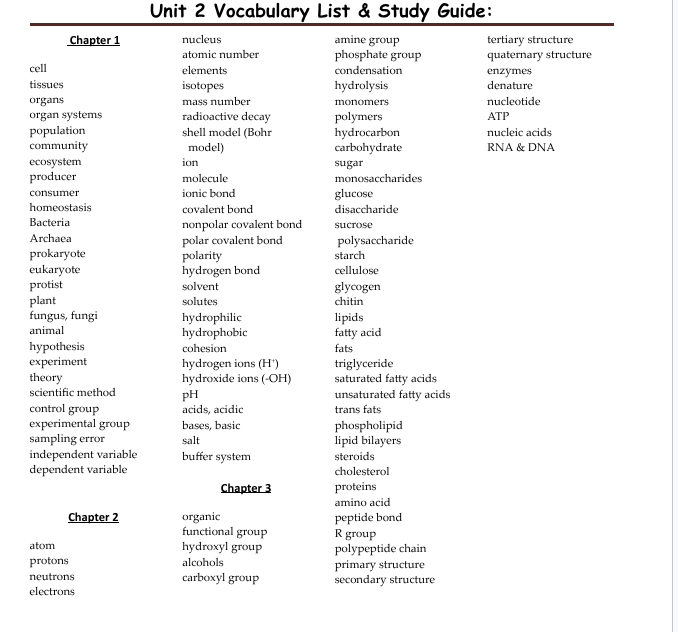
Additional info: This guide covers foundational vocabulary for General Biology, including cell structure, chemistry, and biomolecules, which are essential for understanding subsequent chapters.
