 Back
Unit 3 Biology Study Guide – Thermodynamics, Enzymes, Redox, Respiration, and Photosynthesis
Study Guide - Smart Notes
 Tailored notes based on your materials, expanded with key definitions, examples, and context.
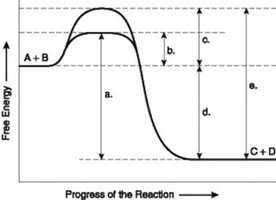
Q7. Label the following graph of Progress of the Reaction vs Free Energy
Background
Topic: Enzyme-catalyzed reactions and energy changes
This question tests your understanding of how free energy changes during a chemical reaction, including concepts like activation energy, reactants, products, and the effect of enzymes.
Key Terms and Formulas:
Activation Energy (): The energy required to start a reaction.
Free Energy (): The energy available to do work in a system.
Reactants: Starting materials (A + B).
Products: Ending materials (C + D).
Exergonic Reaction: Releases energy; .
Endergonic Reaction: Requires energy input; .
Step-by-Step Guidance
Identify the starting point (A + B) and ending point (C + D) on the graph. These represent the reactants and products, respectively.
Observe the curve: The peak represents the transition state, and the difference between the reactants and the peak is the activation energy ().
Label the distances: 'a' is likely the activation energy, 'd' is the difference in free energy between reactants and products (), and 'e' is the total energy difference from reactants to the highest point.
Consider how an enzyme would affect the graph: It would lower the activation energy (distance 'a').
Try solving on your own before revealing the answer!
Final Answer:
'a' = Activation energy ()
'd' = Change in free energy ()
'e' = Total energy difference from reactants to peak
Enzymes lower 'a', making reactions proceed faster
The graph illustrates how energy changes during a reaction and the role of enzymes in lowering activation energy.
Q9. Redox reactions: Oxidation vs Reduction
Background
Topic: Redox reactions in biological systems
This question tests your understanding of how electrons are transferred during oxidation and reduction, and how these processes are fundamental to cellular respiration and photosynthesis.
Key Terms and Formulas:
Oxidation: Loss of electrons (or hydrogen atoms)
Reduction: Gain of electrons (or hydrogen atoms)
Redox Reaction: A chemical reaction involving the transfer of electrons
Step-by-Step Guidance
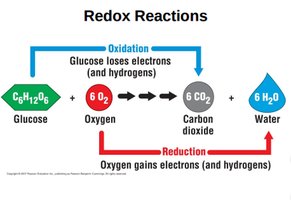
Identify which molecule is being oxidized and which is being reduced. In cellular respiration, glucose is oxidized and oxygen is reduced.
Write the half-reactions for oxidation and reduction. For example, (oxidation) and (reduction).
Understand that oxidation involves loss of electrons, while reduction involves gain of electrons.
Apply these concepts to other biological processes, such as photosynthesis and fermentation.
Try solving on your own before revealing the answer!
Final Answer:
Glucose is oxidized (loses electrons/hydrogen)
Oxygen is reduced (gains electrons/hydrogen)
Redox reactions are essential for energy transfer in cells.
Q14. Aerobic vs Anaerobic Respiration: Fermentation; lactate and alcohol
Background
Topic: Cellular respiration and fermentation
This question tests your understanding of the differences between aerobic and anaerobic respiration, including the processes of fermentation and the products formed (lactate and alcohol).
Key Terms and Formulas:
Aerobic Respiration: Requires oxygen, produces more ATP
Anaerobic Respiration: Occurs without oxygen, produces less ATP
Fermentation: Process that regenerates NAD+ and produces lactate or alcohol
Glycolysis: First step in both aerobic and anaerobic respiration
Step-by-Step Guidance
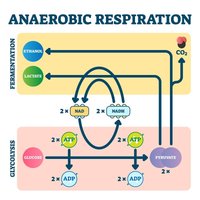
Recall that glycolysis occurs in the cytoplasm and produces pyruvate, ATP, and NADH.
In the absence of oxygen, cells undergo fermentation to regenerate NAD+.
Fermentation can produce lactate (in animals) or alcohol (in yeast and some plants).
Compare the ATP yield of aerobic vs anaerobic respiration.
Try solving on your own before revealing the answer!
Final Answer:
Aerobic respiration produces more ATP and uses oxygen.
Anaerobic respiration (fermentation) produces less ATP and results in lactate or alcohol.
Fermentation allows cells to continue producing ATP when oxygen is unavailable.
Q16. Two main processes of photosynthesis: Light reactions and Calvin cycle
Background
Topic: Photosynthesis in plant cells
This question tests your understanding of the two main stages of photosynthesis, where they occur, and their reactants and products.
Key Terms and Formulas:
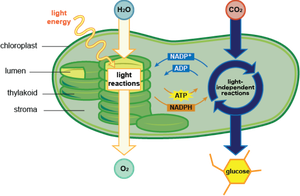
Light Reactions: Occur in the thylakoid membranes; produce ATP, NADPH, and O2
Calvin Cycle: Occurs in the stroma; uses ATP and NADPH to fix CO2 into glucose
Photosynthesis Equation:
Step-by-Step Guidance
Identify the location of light reactions (thylakoid membranes) and Calvin cycle (stroma) in the chloroplast.
List the reactants and products for each stage: Light reactions use water and light, produce ATP, NADPH, and O2; Calvin cycle uses ATP, NADPH, and CO2, produces glucose.
Understand how the products of light reactions are used in the Calvin cycle.
Relate these processes to the overall photosynthesis equation.
Try solving on your own before revealing the answer!
Final Answer:
Light reactions occur in thylakoids; produce ATP, NADPH, O2
Calvin cycle occurs in stroma; uses ATP, NADPH, CO2 to produce glucose
Photosynthesis is divided into light-dependent and light-independent reactions, each with distinct roles and locations.
