 Back
Unit 3 Test Review: Enzyme Function, Energy, and Cellular Processes
Study Guide - Smart Notes
 Tailored notes based on your materials, expanded with key definitions, examples, and context.
Q1. Fill in the blanks with the appropriate term
Background
Topic: Enzyme function, energy, and metabolic regulation
This section tests your knowledge of key vocabulary and concepts related to metabolism, enzyme activity, and energy transformations in biological systems.
Key Terms:
Activation energy: The energy required to start a chemical reaction.
Entropy: A measure of disorder or randomness.
Heat: Energy transferred due to temperature difference.
Active site: The region of an enzyme where substrate binds.
Coenzymes: Organic molecules that assist enzymes.
Metabolism: All chemical reactions in an organism.
Competitive inhibition: Inhibitor binds to active site, blocking substrate.
Feedback inhibition: End product inhibits an earlier enzyme.
Substrate: The reactant an enzyme acts upon.
Phosphorylated intermediate: Molecule with added phosphate group, often more reactive.
Allosteric regulation: Regulation by binding at a site other than the active site.
Mechanical, transport & chemical work: Types of cellular work powered by ATP.
Step-by-Step Guidance
Read each statement carefully and identify the concept or process being described.
Recall the definitions and functions of each term listed in the word bank.
Match the term to the statement based on its definition and context.
For example, "The totality of an organism’s chemical processes" refers to all reactions, so think about the term that encompasses all biochemical reactions.
Continue this process for each blank, using your understanding of enzyme mechanisms, energy transformations, and metabolic regulation.
Try solving on your own before revealing the answer!
Q2. What is catabolism? Anabolism? Give an example of each
Background
Topic: Metabolic pathways
This question tests your understanding of the two main types of metabolic pathways: catabolic (breaking down molecules) and anabolic (building molecules).
Key Terms:
Catabolism: Breakdown of complex molecules into simpler ones, releasing energy.
Anabolism: Synthesis of complex molecules from simpler ones, requiring energy.
Step-by-Step Guidance
Define catabolism and anabolism in your own words.
Think of a biological example for each (e.g., cellular respiration for catabolism, photosynthesis for anabolism).
Explain how energy is involved in each process (released in catabolism, required in anabolism).
Consider how these processes are interconnected in the cell.
Try solving on your own before revealing the answer!
Q3. What is energy defined as? What is the difference between potential energy and kinetic energy?
Background
Topic: Energy in biological systems
This question tests your understanding of energy concepts and their relevance to biology.
Key Terms:
Energy: The capacity to do work or cause change.
Potential energy: Stored energy due to position or structure.
Kinetic energy: Energy of motion.
Step-by-Step Guidance
Write a definition for energy as it applies to biological systems.
Distinguish between potential and kinetic energy with examples (e.g., chemical bonds vs. moving molecules).
Explain why both forms are important in cellular processes.
Try solving on your own before revealing the answer!
Q4. What is thermodynamics?
Background
Topic: Thermodynamics in biology
This question tests your understanding of the laws of thermodynamics and their application to biological systems.
Key Terms:
Thermodynamics: Study of energy transformations.
First law: Energy cannot be created or destroyed.
Second law: Entropy increases in spontaneous processes.
Step-by-Step Guidance
Define thermodynamics and its relevance to biology.
Briefly describe the first and second laws of thermodynamics.
Explain how these laws apply to cellular processes.
Try solving on your own before revealing the answer!
Q5. Fill out the table for the reactions: Is the reaction exergonic or endergonic? Is the reaction spontaneous or non-spontaneous? Is the reaction anabolic or catabolic? Is ∆G positive or negative? Is the energy of the products greater or less than that of the reactants?
Background
Topic: Chemical reactions and energy changes
This question tests your ability to analyze reactions in terms of energy, spontaneity, and metabolic classification.
Key Terms and Formulas:
Exergonic: Releases energy, ∆G is negative.
Endergonic: Requires energy, ∆G is positive.
Catabolic: Breaks down molecules.
Anabolic: Builds molecules.
Spontaneous: Occurs without input of energy.
Non-spontaneous: Requires energy input.
∆G: Change in free energy.
Step-by-Step Guidance
Identify the reactants and products for each reaction.
Determine if the reaction releases or requires energy (exergonic vs endergonic).
Assess whether the reaction is spontaneous or non-spontaneous based on ∆G.
Classify the reaction as anabolic or catabolic.
Compare the energy of products and reactants.
Try solving on your own before revealing the answer!
Q6. Define each part of the equation: ∆G = ∆H - T∆S; what unit is temperature measured in?
Background
Topic: Free energy equation
This question tests your understanding of the Gibbs free energy equation and its components.
Key Formula:
: Change in free energy
: Change in enthalpy (total energy)
: Temperature (measured in Kelvin)
: Change in entropy (disorder)
Step-by-Step Guidance
Identify each variable in the equation and its meaning.
Explain how changes in enthalpy, entropy, and temperature affect free energy.
State the unit for temperature (Kelvin).
Try solving on your own before revealing the answer!
Q7. Enzymes speed up metabolic reactions by ________ energy barriers.
Background
Topic: Enzyme function
This question tests your understanding of how enzymes catalyze reactions by affecting activation energy.
Key Terms:
Activation energy: The energy barrier that must be overcome for a reaction to proceed.
Enzyme: Biological catalyst that lowers activation energy.
Step-by-Step Guidance
Recall the role of enzymes in chemical reactions.
Think about how enzymes affect the activation energy barrier.
Fill in the blank with the appropriate term.
Try solving on your own before revealing the answer!
Q8. Label the energy diagram using the word bank
Background
Topic: Enzyme-catalyzed reactions and energy diagrams
This question tests your ability to interpret energy diagrams showing the effect of enzymes on activation energy and free energy changes.
Key Terms:
Course of reaction with/without enzyme
EA (activation energy) with/without enzyme
∆G (change in free energy)
Reactants and products
Step-by-Step Guidance
Examine the diagram and identify the curves representing reactions with and without enzyme.
Locate the points corresponding to reactants and products.
Identify the activation energy for each scenario (with and without enzyme).
Find the arrow representing ∆G (difference in free energy between reactants and products).
Use the word bank to label each part of the diagram.
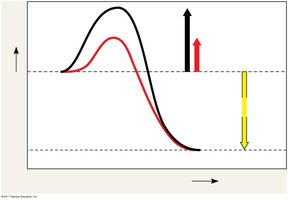
Try solving on your own before revealing the answer!
Q9. What is catalysis?
Background
Topic: Catalysis in biological systems
This question tests your understanding of how catalysts (including enzymes) speed up reactions.
Key Terms:
Catalysis: The process of speeding up a chemical reaction by lowering the activation energy.
Enzyme: Biological catalyst.
Step-by-Step Guidance
Define catalysis in your own words.
Explain how enzymes act as catalysts in cells.
Describe the effect on activation energy and reaction rate.
Try solving on your own before revealing the answer!
