 Back
BackUnit 4 Biology Test Review – Step-by-Step Study Guidance
Study Guide - Smart Notes
 Tailored notes based on your materials, expanded with key definitions, examples, and context.
Q17. What is the molecular makeup of DNA? (What is a nucleotide made up of?)
Background
Topic: DNA Structure
This question tests your understanding of the basic building blocks of DNA and the composition of a nucleotide.
Key Terms and Formulas
Nucleotide: The basic unit of DNA, consisting of three components.
Phosphate group: One of the three parts of a nucleotide.
Deoxyribose sugar: The five-carbon sugar in DNA nucleotides.
Nitrogenous base: The variable part of a nucleotide (A, T, C, G).
Step-by-Step Guidance
Recall that DNA is a polymer made up of repeating units called nucleotides.
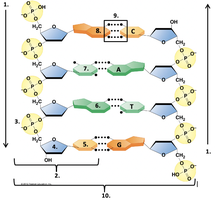
Each nucleotide consists of three main components: a phosphate group, a deoxyribose sugar, and a nitrogenous base.
Identify the four types of nitrogenous bases found in DNA: adenine (A), thymine (T), cytosine (C), and guanine (G).
Understand how nucleotides are linked together: the phosphate group of one nucleotide bonds to the sugar of the next, forming the backbone of the DNA strand.
Recognize that the nitrogenous bases pair with each other via hydrogen bonds, forming the rungs of the DNA double helix.
Try solving on your own before revealing the answer!
Final Answer:
A nucleotide in DNA is made up of a phosphate group, a deoxyribose sugar, and a nitrogenous base (A, T, C, or G).
The diagram above visually shows these three components and how they are connected in the DNA structure.
Q18. DNA Replication Labeling Diagram
Background
Topic: DNA Replication
This question is about understanding the process of DNA replication and being able to identify and label the key components and enzymes involved.
Key Terms and Formulas
DNA polymerase: The enzyme responsible for synthesizing new DNA strands.
Helicase: The enzyme that unwinds the DNA double helix.
Primase: The enzyme that synthesizes RNA primers.
Leading strand: The strand synthesized continuously.
Lagging strand: The strand synthesized in fragments (Okazaki fragments).
Step-by-Step Guidance
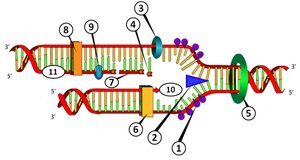
Identify the replication fork in the diagram, where the DNA is being unwound.
Locate the enzyme helicase, which separates the two DNA strands.
Find the primase, which lays down RNA primers to start DNA synthesis.
Recognize the direction of synthesis for the leading and lagging strands.
Label the DNA polymerase, which extends the new DNA strand from the primer.
Try solving on your own before revealing the answer!
Final Answer:
The DNA replication diagram should be labeled with the replication fork, helicase, primase, DNA polymerase, leading strand, lagging strand, and Okazaki fragments. Each enzyme and strand plays a specific role in the replication process.
The image above helps visualize where each component is located and how they interact during DNA replication.
Q19. What is the role of DNA polymerase?
Background
Topic: DNA Replication Enzymes
This question tests your understanding of the function of DNA polymerase during DNA replication.
Key Terms and Formulas
DNA polymerase: An enzyme that synthesizes new DNA strands by adding nucleotides to a pre-existing chain.
Template strand: The original DNA strand used as a guide for synthesis.
Primer: A short RNA sequence that provides a starting point for DNA polymerase.
Step-by-Step Guidance
Recall that DNA polymerase is essential for copying DNA during cell division.
Understand that DNA polymerase adds nucleotides to the 3' end of the growing DNA strand, using the template strand as a guide.
Recognize that DNA polymerase requires a primer to begin synthesis; it cannot start from scratch.
Know that DNA polymerase also proofreads the new DNA strand, correcting errors as it goes.
Try solving on your own before revealing the answer!
Final Answer:
DNA polymerase synthesizes new DNA strands by adding nucleotides to the primer, using the template strand as a guide, and also proofreads for errors.
This ensures accurate DNA replication during cell division.
