 Back
Urinary System: Structure, Function, and Regulation
Study Guide - Smart Notes
 Tailored notes based on your materials, expanded with key definitions, examples, and context.
Urinary System Overview
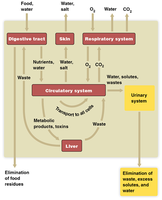
Excretion and Body Fluid Regulation
The urinary system is essential for maintaining homeostasis by regulating the composition and volume of body fluids and removing metabolic wastes. Several organ systems participate in excretion, each targeting specific waste products.
Excretion: The process of removing wastes and excess materials from the body.
Participating organ systems:
Digestive system: Excretes food residues and wastes produced by the liver.
Respiratory system: Excretes carbon dioxide.
Integumentary system: Excretes water and salt.
Urinary system: Excretes nitrogenous wastes, excess solutes, and water.
Homeostasis: The urinary system maintains internal balance by adjusting water and solute excretion.
Structures of the Urinary System
Main Organs and Their Functions
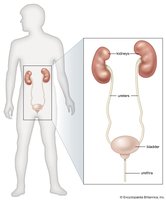
The urinary system consists of four main structures, each with a specific role in urine production and elimination.
Kidneys: Two organs that produce urine by filtering blood.
Ureters: Muscular tubes that transport urine from kidneys to bladder.
Urinary bladder: Stores urine until excretion (capacity: 600–1000 mL).
Urethra: Tube carrying urine from bladder to outside the body.
Urine: Composed of water and solutes; kidneys regulate its composition to maintain homeostasis.
Internal Structure of the Kidney
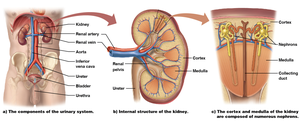
The kidney is divided into three main regions, each contributing to urine formation and transport.
Cortex: Outer portion where urine is produced.
Medulla: Inner region that transports urine.
Renal pelvis: Hollow space in the center where urine collects before entering the ureter.
Nephron: Functional Unit of the Kidney
Nephron Structure and Function
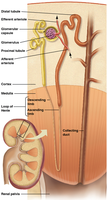
Each kidney contains about one million nephrons, which are responsible for filtering blood and forming urine.
Nephron: Functional unit of the kidney.
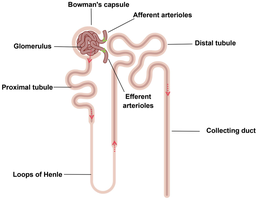
Glomerulus: Ball of capillaries where filtration occurs.
Tubule: Thin hollow tube of epithelial cells for reabsorption and secretion.
Glomerular capsule (Bowman's capsule): Surrounds the glomerulus and collects filtrate.
Regions of the Nephron Tubule
The nephron tubule is divided into four distinct regions, each with specialized functions.
Proximal tubule: Extends from glomerular capsule to renal medulla; site of most reabsorption.
Loop of Henle: Extends into medulla and back into cortex; concentrates urine.
Distal tubule: Further modifies filtrate.
Collecting duct: Shared by several nephrons; empties into renal pelvis.
Formation of Urine
Filtration, Reabsorption, and Secretion
Urine formation involves three main processes, each critical for waste removal and fluid balance.
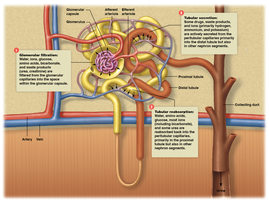
Glomerular filtration: Movement of protein-free fluid and solutes from blood into the glomerular capsule, driven by high blood pressure.
Tubular reabsorption: Return of most filtered water and solutes to the blood, primarily in the proximal tubule.
Tubular secretion: Addition of certain solutes from blood into the tubule for excretion.
Regulation of Filtration
Filtration is highly selective and regulated by blood pressure in glomerular capillaries.
Resting rate is controlled locally by adjusting afferent arteriole diameter.
Stress activates the sympathetic nervous system, reducing blood flow to kidneys.
Tubular Reabsorption
100% of filtered glucose, amino acids, and bicarbonate, and 50% of urea are reabsorbed.
Most reabsorption occurs in the proximal tubule.
Sodium is actively transported, creating a gradient for facilitated diffusion.
Chloride passively accompanies sodium to balance charge.
Water diffuses through aquaporins, following sodium movement.
Glucose and amino acids are cotransported with sodium and then diffuse to capillaries.
Tubular Secretion
Removes substances such as drugs, hydrogen ions, ammonium, and potassium from blood to tubule.
Regulates chemical levels and excretes harmful chemicals.
Regulation of Water and Solute Balance
Response to Fluid Intake
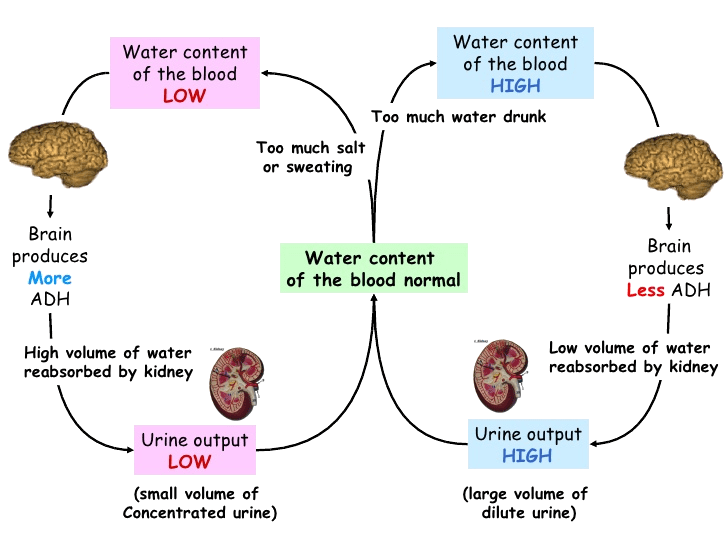
The kidneys adjust urine concentration based on water intake and loss.
Excess water: Kidneys reabsorb less water, producing dilute urine.
Too little water: Kidneys conserve water, producing concentrated urine.
Hormonal Regulation
ADH (Antidiuretic Hormone): Increases permeability of collecting ducts to water, promoting reabsorption and conservation.
Aldosterone: Adrenal hormone that increases sodium reabsorption; water follows sodium, increasing blood volume.
Renin-Angiotensin System: Controls blood volume and pressure via vasoconstriction and aldosterone secretion.
Atrial Natriuretic Hormone (ANH): Inhibits sodium reabsorption, increasing sodium and water excretion.
Kidney Functions in Homeostasis
Additional Roles
The kidneys contribute to several aspects of homeostasis beyond waste removal.
Maintain water and salt balance.
Secrete enzymes for blood volume and pressure control.
Regulate acid-base balance and blood pH (7.35–7.45).
Regulate red blood cell production via erythropoietin.
Activate vitamin D.
Acid-Base Balance
Reabsorption of filtered bicarbonate.
Excretion of acid as ammonium (NH4+).
Erythropoietin and Oxygen Regulation
Decrease in oxygen triggers erythropoietin secretion by O2-sensitive kidney cells.
Erythropoietin stimulates red blood cell production in bone marrow.
Summary Table: Hormonal Regulation of Kidney Function
Hormone | Source | Effect on Kidney | Result |
|---|---|---|---|
ADH | Posterior pituitary | Increases water reabsorption in collecting ducts | Concentrated urine, water conservation |
Aldosterone | Adrenal cortex | Increases sodium reabsorption in distal tubule and collecting duct | Increased blood volume and pressure |
ANH | Atria of heart | Inhibits sodium reabsorption | Increased sodium and water excretion |
Key Equations
Filtration Rate:
Acid-Base Balance:
Example: Protein Metabolism and Nitrogenous Waste
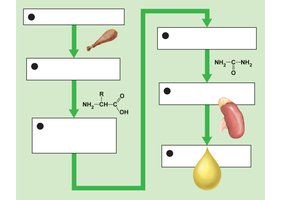
Proteins are digested to amino acids.
Amino groups are converted to ammonia (NH3), which is toxic.
Liver converts ammonia to urea, which is less toxic.
Urea is filtered by kidneys and excreted in urine.
Summary
The urinary system is vital for waste removal, fluid and electrolyte balance, acid-base regulation, and hormone production. Its complex structure and regulatory mechanisms ensure the maintenance of internal stability and health. Understanding these processes is essential for comprehending human physiology and the impact of disease or dysfunction on homeostasis.
