 Back
BackVascular Plant Structure and Growth: Study Guide
Study Guide - Smart Notes
 Tailored notes based on your materials, expanded with key definitions, examples, and context.
Vascular Plant Structure & Growth
Overview of Angiosperm Clades
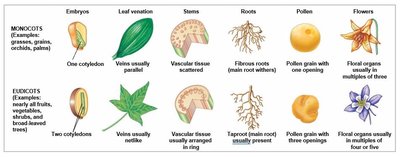
Vascular plants, especially angiosperms, are divided into two major clades based on the number of cotyledons (seed leaves) present in the embryo. Cotyledons are the first leaf or leaves of a developing plant and are crucial for supplying nutrition during germination.
Monocots: Have one cotyledon.
Eudicots: Have two cotyledons.
Cotyledon: Seed leaf that absorbs nutrients from the seed to aid the plant's early growth.
All flowering plants possess cotyledons.
Example: Grasses (monocots), beans (eudicots).
Hierarchical Organization of Plant Structure
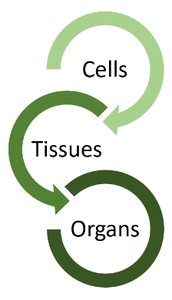
Plants are organized in a hierarchy: cells form tissues, tissues form organs, and organs make up the plant body. This organization allows for specialization and efficient functioning.
Cells: Basic structural units.
Tissues: Groups of cells performing specialized functions.
Organs: Composed of several tissue types, carrying out one or more functions.
Plant Cell Types
Parenchyma Cells
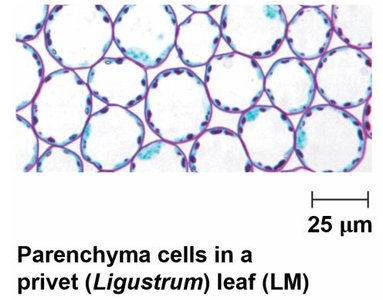
Parenchyma cells are the most common and versatile plant cells, found in dermal and ground tissues. They have flexible walls and large vacuoles, serving as the primary site of photosynthesis and storage.
Location: Dermal tissue, ground tissue.
Function: Photosynthesis, storage, wound repair.
Structure: Only primary cell walls, large intercellular air spaces.
Example: Parenchyma cells in leaves.
Collenchyma Cells
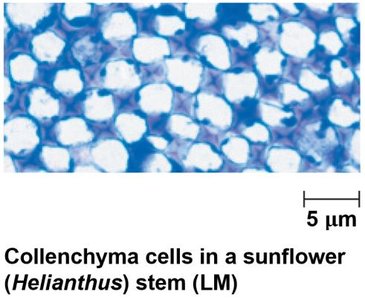
Collenchyma cells provide flexible support, especially in growing regions of the plant. Their primary walls are unevenly thickened, allowing them to support organs without restricting growth.
Location: Cortex of stems and leaves.
Function: Flexible support during growth.
Structure: Unevenly thickened primary cell walls.
Example: Collenchyma cells in sunflower stems.
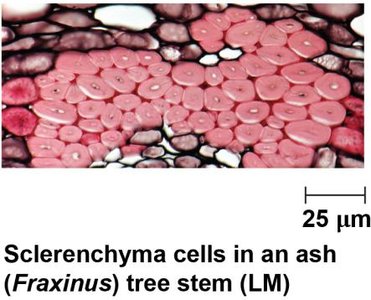
Sclerenchyma Cells
Sclerenchyma cells provide rigid support and protection due to their thick, lignified secondary walls. They are dead at functional maturity and come in two types: sclereids and fibers.
Sclereids: Boxy, irregular shape, thick lignified walls.
Fibers: Long, slender, tapered, lignified walls.
Function: Support, protection, water transport.
Example: Sclerenchyma cells in tree stems.
Water-Conducting Cells of the Xylem
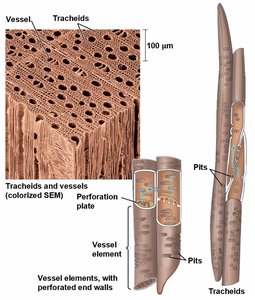
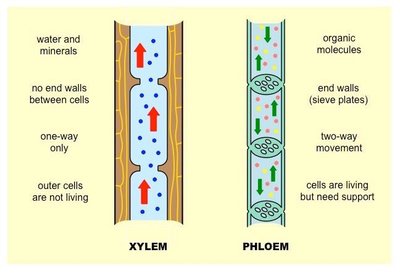
Xylem cells are dead at maturity and transport water and minerals. The two main types are tracheids and vessel elements.
Tracheids: Long, thin cells with pits, found in all vascular plants.
Vessel Elements: Shorter, wider cells with perforated plates, primarily in angiosperms.
Function: Water and mineral transport.
Sugar-Conducting Cells of the Phloem
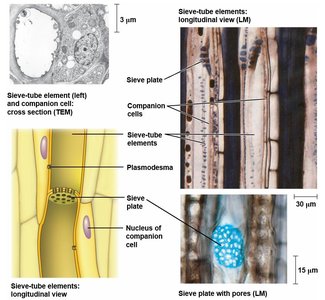
Phloem cells are alive at maturity and transport sugars and nutrients. Sieve tube elements and companion cells are the main components.
Sieve Tube Elements: Porous end walls (sieve plates) allow fluid flow.
Companion Cells: Support sieve tube elements.
Function: Transport of sugars and nutrients.
Plant Tissue Types
Three Fundamental Tissue Types
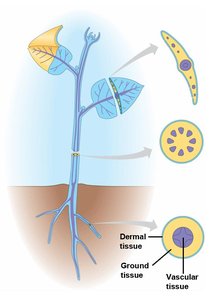
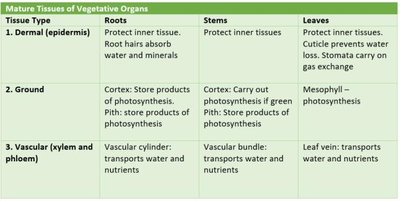
All plant organs are composed of three fundamental tissue types: dermal, vascular, and ground tissue. Their arrangement and function vary by organ.
Dermal Tissue: Outermost protective layer (epidermis, cuticle, periderm).
Vascular Tissue: Transport system (xylem and phloem).
Ground Tissue: Photosynthesis, storage, support (pith, cortex, mesophyll).
Tissue Type | Roots | Stems | Leaves |
|---|---|---|---|
Dermal (epidermis) | Protect inner tissue. Root hairs absorb water and minerals | Protect inner tissues | Protect inner tissues. Cuticle prevents water loss. Stomata carry on gas exchange |
Ground | Cortex: Store products of photosynthesis. Pith: Store products of photosynthesis | Cortex: Carry out photosynthesis if green. Pith: Store products of photosynthesis | Mesophyll—photosynthesis |
Vascular (xylem and phloem) | Vascular cylinder: transports water and nutrients | Vascular bundle: transports water and nutrients | Leaf vein: transports water and nutrients |
Plant Organs
Roots
Roots anchor the plant, absorb water and minerals, and store carbohydrates. There are two main types: taproots and fibrous roots. Specialized roots include prop roots, storage roots, pneumatophores, and strangling roots.
Taproot: Long, vertical root for anchoring and storage.
Lateral Roots: Branches off the taproot for absorption.
Fibrous Roots: Thin, interwoven roots for surface absorption.
Root Hairs: Extensions of epidermis for increased absorption.
Specialized Roots: Prop roots (support), storage roots (store water/food), pneumatophores (gas exchange), strangling roots (aerial, can kill host trees).
Stems
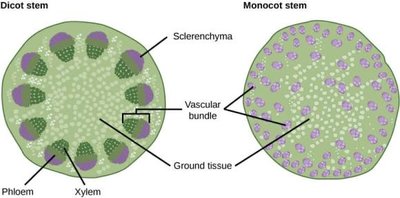
Stems support the plant, lift reproductive structures, and sometimes perform limited photosynthesis. Key parts include nodes, internodes, apical buds, and axillary buds. Adaptations include rhizomes, stolons, and tubers.
Node: Point where leaves attach.
Internode: Stem segment between leaves.
Apical Bud: Growth at stem tip.
Axillary Bud: Can form branches, thorns, or flowers.
Rhizomes: Underground stems.
Stolons: Horizontal shoots along ground.
Tubers: Enlarged ends of rhizomes/stolons for storage.
Leaves
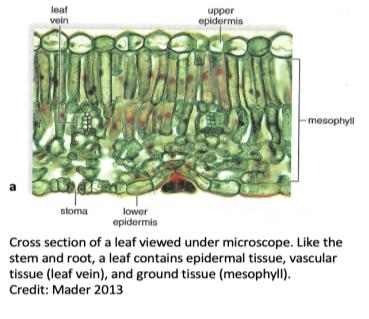
Leaves are the main photosynthetic organs, primary sites of gas exchange, and can aid in heat dissipation and predator defense. They consist of a blade and petiole, with vein arrangements varying between monocots (parallel) and eudicots (branched).
Blade: Flattened part for photosynthesis.
Petiole: Connects blade to stem.
Vein Arrangement: Parallel in monocots, branched in eudicots.
Adaptations: Tendrils (climbing), spines (defense), storage leaves (bulbs), reproductive leaves (plantlets).
Meristems and Plant Growth
Meristems: Primary and Secondary Growth
Meristems are regions of actively dividing, undifferentiated cells. Plants exhibit indeterminate growth due to meristems. There are two main types: apical (primary growth) and lateral (secondary growth).
Apical Meristems: Located at tips of roots and shoots; responsible for elongation.
Lateral Meristems: Responsible for increase in diameter (secondary growth); includes vascular cambium and cork cambium.
Primary Growth: Lengthening from apical meristems.
Secondary Growth: Thickening from lateral meristems.
Primary Growth in Roots and Shoots
Primary growth lengthens roots and shoots. In roots, growth occurs behind the root cap in three zones: cell division, elongation, and differentiation. The cortex stores carbohydrates and aids in transport, while the endodermis regulates passage into the vascular cylinder.
Stele: Root vascular cylinder; arrangement differs in monocots and eudicots.
Pericycle: Outermost layer of stele; can produce lateral roots.
Secondary Growth in Woody Plants
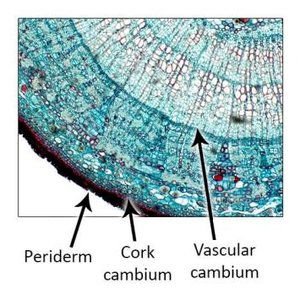
Secondary growth increases the diameter of stems and roots. The vascular cambium produces secondary xylem (wood) and phloem, while the cork cambium produces cork cells that replace the epidermis. Bark consists of all tissues exterior to the vascular cambium.
Vascular Cambium: Lays down secondary xylem inside and secondary phloem outside.
Cork Cambium: Produces cork and forms periderm.
Vascular Rays: Cells extending from cambium into xylem and phloem for support and fluid conduction.
Tree Rings: Early wood (thin-walled, water delivery) and late wood (thick-walled, support) form annual rings used to age trees and infer environmental conditions.
Heartwood: Older, inner xylem layers; no longer transport sap but provide support.
Sapwood: Newer, outer xylem layers; actively transport water and minerals.
Feature | Monocots | Eudicots |
|---|---|---|
Embryos | One cotyledon | Two cotyledons |
Leaf venation | Veins usually parallel | Veins usually netlike |
Stems | Vascular tissue scattered | Vascular tissue in ring |
Roots | Fibrous roots | Taproot usually present |
Pollen | One opening | Three openings |
Flowers | Multiples of three | Multiples of four or five |
Additional info: The study notes above expand on the original content by providing definitions, examples, and context for each cell, tissue, and organ type, as well as the processes of primary and secondary growth. Tables and diagrams are included to clarify comparisons and structural organization.
