Back
BackVertebrate Diversity and Evolution: Chordates to Mammals
Study Guide - Smart Notes
 Tailored notes based on your materials, expanded with key definitions, examples, and context.
Vertebrate Diversity and Evolution
Chordates: Defining Characteristics
Chordates are a diverse phylum within the animal kingdom, unified by four key anatomical features present at some stage of development. These features are critical for understanding the evolutionary relationships among major animal groups.
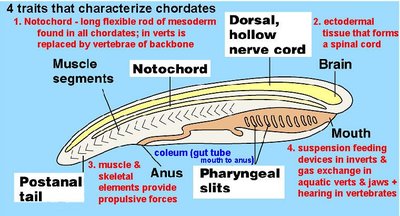
Notochord: A flexible, rod-shaped structure that provides support. In vertebrates, it is replaced by the vertebral column during development.
Dorsal, hollow nerve cord: Develops into the central nervous system (brain and spinal cord).
Pharyngeal slits or pouches: Openings in the pharynx that function in filter-feeding in invertebrate chordates and develop into gills or other structures in vertebrates.
Post-anal tail: An extension of the body past the anal opening, which may be reduced in some adult chordates.
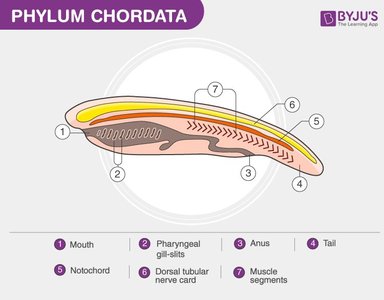
Additional info: Chordates also exhibit bilateral symmetry, a complete digestive tract, and a closed circulatory system.
Major Animal Phyla: Comparative Overview
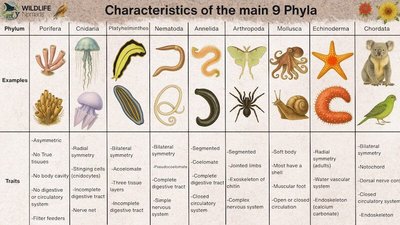
The animal kingdom is divided into several major phyla, each with distinct body plans and evolutionary adaptations. Chordates are one of the nine main phyla, distinguished by their unique features.
Phylum | Examples | Key Traits |
|---|---|---|
Porifera | Sponges | No true tissues, asymmetrical |
Cnidaria | Jellyfish, corals | Radial symmetry, stinging cells |
Platyhelminthes | Flatworms | Bilateral symmetry, no body cavity |
Nematoda | Roundworms | Body cavity, complete digestive tract |
Annelida | Earthworms | Segmented body, closed circulatory system |
Arthropoda | Insects, spiders | Exoskeleton, jointed appendages |
Mollusca | Snails, octopus | Soft body, often with shell |
Echinodermata | Starfish | Radial symmetry (adults), water vascular system |
Chordata | Fish, birds, mammals | Notochord, dorsal nerve cord, pharyngeal slits, post-anal tail |
Chordate Groups: Quick Reference
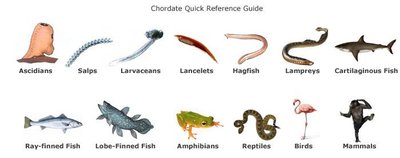
Chordates include both invertebrate and vertebrate groups. The main subgroups are:
Invertebrate chordates: Ascidians (tunicates), salps, larvaceans, lancelets
Jawless vertebrates: Hagfish, lampreys
Jawed vertebrates: Cartilaginous fish (sharks, rays), ray-finned fish, lobe-finned fish
Tetrapods: Amphibians, reptiles, birds, mammals
Key Traits of Chordates
All chordates share four defining traits at some stage of their life cycle. These features are essential for their classification and evolutionary significance.
Notochord: Provides skeletal support; replaced by vertebral column in vertebrates.
Dorsal, hollow nerve cord: Forms the central nervous system.
Pharyngeal slits: Function in feeding and respiration.
Post-anal tail: Aids in locomotion for many chordates.
Evolution of Vertebrates
Phylogenetic Relationships Among Chordates
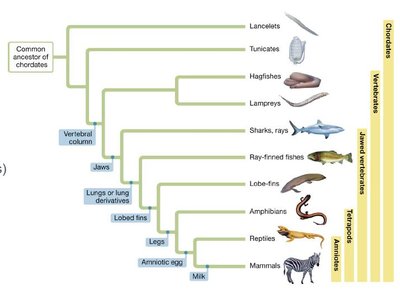
Vertebrates evolved from invertebrate chordate ancestors. Key evolutionary innovations include the development of a vertebral column, jaws, lungs, limbs, and the amniotic egg.
Lancelets and tunicates: Exhibit all four chordate traits but lack a backbone.
Hagfish and lampreys: Jawless vertebrates; hagfish retain a notochord, lampreys have rudimentary vertebrae.
Jawed vertebrates: Include cartilaginous and bony fishes.
Tetrapods: Vertebrates with four limbs (amphibians, reptiles, birds, mammals).
Amniotes: Tetrapods with amniotic eggs adapted for terrestrial life (reptiles, birds, mammals).
Jawless Vertebrates: Hagfish and Lampreys
Jawless vertebrates represent the most primitive living vertebrates. They lack jaws and paired fins, and their skeletons are made of cartilage.
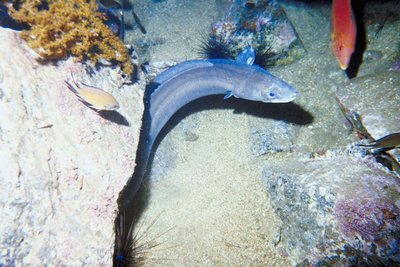
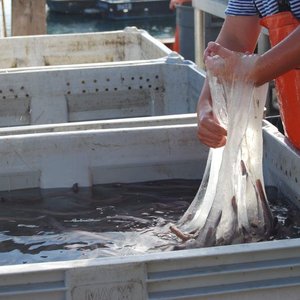
Hagfish: Scavengers that produce slime as a defense mechanism; used commercially for leather.
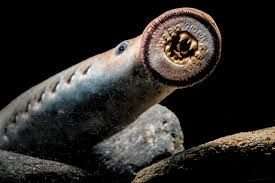
Lampreys: Larvae are suspension feeders; adults are often parasitic with a rasping mouth.
Jawed Fishes: Cartilaginous, Ray-Finned, and Lobe-Finned Fishes
Jawed fishes are a diverse group with specialized adaptations for aquatic life. They are classified based on their skeletal structure and fin morphology.
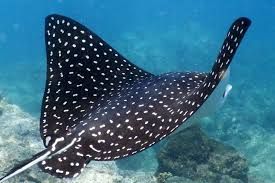
Chondrichthyans (cartilaginous fish): Sharks and rays; skeleton made of cartilage, electrosensory organs, lateral line system.
Ray-finned fishes: Bony skeleton, operculum covering gills, swim bladder for buoyancy.
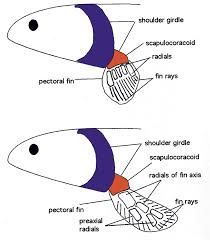
Lobe-finned fishes: Muscular fins with bones; ancestors of tetrapods.
Circulatory System Evolution: Heart Chambers
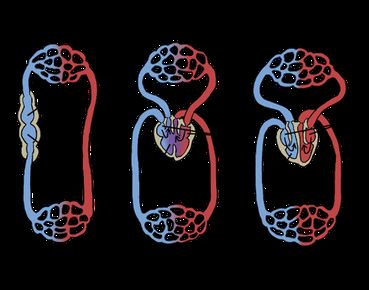
The vertebrate heart has evolved from a simple two-chambered structure in fishes to a more complex four-chambered heart in mammals and birds, increasing the efficiency of oxygen delivery.
2-chambered heart: Found in fishes; single circuit of blood flow.
3-chambered heart: Found in amphibians and most reptiles; partial separation of oxygenated and deoxygenated blood.
4-chambered heart: Found in birds and mammals; complete separation of oxygenated and deoxygenated blood, supporting high metabolic rates.
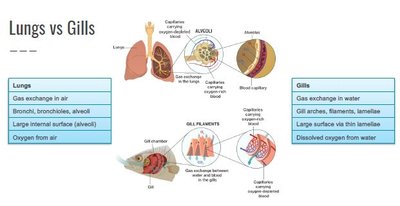
Lungs vs. Gills: Respiratory Adaptations
Vertebrates have evolved different respiratory structures to adapt to aquatic and terrestrial environments.
Gills: Specialized for extracting oxygen from water; found in fish and some amphibians.
Lungs: Adapted for gas exchange in air; found in most terrestrial vertebrates.
Amphibians: Transition to Land
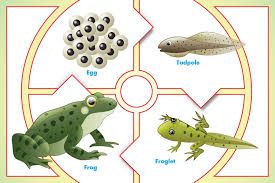
Amphibians are the first tetrapods, representing a key evolutionary step from water to land. They have a dual life cycle, with aquatic larvae and terrestrial adults.
Respiration: Lungs and moist skin for gas exchange.
Heart: 3-chambered, mixing oxygen-rich and oxygen-poor blood.
Reproduction: Eggs and larvae are aquatic; adults are terrestrial.
Defense: Poison glands and warning coloration.
Reptiles: Amniotic Egg and Terrestrial Adaptations
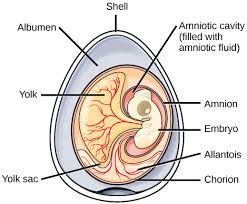
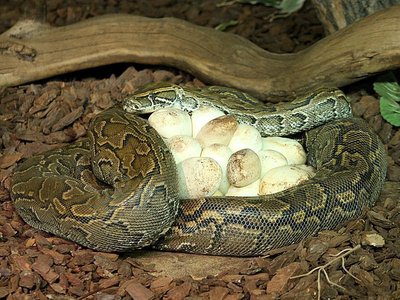
Reptiles are amniotes, possessing eggs with specialized membranes that allow development on land. They have adaptations for a fully terrestrial lifestyle.
Amniotic egg: Contains amnion (protection), yolk sac (nutrition), chorion and allantois (gas exchange and waste storage).
Traits: Scaly, waterproof skin; lungs for respiration; ectothermic metabolism.
Birds: Adaptations for Flight
Birds are endothermic vertebrates descended from theropod dinosaurs. They are highly adapted for flight, with specialized anatomy and physiology.
Feathers and hollow bones: Reduce weight for flight.
Efficient respiratory system: Air sacs enhance oxygen uptake.
Behavior: Complex courtship, vocalizations, migration, and parental care.
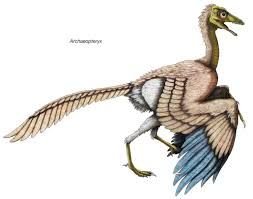
Evolution: Archaeopteryx is the earliest known bird fossil, showing both reptilian and avian traits.
Mammals: Diversity and Evolution
Mammals are endothermic vertebrates with hair, mammary glands, and a four-chambered heart. They are classified into three main groups based on reproductive strategies.
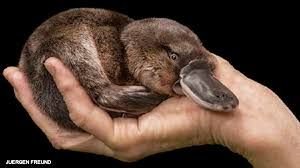
Monotremes: Egg-laying mammals (e.g., platypus).
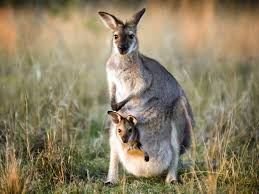
Marsupials: Young develop in a pouch (e.g., kangaroos).
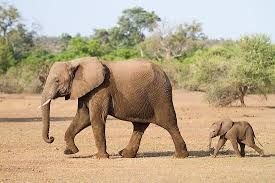
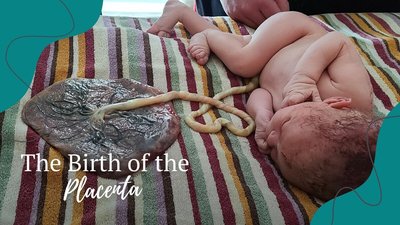
Placental mammals: Young develop inside the uterus, nourished by a placenta.

Primates and Human Evolution
Primate Characteristics and Groups
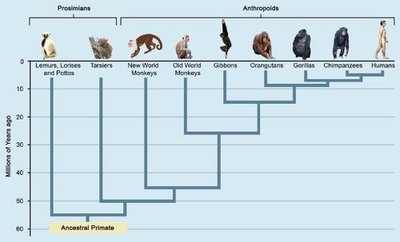
Primates are a group of mammals with adaptations for life in trees and complex social behaviors. They are divided into prosimians and anthropoids.
Adaptations: Grasping hands and feet, forward-facing eyes, large brains.
Groups: Prosimians (lemurs, lorises, tarsiers); Anthropoids (monkeys, apes, humans).
Human Evolution
Humans are closely related to chimpanzees and other apes. Key features of human evolution include bipedalism, enlarged brains, and complex language.
Hominins: Species more closely related to humans than to chimps.
Bipedalism: Evolved before large brain size.
Genus Homo: Characterized by increased brain size and tool use.
Homo sapiens: Originated in Africa ~200,000 years ago; spread globally and interbred with Neanderthals and Denisovans.