 Back
BackVertebrate Evolution: Chordates, Vertebrates, and the Origin of Major Animal Groups
Study Guide - Smart Notes
 Tailored notes based on your materials, expanded with key definitions, examples, and context.
Chordates and Vertebrate Evolution
Overview of Chordate and Vertebrate Diversity
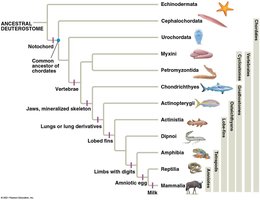
Vertebrates are animals with a backbone and represent some of the largest and most complex animals on Earth. The evolutionary history of vertebrates spans over half a billion years, with key innovations leading to the diversity seen today. Chordates, the broader group, include all vertebrates and two groups of invertebrates: urochordates and cephalochordates.
Chordates are bilaterian animals in the clade Deuterostomia.
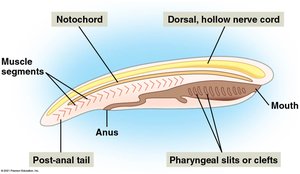
Chordates share four key derived characters: notochord, dorsal hollow nerve cord, pharyngeal slits or clefts, and a muscular post-anal tail.
Vertebrates are distinguished by the presence of a backbone and additional derived features.
Chordate Characteristics
Key Derived Characters of Chordates
All chordates possess four defining features at some stage of development. These features may be present only during embryonic development in some groups.
Notochord: A flexible, longitudinal rod providing skeletal support. In most vertebrates, it is replaced by the vertebral column during development.
Dorsal, hollow nerve cord: Develops from ectoderm and forms the central nervous system (brain and spinal cord).
Pharyngeal slits or clefts: Grooves in the pharynx that function in suspension feeding, gas exchange, or develop into structures of the head and neck in tetrapods.
Muscular, post-anal tail: Tail extending beyond the anus, containing muscle and skeletal elements for locomotion.
Examples of Chordates
Lancelets (Cephalochordata): Marine suspension feeders that retain all chordate features as adults.
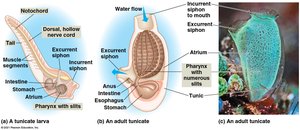
Tunicates (Urochordata): Larvae display chordate features; adults are sessile filter feeders with a simplified body plan.
Early Vertebrate Evolution
Transition from Chordates to Vertebrates
Vertebrates evolved from ancestral chordates, acquiring a backbone and a more complex nervous system. The neural crest, unique to vertebrates, gives rise to diverse structures such as bones, cartilage, and sensory organs.
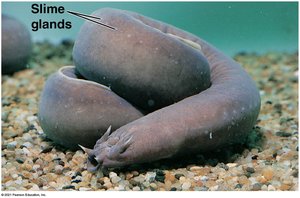
Hagfishes (Myxini): Jawless vertebrates with reduced vertebrae, a cartilaginous skull, and slime glands for defense.
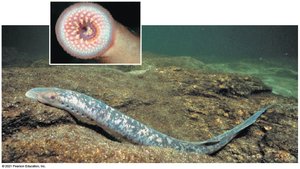
Lampreys (Petromyzontida): Jawless vertebrates with a notochord and cartilaginous skeleton; some are parasitic.
Fossil Evidence and Early Innovations
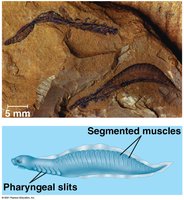
Haikouella: Early chordate with a brain and segmented muscles but lacking a skull.
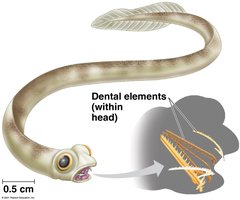
Conodonts: Early jawless vertebrates with mineralized dental elements for capturing prey.
Gnathostomes: Jawed Vertebrates
Origin and Characteristics of Gnathostomes
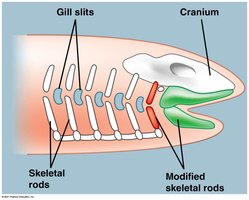
Gnathostomes are vertebrates with jaws, a major evolutionary innovation that allowed for more efficient predation and diversification. Jaws likely evolved from skeletal supports of pharyngeal slits.
Other features include genome duplication (four sets of Hox genes), enlarged forebrain, and lateral line system in aquatic species.
Major Groups of Gnathostomes
Chondrichthyans: Cartilaginous fishes including sharks, rays, and chimaeras.
Osteichthyans: Bony fishes and tetrapods.
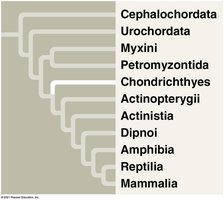
Osteichthyans: Bony Fishes and Tetrapods
Ray-Finned Fishes (Actinopterygii)
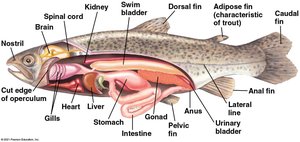
Ray-finned fishes are the most diverse group of vertebrates, characterized by bony skeletons, operculum-covered gills, and swim bladders for buoyancy.
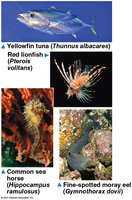
Examples include tuna, lionfish, seahorses, and eels.
Lobe-Finned Fishes (Sarcopterygii)
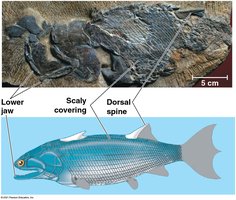
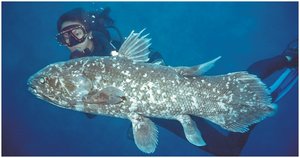
Lobe-finned fishes have rod-shaped bones in their fins and are the ancestors of tetrapods. Only three lineages survive today: coelacanths, lungfishes, and tetrapods.
Tetrapods: Vertebrates with Limbs
Origin of Tetrapods
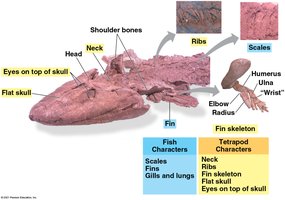
The transition from aquatic lobe-finned fishes to tetrapods involved the evolution of limbs with digits, a neck, and other adaptations for life on land. Tiktaalik is a key fossil showing both fish and tetrapod features.
Tetrapods have four limbs, a neck, fusion of the pelvic girdle to the backbone, and ears for detecting airborne sounds.
Amphibians
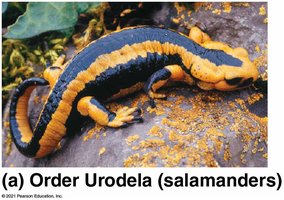
Amphibians are the earliest tetrapods, including salamanders, frogs, and caecilians. They typically have a life cycle that includes aquatic larvae and terrestrial adults.
Salamanders (Urodela): Amphibians with tails, some aquatic, some terrestrial.
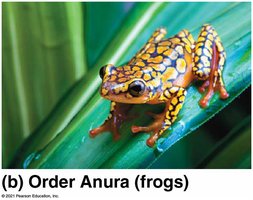
Frogs (Anura): Tail-less adults with powerful hind legs for jumping.
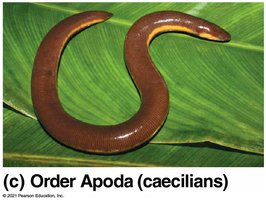
Caecilians (Apoda): Legless, burrowing amphibians resembling worms.
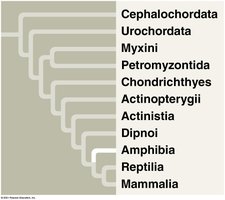
Amniotes: Tetrapods with a Terrestrially Adapted Egg
Amniotic Egg and Adaptations
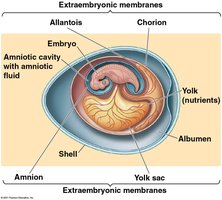
Amniotes include reptiles (including birds) and mammals. The amniotic egg, with its protective membranes, allowed vertebrates to reproduce away from water.
The amniotic egg contains four membranes: amnion, chorion, yolk sac, and allantois.
Other adaptations include less permeable skin and rib cage ventilation of the lungs.
Reptiles and Their Evolution
Major Groups of Reptiles
Reptiles are a diverse group including turtles, lepidosaurs (tuataras, lizards, snakes), crocodilians, and birds. Most are ectothermic, except birds, which are endothermic.
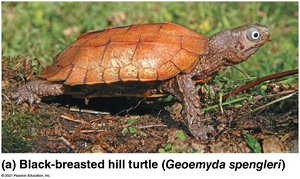
Turtles: Boxlike shell fused to the skeleton; some are aquatic, others terrestrial.
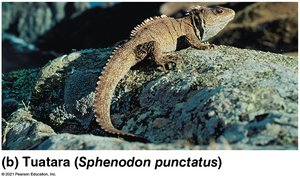
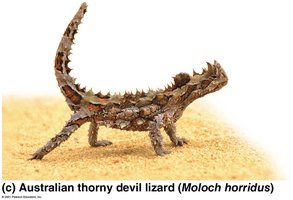
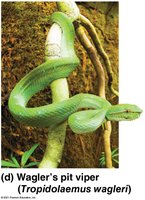
Lepidosaurs: Includes tuataras, lizards, and snakes.
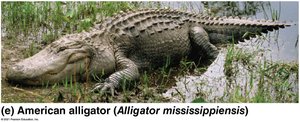
Crocodilians: Alligators and crocodiles, mostly aquatic.
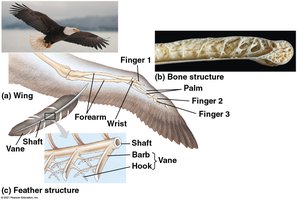
Birds: Highly modified for flight, with feathers, hollow bones, and high metabolic rates.
Mammals: Amniotes with Hair and Milk
Derived Characters of Mammals
Mammals are characterized by mammary glands, hair, endothermy, and a high metabolic rate. They have specialized teeth and extensive parental care.
Three major lineages: monotremes (egg-laying), marsupials (pouched), and eutherians (placental).
Primates and Human Evolution
Characteristics of Primates
Primates include lemurs, tarsiers, monkeys, and apes (including humans). They are adapted for life in trees, with grasping hands and feet, large brains, and complex social behaviors.
Humans are distinguished by bipedalism, large brains, and complex language and tool use.
Human Evolution
Human evolution is characterized by a branching tree of hominin species, with Homo sapiens as the only surviving lineage. Key features include upright posture, tool use, and symbolic thought.
