 Back
BackViruses: Structure, Classification, Multiplication, and Pathogenesis
Study Guide - Smart Notes
 Tailored notes based on your materials, expanded with key definitions, examples, and context.
Viruses: Structure, Classification, Multiplication, and Pathogenesis
General Structure and Classification of Viruses
Viruses are unique infectious agents that differ fundamentally from other microorganisms in their structure, biology, and reproduction. They are obligate intracellular parasites, meaning they require a host cell to replicate. Viruses infect both prokaryotic and eukaryotic cells, and their classification is based on several criteria.
Genome: Viruses contain either DNA or RNA as their genetic material, but never both.
Capsid: The protein shell that encases the viral genome, composed of subunits called capsomeres.
Nucleocapsid: The combination of the viral genome and capsid.
Virion: A fully assembled, infectious virus particle.
Envelope: Some viruses possess a lipid membrane derived from the host cell, surrounding the nucleocapsid.
Classification Systems
Virus classification is complex and utilizes multiple systems:
ICTV System: Based on morphology, nucleic acid type, mode of replication, host organism, and disease caused.
Baltimore Classification: Groups viruses into seven categories based on the relationship between their genome and mRNA production.
Taxonomic Hierarchy: Order (-virales), Family (-viridae), Subfamily (-virinae), Genus (virus), Species (-virus).
Morphology and Size
Viruses exhibit a wide range of sizes and shapes, from the tiny parvovirus (~20 nm) to the large poxvirus (~450 nm). Most viruses are not visible under light microscopy. The largest known viral genome is found in the Mimivirus.
Major Morphological Types
Helical Viruses: Rod-shaped capsomeres; genetic material is often ssRNA or ssDNA. Can be naked (e.g., tobacco mosaic virus) or enveloped (e.g., influenza virus).
Icosahedral Viruses: Symmetrical, 20-sided structure; can be naked (e.g., adenovirus) or enveloped (e.g., herpes simplex virus).
Enveloped Viruses: Surrounded by a lipid bilayer derived from the host; may contain viral glycoproteins (spikes) for host cell attachment (e.g., influenza virus).
Complex Viruses: Possess additional structures such as tails or complex outer walls (e.g., bacteriophages, poxviruses).
Viral Genomes
Viral genomes can be:
DNA or RNA
Single-stranded (ss) or double-stranded (ds)
Linear or circular
Segmented or non-segmented
Some viruses, such as retroviruses, replicate via a DNA intermediate despite having an RNA genome.
Viral Multiplication
Multiplication of Bacteriophages
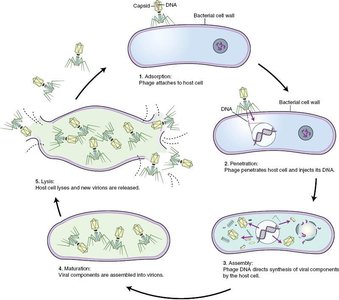
Bacteriophages (phages) are viruses that infect bacteria. Their multiplication follows a six-step process:
Adsorption: Phage attaches to specific receptors on the bacterial surface.
Penetration: Phage injects its nucleic acid into the host cell.
Replication: Host machinery synthesizes viral components.
Assembly: Viral components are assembled into new phages.
Maturation: Phages become fully infectious.
Release: Host cell lyses, releasing new phages.
Multiplication of Animal Viruses
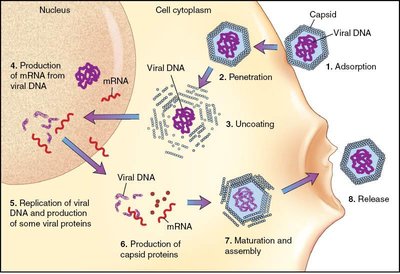
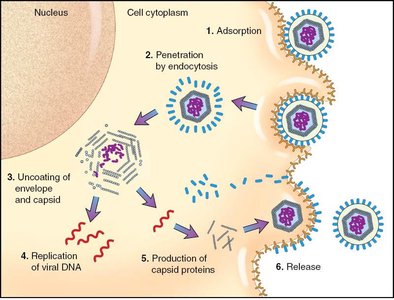
Animal viruses follow a similar but distinct process, with an additional uncoating step:
Adsorption: Virus attaches to host cell receptors.
Penetration: Virus enters the host cell via endocytosis or membrane fusion.
Uncoating: Viral genome is released from the capsid.
Replication: Synthesis of viral nucleic acids and proteins.
Assembly: New virions are assembled.
Release: Virions exit the cell by budding (enveloped viruses) or lysis (naked viruses).
Types of Viral Infections
Abortive: Infection without viral production.
Lytic (Cytocidal): Kills the host cell.
Persistent: Chronic (productive), latent (limited synthesis), slow (prolonged incubation), or transforming (oncogenic changes).
Host Cell Damage
Morphological Effects: Cell rounding, detachment, lysis, inclusion bodies.
Physiological Effects: Altered membrane properties, ion movement, and cellular activities.
Biochemical Effects: Inhibition or alteration of host macromolecule synthesis.
Genotoxic Effects: DNA damage, mutations, potential cancer initiation.
Virus | Cytopathic Effect |
|---|---|
Adenovirus | Nuclear inclusions; cell clumping |
Herpes simplex virus | Cell fusion, multinucleated giant cells; nuclear inclusions |
HIV | Multinucleated giant cells |
Influenza virus | Rounding of cells |
Poliovirus | Cell lysis |
Rabies virus | Cytoplasmic inclusions: Negri bodies |
Reovirus | Cell enlargement; vacuoles and inclusions in cytoplasm |
Smallpox virus | Rounding of cells; cytoplasmic inclusions |
Major Groups of Viruses in Vertebrates
DNA Viruses
Adenoviruses: Respiratory illness, gastroenteritis, conjunctivitis.
Hepadnaviruses: Hepatitis B, acute and chronic liver disease.
Herpesviruses: Herpes simplex, varicella-zoster, Epstein-Barr, cytomegalovirus.
Papillomaviruses/Polyomaviruses: Warts, cervical carcinomas.
Parvoviruses: Fifth disease (erythema infectiosum).
Poxviruses: Smallpox, vaccinia virus (used in vaccines).
Subfamily | Virus | Pathophysiology | Transmission |
|---|---|---|---|
Alphaherpesvirinae | Herpes simplex virus 1 & 2, Varicella-zoster virus | Oral/genital herpes, chickenpox, shingles | Close contact, respiratory, sexual |
Gammaherpesvirinae | Epstein-Barr virus, Lymphocryptovirus | Mononucleosis, lymphomas | Saliva, close contact |
Betaherpesvirinae | Cytomegalovirus, Human herpesvirus 6 & 7 | Mononucleosis, exanthema | Close contact, congenital |
RNA Viruses
Bunyaviridae: Arthropod-borne viruses.
Coronaviruses: Respiratory and enteric diseases, including SARS and COVID-19.
Hepatitis viruses: Hepatitis, cirrhosis, hepatocellular carcinoma.
Orthomyxoviruses: Influenza A, B, and C.
Paramyxoviruses: Measles, mumps, parainfluenza, respiratory syncytial virus.
Picornaviruses: Enterovirus, rhinovirus, poliovirus, hepatitis A.
Rhabdoviruses: Rabies virus.
Reoviruses: Rotavirus (gastroenteritis in children).
Retroviruses: HIV, oncoviruses.
Togaviruses: Rubella virus.
Flaviviruses: Yellow fever, dengue, hepatitis C, West Nile virus.
Subviral Agents
Viroids
Viroids are small, circular, single-stranded RNA molecules that infect plants. They do not encode proteins and do not require a helper virus for replication.
Virusoids (Satellite RNAs)
Virusoids are similar to viroids but require a helper virus for replication. They are generally associated with plant infections, but the hepatitis delta virus in humans is a notable exception, requiring co-infection with hepatitis B virus.
Prions
Prions are infectious proteins that lack nucleic acids. They cause transmissible spongiform encephalopathies, such as mad cow disease, by inducing abnormal folding of normal host proteins.
Additional Information
Bacteriophage Therapy: The use of lytic bacteriophages as therapeutic agents against bacterial infections, especially antibiotic-resistant strains, is an emerging field.
Medical Relevance: Many viruses are important human pathogens, and understanding their structure and replication is crucial for developing antiviral therapies and vaccines.
