 Back
BackViruses: Structure, Life Cycles, and Control
Study Guide - Smart Notes
 Tailored notes based on your materials, expanded with key definitions, examples, and context.
Viruses: Structure, Life Cycles, and Control
Are Viruses Alive?
Viruses occupy a unique position at the boundary between living and non-living entities. Their classification as living or non-living is debated based on their characteristics and life processes.
Traits of Living Organisms: Cellular structure, metabolism, growth, response to stimuli, and reproduction.
Arguments for Viruses Being Alive: They possess genetic material (DNA or RNA), evolve through natural selection, and reproduce (but only inside host cells).
Arguments Against Viruses Being Alive: They lack cellular structure, do not carry out metabolism independently, and cannot reproduce without a host cell.
Virus Morphology
Viruses are acellular infectious agents with diverse shapes and sizes. All viruses share certain structural features, but some have additional components.
All viruses contain: Genetic material (DNA or RNA) and a protein coat (capsid).
Some viruses also contain: A lipid envelope derived from the host cell membrane.
Size: Viruses are much smaller than prokaryotic and eukaryotic cells, with the largest known virus being about 0.44 μm.
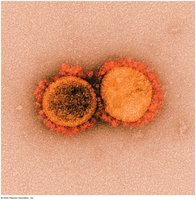
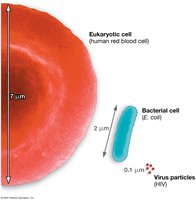
Variation in Viral Morphology
Viruses exhibit a wide range of shapes and structural complexity, which can be visualized using electron microscopy and molecular models.
Examples: Helical (e.g., Tobacco mosaic virus), icosahedral (e.g., Adenovirus), complex (e.g., Bacteriophage T4), and enveloped (e.g., Measles virus).
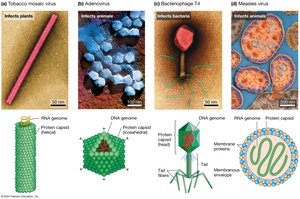
Viral Life Cycles
The Lytic Cycle (Replicative Growth)
The lytic cycle is a process by which viruses rapidly replicate within a host cell, leading to cell lysis and release of new virions.
Steps: Attachment, entry, synthesis of viral components, assembly, and release.
Outcome: Destruction of the host cell and release of progeny viruses.
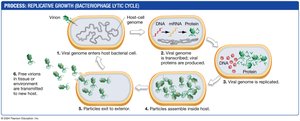
Comparison of Replicative Growth and Cell Division
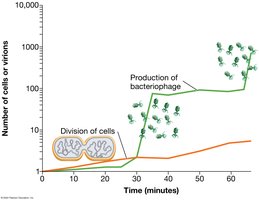
Viral replicative growth is typically much faster than cellular division, resulting in a rapid increase in the number of virions compared to host cells.
Lysogeny and Latency (Dormant Viral States)
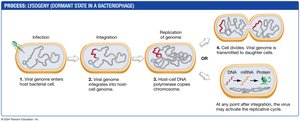
Some viruses can enter a dormant state within the host cell, integrating their genome into the host's DNA. This state is called lysogeny in bacteria and latency in animals.
Purpose: Allows the virus to persist in the host without killing it immediately; reactivation can occur under certain conditions.
Integration: Viral genome becomes part of the host genome and is replicated along with it.
Viral Entry and Exit Mechanisms
Mechanisms of Viral Entry
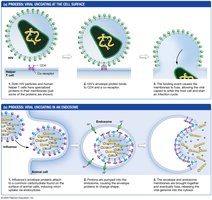
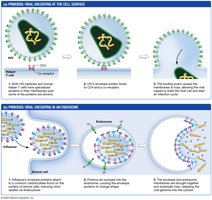
Viruses enter host cells by binding to specific receptors on the cell surface. The mechanism of entry varies by virus type.
Examples of receptors: HIV binds to CD4, SARS-CoV-2 binds to ACE2, Influenza binds to sialic acid residues.
Entry methods: Direct fusion with the plasma membrane (enveloped viruses) or endocytosis (nonenveloped viruses).
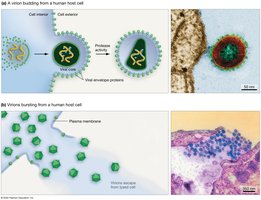
Mechanisms of Viral Exit
Viruses exit host cells by two main mechanisms, depending on whether they are enveloped or nonenveloped.
Budding: Enveloped viruses acquire their envelope from the host cell membrane as they exit (e.g., HIV).
Lysis: Nonenveloped viruses typically burst out of the cell, destroying it (e.g., Adenovirus).
Viral Genomes and Gene Expression
Variety of Viral Genomes
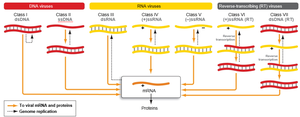
Viral genomes are highly diverse in structure and composition, influencing their replication strategies.
Forms: Linear or circular; DNA or RNA; single-stranded (ss) or double-stranded (ds).
Types: dsDNA, ssDNA, dsRNA, ssRNA (positive-sense, negative-sense, ambisense).
Positive-sense ssRNA: Genome can be directly translated by host ribosomes.
Negative-sense ssRNA: Genome must be copied into a complementary strand before translation.
Ambisense: Genome contains both positive and negative sense regions.
Viral Enzymes
Some viruses encode or carry their own enzymes to facilitate genome replication and protein processing.
RNA replicase: Synthesizes RNA from an RNA template (required for RNA viruses).
Reverse transcriptase: Synthesizes DNA from an RNA template (used by retroviruses).
Protease: Cleaves viral polyproteins into functional proteins.

Viral Gene Expression Strategies
All viruses rely on host ribosomes for translation, but the requirements for other enzymes depend on the type of viral genome.
DNA viruses: Often use host DNA and RNA polymerases.
RNA viruses: May require viral RNA-dependent RNA polymerase (replicase).
Retroviruses: Require reverse transcriptase to convert RNA to DNA.
Treatment and Prevention of Viral Infections
Antiviral Drugs
Antiviral drugs are designed to specifically target viral components or processes, minimizing harm to host cells.
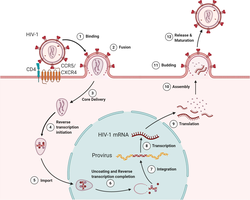
Examples for HIV: Reverse transcriptase inhibitors, protease inhibitors, entry inhibitors, and integrase inhibitors.
Mechanism: Block essential steps in the viral life cycle, preventing replication and spread.
Vaccines
Vaccines are a primary tool for preventing viral infections by training the immune system to recognize and respond to viral antigens.
Mechanism: Stimulate production of antibodies and memory cells against viral antigens.
Types of Vaccines:
Live attenuated: Weakened viruses (e.g., MMR, Varicella).
Inactivated: Killed viruses (e.g., Flu, rabies, polio).
Subunit: Viral protein fragments (e.g., HPV, DTaP/Tdap).
mRNA: Encodes viral proteins (e.g., SARS-CoV-2).
