 Back
BackViruses: Structure, Replication, and Impact (Chapter 19 Study Notes)
Study Guide - Smart Notes
 Tailored notes based on your materials, expanded with key definitions, examples, and context.
Viruses: Structure, Replication, and Impact
Introduction to Viruses
Viruses are acellular infectious particles that consist of genetic material encased in a protein coat. They are simpler than prokaryotic cells and lack the machinery for independent metabolism or replication. Viruses can only reproduce by infecting host cells, altering the host's intracellular physiology to propagate themselves.
Acellular nature: Viruses are not considered living organisms because they cannot carry out metabolic processes or replicate independently.
Obligate intracellular parasites: Viruses require a host cell to reproduce and complete their life cycle.
Impact: Viruses can be pathogenic, causing diseases in humans, animals, plants, and even bacteria. However, some viruses play beneficial roles, such as recycling organic matter in aquatic ecosystems.
Basic Structure of Viruses
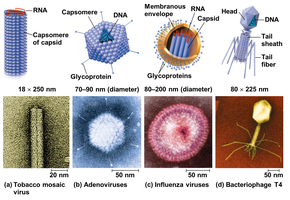
Viruses are composed of nucleic acid (either DNA or RNA) surrounded by a protein coat called a capsid. Some viruses also possess a membranous envelope derived from the host cell.
Nucleic acid: Can be double- or single-stranded DNA or RNA.
Capsid: Protein shell made of subunits called capsomeres.
Viral envelope: A lipid membrane containing viral and host molecules, present in many animal viruses.
Bacteriophages (Phages)
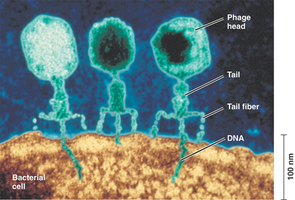
Bacteriophages are viruses that infect bacteria. They have complex structures, including an elongated capsid head that contains DNA and a tail apparatus for attaching to and injecting DNA into the host cell.
Capsid head: Encloses the viral genome.
Tail fibers: Attach the phage to the bacterial cell surface.
Tail sheath: Contracts to inject DNA into the host.
Viral Genomes
Viral genomes are highly variable and may consist of DNA or RNA, which can be single- or double-stranded. The number of genes in viral genomes ranges from as few as three to several thousand.
DNA viruses: Contain DNA as their genetic material.
RNA viruses: Contain RNA as their genetic material.
Genome size: Varies widely among viruses.
Host Range and Specificity
Viruses are obligate intracellular parasites with a specific host range, meaning they can infect only certain species or cell types. Some viruses are highly specific, while others can infect multiple hosts.
Host range: The spectrum of host cells a virus can infect.
Pathogenicity: Some viruses can cause disease in more than one host species.
General Viral Replicative Cycles
Once inside a host cell, the viral genome directs the host's machinery to produce viral proteins and replicate the viral genome. New viral particles self-assemble and are released from the host cell.
Entry: Virus enters the host cell.
Replication and transcription: Host machinery is used to replicate viral nucleic acids and synthesize proteins.
Assembly: New viral particles are assembled from replicated genomes and proteins.
Release: New viruses exit the host cell, often destroying it in the process.
Phage Replicative Cycles
Bacteriophages can reproduce via two main cycles: the lytic cycle and the lysogenic cycle.
Lytic cycle: Results in the destruction of the host cell and release of new phages.
Lysogenic cycle: Viral DNA integrates into the host genome as a prophage and is replicated along with the host DNA without killing the host.
Temperate phages: Can switch between lytic and lysogenic cycles in response to environmental signals.
Animal Virus Replication
Animal viruses often have an envelope and may possess either DNA or RNA genomes. Two key variables for classification are the type of nucleic acid (DNA or RNA) and whether it is single- or double-stranded.
Viral envelopes: Facilitate entry into host cells by binding to specific receptors.
Genome type: Determines the replication strategy of the virus.
Viral Envelopes
Many animal viruses have a membranous envelope derived from the host cell. Viral glycoproteins on the envelope bind to specific receptors on the host cell, facilitating entry.
Origin: Envelopes may be derived from the host plasma membrane or internal membranes such as the Golgi apparatus.
Function: Aid in host cell recognition and entry.
Viruses and the Central Dogma
Some viruses, such as retroviruses, challenge the central dogma of molecular biology by using reverse transcriptase to copy their RNA genome into DNA, which is then integrated into the host genome as a provirus.
Retroviruses: Use reverse transcriptase to synthesize DNA from an RNA template.
Provirus: Integrated viral DNA that remains a permanent resident of the host cell.
Transcription: Host RNA polymerase transcribes proviral DNA into RNA for new virus production.
Pathogenic Impacts of Viruses
Viruses can cause disease by killing host cells, releasing toxins, or producing toxic viral proteins. Viral infections cannot be treated with antibiotics, but antiviral drugs and vaccines can help prevent or manage infections.
Cell damage: Viruses may lyse cells or cause the release of hydrolytic enzymes.
Toxins: Some viruses induce host cells to produce toxins or have toxic envelope proteins.
Treatment: Antiviral drugs inhibit viral replication; vaccines stimulate immune protection.
Emerging Viruses and Epidemics
Emerging viruses are those that suddenly become apparent, often causing epidemics or pandemics. New viral strains can arise from mutations or by crossing species barriers, sometimes exchanging genetic material with other viruses.
Epidemics: Local outbreaks of new viral strains.
Pandemics: Global outbreaks caused by highly transmissible new strains.
Species jump: Viruses can move from animals to humans, sometimes leading to new diseases.
Influenza Virus
Influenza viruses are classified by their surface proteins, hemagglutinin (H) and neuraminidase (N). Mutations in these proteins can lead to new strains and epidemics.
H protein: Facilitates viral entry into host cells.
N protein: Assists in viral release from host cells.
Classification: 18 H and 9 N subtypes allow for many combinations (e.g., H1N1, H5N1).
Vaccines: Designed to target the most common H/N types each season.
Viral Diseases in Plants
Plant viruses, most of which have RNA genomes, can spread through horizontal transmission (via damaged cell walls) or vertical transmission (inherited from parent plants).
Horizontal transmission: Virus enters through wounds or vectors.
Vertical transmission: Virus is passed from parent to offspring.
Viroids and Prions: Simpler Infectious Agents
Viroids and prions are infectious agents even simpler than viruses. Viroids are small, circular RNA molecules that infect plants, while prions are misfolded proteins that cause neurodegenerative diseases in animals.
Viroids: Infect plants and disrupt growth.
Prions: Infectious proteins that propagate by converting normal proteins into the prion form, causing diseases such as mad cow disease.
