 Back
Viruses: Structure, Replication, and Impact in General Biology
Study Guide - Smart Notes
 Tailored notes based on your materials, expanded with key definitions, examples, and context.
Viruses
Introduction to Viruses
Viruses are infectious particles that consist of genetic material packaged within a protein coat. They are much simpler than prokaryotic cells and occupy a unique position between living organisms and chemicals, as they cannot reproduce or carry out metabolism outside of a host cell. - Key Point 1: Viruses are not cells; they are composed of nucleic acid (DNA or RNA) enclosed in a protein coat, sometimes surrounded by a membranous envelope. - Key Point 2: Viruses can cause a wide variety of diseases in humans, animals, and plants. - Example: Human immunodeficiency virus (HIV) infects immune cells and releases new virus particles. 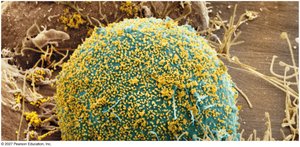
Viral Structure
The structure of viruses is simple yet diverse, making them useful biological systems for study. - Key Point 1: Viral genomes may be double- or single-stranded DNA or RNA, classified as DNA viruses or RNA viruses. - Key Point 2: The genome is either a single linear or circular molecule, with 3 to 2,000 genes. - Key Point 3: The capsid is the protein shell that encloses the viral genome; capsids are built from subunits called capsomeres and can be helical or icosahedral. 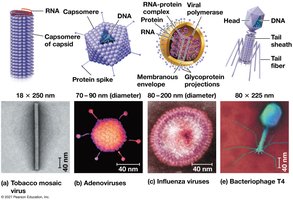
Viral Replication and Host Interaction
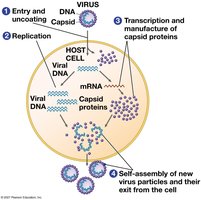
Viruses are obligate intracellular parasites, meaning they can replicate only within a host cell. Each virus has a specific host range, determined by its ability to infect certain species. - Key Point 1: The viral genome enters the host cell in various ways, and the cell begins to manufacture viral proteins using host resources. - Key Point 2: Viral nucleic acids and capsomeres self-assemble into new viruses. 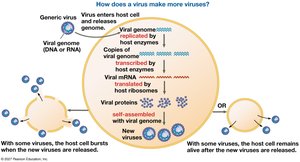
Bacteriophages and Their Replicative Cycles
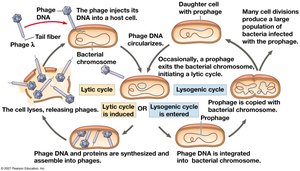
Bacteriophages (phages) are viruses that infect bacteria and are among the best understood viruses. - Key Point 1: Phages have two main reproductive mechanisms: the lytic cycle and the lysogenic cycle. - Key Point 2: The lytic cycle results in the destruction of the host cell, while the lysogenic cycle allows the viral genome to be incorporated into the host chromosome without immediate destruction. 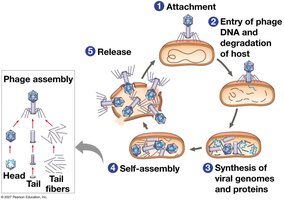
Bacterial Defenses Against Viruses
Bacteria have evolved several mechanisms to defend against phage infection. - Key Point 1: Surface protein mutations can prevent phage recognition. - Key Point 2: Restriction enzymes cut foreign DNA, while bacterial DNA is protected by methylation. - Key Point 3: The CRISPR-Cas system provides adaptive immunity by storing phage DNA sequences and targeting them during reinfection. 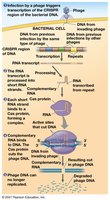
Animal Viruses and Their Classification
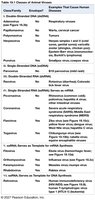
Many animal viruses possess a membranous envelope derived from the host cell. - Key Point 1: Viral glycoproteins on the envelope bind to specific host cell receptors. - Key Point 2: Animal viruses are classified by genome type (RNA or DNA, single- or double-stranded) and the presence or absence of an envelope. 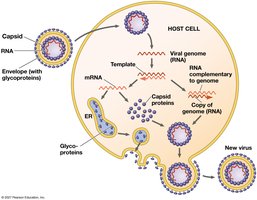
Retroviruses and HIV
Retroviruses, such as HIV, use reverse transcriptase to copy their RNA genome into DNA, which is then integrated into the host genome as a provirus. - Key Point 1: The provirus remains a permanent resident of the host cell. - Key Point 2: RNA polymerase transcribes proviral DNA into RNA for viral protein synthesis and new virus genomes. 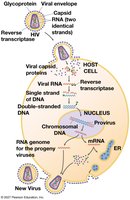
Origin and Evolution of Viruses
Viruses do not fit the definition of living organisms and likely evolved from bits of cellular nucleic acid, such as plasmids and transposons. - Key Point 1: Plasmids, transposons, and viruses are all mobile genetic elements. - Key Point 2: The largest viruses identified have genomes encoding proteins involved in translation, DNA repair, and other cellular functions.
Diseases Caused by Viruses and Prions
Viral infections affect humans, crops, and livestock worldwide. Prions are infectious proteins that cause degenerative brain diseases in animals. - Key Point 1: Viruses may damage or kill cells by causing the release of hydrolytic enzymes or toxins. - Key Point 2: Vaccines stimulate the immune system to defend against pathogens; antiviral drugs inhibit viral replication. - Key Point 3: Prions are misfolded proteins that can convert normal proteins into the misfolded form, leading to aggregation and disease. 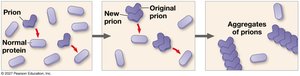
Emerging Viruses
Emerging viruses are those that suddenly become apparent, often due to mutation, spread from isolated populations, or transmission from other animals. - Key Point 1: Examples include HIV, Ebola, chikungunya, and Zika viruses. - Key Point 2: Flu epidemics are caused by type A influenza viruses, which infect a wide range of animals and undergo frequent genetic reassortment. 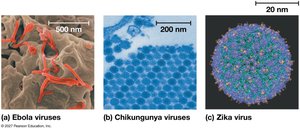
Plant Viruses
Plant viruses cause numerous diseases, often characterized by spots, stunted growth, and damaged tissues. - Key Point 1: Most plant viruses have an RNA genome and may have helical or icosahedral capsids. - Key Point 2: Plant viruses spread by horizontal transmission (through damaged cell walls) or vertical transmission (inherited from parent plants). 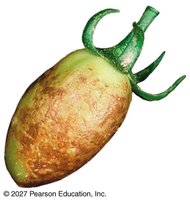
Summary Table: Classes of Animal Viruses
Class/Family | Envelope? | Example(s) That Cause Human Disease |
|---|---|---|
Double-Stranded DNA (dsDNA) | Yes/No | Herpesvirus, Papillomavirus, Adenovirus |
Single-Stranded DNA (ssDNA) | No | Parvovirus |
Double-Stranded RNA (dsRNA) | No | Rotavirus |
Single-Stranded RNA (ssRNA) | Yes/No | Influenza, HIV, Ebola, Zika, Chikungunya |
Retrovirus | Yes | HIV |
Model for Prion Propagation
Prions propagate by converting normal proteins into the misfolded prion form, which then aggregate and cause disease. Additional info: Prions are virtually indestructible and may be involved in diseases such as Alzheimer's and Parkinson's.
