 Back
BackLECTURE 22 STUDY GUIDE
Study Guide - Smart Notes
 Tailored notes based on your materials, expanded with key definitions, examples, and context.
LECTURE 22
Viruses: Structure, Replication, and Impact on Living Systems
Introduction to Viruses
Viruses are infectious particles that exist at the boundary between living and non-living matter. They are much simpler than prokaryotic or eukaryotic cells and require a host cell to reproduce. Viruses are responsible for a wide variety of diseases in animals, plants, and even bacteria.
Definition: A virus is a small infectious agent consisting of genetic material (DNA or RNA) enclosed in a protein coat, and sometimes a membranous envelope.
Obligate Intracellular Parasites: Viruses cannot reproduce or carry out metabolism outside a host cell.
Genome: Viral genomes may be double- or single-stranded DNA or RNA, containing 3 to 2,000 genes.
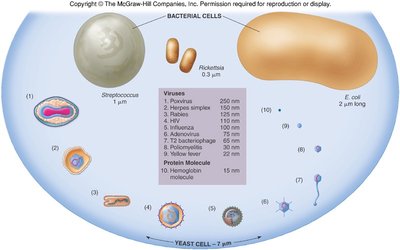
Size: Viruses are ultramicroscopic, ranging from 20 nm to 450 nm in diameter.
The Discovery of Viruses
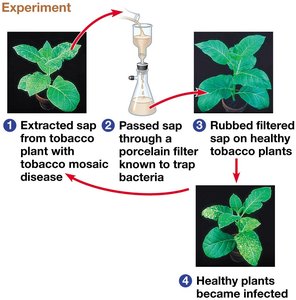
The discovery of viruses began with the study of tobacco mosaic disease, which stunted plant growth and caused mosaic coloration. Early experiments showed that the infectious agent could pass through filters that trapped bacteria, indicating it was much smaller than bacteria. In 1935, Wendell Stanley crystallized the infectious particle, confirming it was not a bacterium but a virus.
Virus Structure
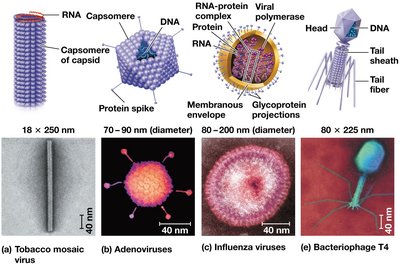
Viruses are composed of a nucleic acid genome surrounded by a protein coat called a capsid. Some viruses also possess a membranous envelope derived from the host cell membrane.
Capsid: The protein shell enclosing the viral genome, made of protein subunits called capsomeres. Capsids can be helical or icosahedral in shape.
Envelope: A lipid membrane surrounding the capsid in some viruses, containing both viral and host molecules.
Surface Molecules: Determine host specificity by mediating attachment to host cell receptors.
Bacteriophages (Phages)
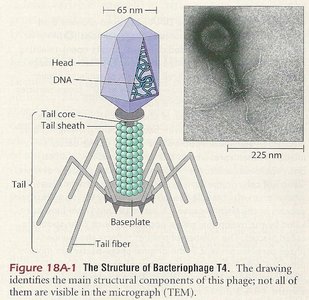
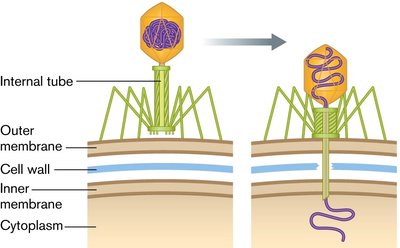
Bacteriophages are viruses that infect bacteria. They have complex structures, including an elongated capsid head that encloses DNA and a tail apparatus for injecting DNA into the host cell.
Phage Structure: Includes a head, tail sheath, tail fibers, and baseplate.
Attachment and DNA Injection: The tail fibers attach to the bacterial surface, and the tail sheath contracts to inject DNA into the host.
Viral Replication Cycles
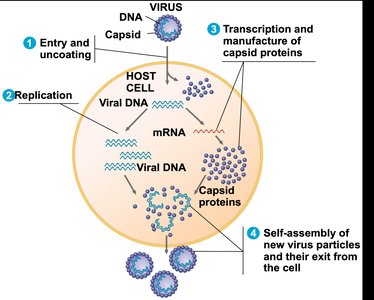
Viruses replicate only within host cells, using the host's machinery to produce new viral particles. The two main replication cycles in phages are the lytic and lysogenic cycles.
Lytic Cycle
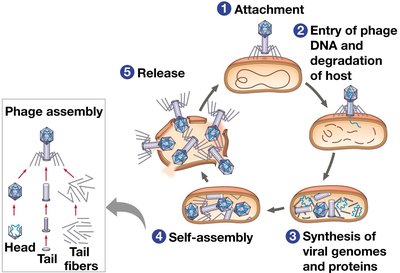
Definition: A reproductive cycle resulting in the destruction of the host cell and release of new phages.
Steps: Attachment, entry of DNA, synthesis of viral components, self-assembly, and release (lysis).
Virulent Phage: A phage that reproduces only by the lytic cycle.
Lysogenic Cycle
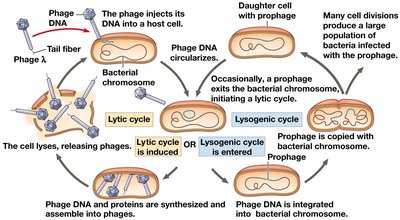
Definition: The phage genome integrates into the host chromosome and replicates without killing the host.
Prophage: The integrated viral DNA in the host genome.
Temperate Phage: Phages capable of both lytic and lysogenic cycles (e.g., lambda phage).
Induction: Environmental signals can trigger the switch from lysogenic to lytic cycle.
Bacterial Defenses Against Phages
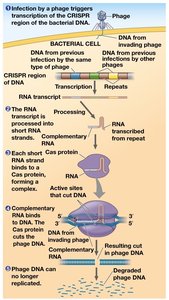
Bacteria have evolved several mechanisms to defend against phage infection, including mutation of surface receptors, restriction enzymes, and the CRISPR-Cas system.
Restriction Enzymes: Cut foreign DNA at specific sequences; bacterial DNA is protected by methylation.
CRISPR-Cas System: Adaptive immune system in bacteria and archaea that uses stored viral DNA sequences (spacers) to recognize and destroy invading phage DNA.
Classification of Animal Viruses
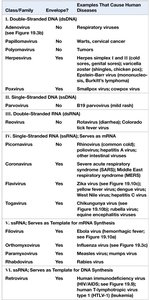
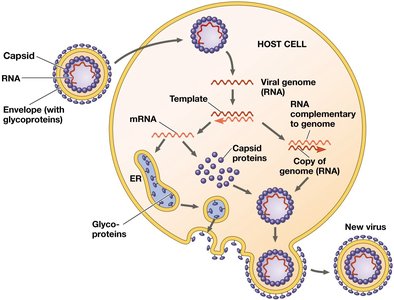
Animal viruses are classified based on the nature of their genome (DNA or RNA, single- or double-stranded) and the presence or absence of an envelope. Many animal viruses have both an envelope and an RNA genome.
Viral Replication in Animal Cells
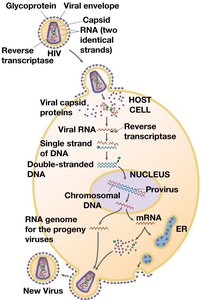
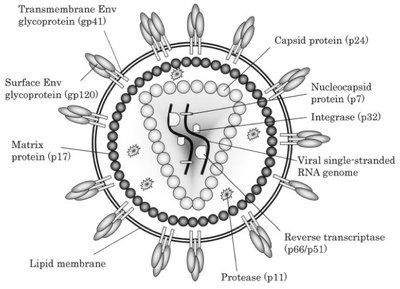
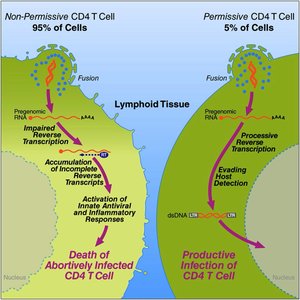
Animal viruses exhibit diverse replication strategies, often involving entry by membrane fusion or endocytosis, replication of the genome, synthesis of viral proteins, assembly, and release. Retroviruses, such as HIV, use reverse transcription to integrate their genome into the host DNA as a provirus.
Obligate Intracellular Parasites: Viruses can only replicate within a host cell.
Host Range: The spectrum of host cells a virus can infect.
Self-Assembly: Viral components spontaneously assemble into new viruses.
HIV and AIDS
HIV is a retrovirus that causes AIDS by infecting and destroying CD4+ helper T cells, leading to immune system failure. The virus integrates as a provirus in the host genome and can remain latent.
Transmission: Originated from simian viruses; transmitted via blood and body fluids.
Drug Treatments: Antiretroviral drugs can extend life expectancy but do not cure HIV.
Genetic Resistance: Some individuals have mutations in the CCR5 coreceptor, conferring resistance to HIV infection.
Viral Evolution
Viruses may have evolved from mobile genetic elements such as plasmids and transposons. Viral DNA makes up a significant portion of the human genome, and some viral genes are associated with diseases.
Mobile Genetic Elements: Plasmids, transposons, and viruses are all capable of moving within and between genomes.
Endogenous Viral Elements: Viral DNA sequences are present in the genomes of many organisms.
Viral Diseases and Their Impact
Viruses cause diseases in humans, animals, and plants. They may kill host cells, cause the release of toxins, or alter host cell function. Epidemics and pandemics can result from the emergence of new viral strains, such as influenza and coronaviruses.
Emerging Viruses: Viruses that appear suddenly or increase in incidence, often originating from animal hosts (zoonoses).
Vaccines: Stimulate the immune system to prevent viral infections; antibiotics are ineffective against viruses.
Antiviral Drugs: Can treat, but not cure, viral infections (e.g., acyclovir for herpes, AZT for HIV).
Plant Viruses, Viroids, and Prions
Plant viruses often have RNA genomes and spread via horizontal (through wounds) or vertical (inherited) transmission. Viroids are small, circular RNA molecules that infect plants, while prions are infectious proteins causing neurodegenerative diseases in animals.
Viroids: Infectious RNA molecules that disrupt plant growth.
Prions: Misfolded proteins that induce abnormal folding of normal proteins, leading to diseases such as mad cow disease and Creutzfeldt-Jakob disease.
Detection and Cytopathic Effects of Viruses
Diagnosing viral infections can be challenging. Methods include detecting viral antigens, culturing viruses, and observing cytopathic effects (CPE) such as cell lysis, inclusion bodies, and transformation into cancerous cells.
Cytopathic Effects: Observable changes in host cells due to viral infection, including cell fusion, lysis, and transformation.
Diagnostic Methods: Cell culture, serological assays, and molecular techniques (e.g., PCR).
Herpesviruses and Other Notable Human Viruses
Herpesviruses are a large family of DNA viruses that establish latency and can reactivate. Examples include herpes simplex virus (HSV), varicella-zoster virus (VZV), cytomegalovirus (CMV), and Epstein-Barr virus (EBV).
Latency: Viral DNA persists in host cells and can reactivate under certain conditions.
Diseases: HSV causes cold sores and genital herpes; VZV causes chickenpox and shingles; CMV and EBV cause mononucleosis and are associated with certain cancers.
Summary Table: Classes of Animal Viruses
Class/Family | Envelope? | Examples That Cause Human Diseases |
|---|---|---|
Double-Stranded DNA (dsDNA) | Yes/No | Adenovirus, Herpesvirus, Papillomavirus, Poxvirus |
Single-Stranded DNA (ssDNA) | No | Parvovirus (B19) |
Double-Stranded RNA (dsRNA) | No | Reovirus (Rotavirus) |
Single-Stranded RNA (ssRNA) | Yes | Coronavirus, Flavivirus, Togavirus, Orthomyxovirus (Influenza), Paramyxovirus, Rhabdovirus, Retrovirus (HIV) |
Additional info: Table content inferred and summarized from the original table for clarity.
