 Back
Viruses: Structure, Replication, and Impact on Living Organisms
Study Guide - Smart Notes
 Tailored notes based on your materials, expanded with key definitions, examples, and context.
Viruses: Structure, Replication, and Impact on Living Organisms
Introduction to Viruses
Viruses are infectious particles that exist at the boundary between living and non-living entities. They are much simpler than prokaryotic cells and cannot reproduce or carry out metabolism outside of a host cell. Viruses are considered obligate intracellular parasites, meaning they require a host cell to replicate and propagate.
Definition: A virus consists of genetic material (DNA or RNA) enclosed in a protein coat, and sometimes a membranous envelope.
Borrowed Life: Viruses do not fit the traditional definition of life, as they cannot independently reproduce or metabolize.
Examples: Tobacco mosaic virus (TMV), Influenza virus, HIV, and SARS-CoV-2 (COVID-19 virus).
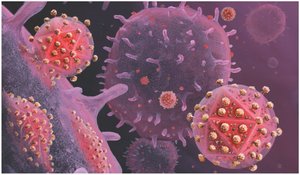
Structure of Viruses
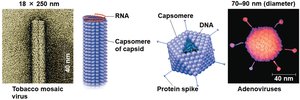
Viruses are not cells and are structurally diverse. Their basic components include a nucleic acid genome, a protein coat (capsid), and in some cases, a membranous envelope derived from the host cell.
Genetic Material: Can be double- or single-stranded DNA or RNA. Viruses are classified as DNA viruses or RNA viruses based on their genome type.
Capsid: The protein shell that encloses the viral genome, built from protein subunits called capsomeres. Capsids can be helical, icosahedral, or more complex in shape.
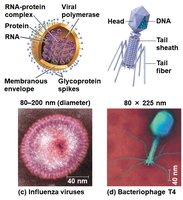
Envelope: Some viruses possess a lipid envelope with embedded glycoproteins, aiding in host cell recognition and entry.

Specialized Viral Structures
Some viruses have accessory structures that facilitate infection. For example, bacteriophages (viruses that infect bacteria) have a complex structure with a head, tail, and tail fibers for attachment and DNA injection.
Bacteriophages: Infect bacteria, have an elongated capsid head, and a tail apparatus for injecting DNA into the host.
Viral Envelopes: Derived from host cell membranes, contain both viral and host molecules, and are common in animal viruses.
Viral Replication and Life Cycles
General Replication Cycle
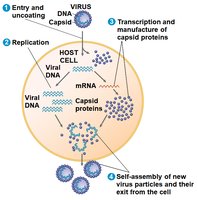
Viruses replicate only within host cells. The viral genome enters the host cell, which then manufactures viral proteins and assembles new virus particles using host resources.
Host Range: Each virus can infect only a limited range of host cells, determined by specific interactions between viral proteins and host cell receptors.
Replication Steps: Entry, replication of viral genome, synthesis of viral proteins, assembly, and release.
Phage Replicative Cycles
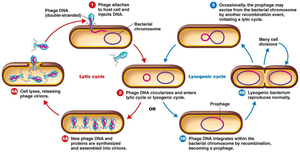
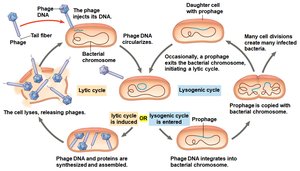
Bacteriophages (phages) are well-studied viruses with two main reproductive cycles: the lytic cycle and the lysogenic cycle.
Lytic Cycle: Results in the destruction (lysis) of the host cell and release of new phages. Virulent phages reproduce only by this cycle.
Lysogenic Cycle: The phage genome integrates into the host chromosome as a prophage and is replicated along with the host DNA. Temperate phages can switch between lysogenic and lytic cycles.
Bacterial Defenses Against Phages
Bacteria have evolved several defense mechanisms against phage infection, including restriction enzymes and the CRISPR-Cas system.
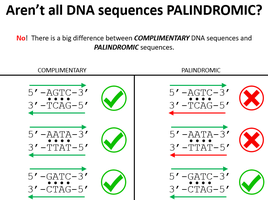
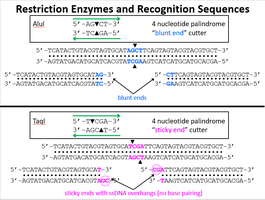
Restriction Enzymes: Enzymes that recognize and cut foreign DNA at specific palindromic sequences, protecting the bacterium from viral DNA.
CRISPR-Cas System: A form of adaptive immunity in bacteria and archaea, using sequences from previous infections to recognize and destroy viral DNA.
Animal Viruses and Their Replication
Classification of Animal Viruses
Animal viruses are classified based on their genome type (DNA or RNA, single- or double-stranded) and the presence or absence of an envelope. Many animal viruses have both an envelope and an RNA genome.
Viral Envelopes: Aid in host cell entry by binding to specific receptors. The envelope is usually derived from the host cell's plasma or nuclear membrane.
Retroviruses: RNA viruses that use reverse transcriptase to synthesize DNA from their RNA genome. HIV is a well-known retrovirus.
Provirus: The integrated viral DNA in the host genome, which remains a permanent resident (unlike a prophage in bacteria).
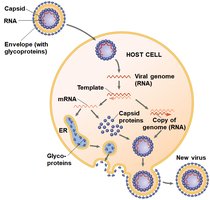
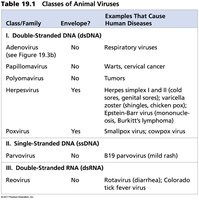
Table: Classes of Animal Viruses
The following table summarizes major classes of animal viruses, their genome types, envelope status, and examples of diseases they cause.
Class/Family | Envelope? | Examples That Cause Human Diseases |
|---|---|---|
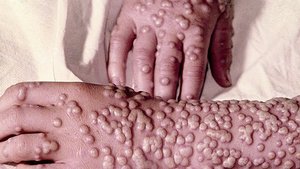
Double-Stranded DNA (dsDNA) | Yes/No | Respiratory viruses, warts, cervical cancer, herpes, smallpox |
Single-Stranded DNA (ssDNA) | No | B19 parvovirus (mild rash) |
Double-Stranded RNA (dsRNA) | No | Rotavirus (diarrhea), Colorado tick fever virus |
Single-Stranded RNA (ssRNA; serves as mRNA) | Yes/No | Rhinovirus (common cold), hepatitis A, SARS, Zika, West Nile, yellow fever |
ssRNA (template for mRNA synthesis) | Yes | Ebola, influenza, rabies |
Evolution and Impact of Viruses
Evolution of Viruses
Viruses likely evolved from mobile genetic elements such as plasmids and transposons. Their origin is debated, but they are considered to have evolved after the first cells. Viruses do not fit the definition of living organisms as they cannot replicate independently.
Mobile Genetic Elements: Plasmids, transposons, and viruses can move within and between genomes.
Largest Virus: Megavirus chilensis, with a genome size of 1.3 MB and a capsid diameter of 440 nm.
Viruses and Prions as Pathogens
Viruses and prions are significant pathogens in animals and plants. Viral infections can cause cell death, toxin production, and disease symptoms. Prions are infectious proteins that cause degenerative brain diseases.
Vaccines: Harmless derivatives of pathogens that stimulate immune defense. Vaccines prevent, but do not cure, viral diseases.
Antiviral Drugs: Inhibit viral replication or assembly, but do not eliminate the virus from the body.
Prions: Misfolded proteins that induce normal proteins to misfold, causing diseases such as mad cow disease and Creutzfeldt-Jakob disease.
Emerging Viruses and Disease Transmission
Emerging viruses are those that suddenly become apparent, often due to mutation, cross-species transmission, or changes in human behavior. Transmission terminology includes epidemic, pandemic, endemic, and sporadic diseases.
Emerging Viruses: Ebola, Zika, and SARS-CoV-2 are examples of viruses that have recently caused outbreaks.
Transmission Terms:
Epidemic: Widespread occurrence in a community.
Pandemic: Global epidemic.
Endemic: Constant presence in a population.
Sporadic: Occasional cases without geographic concentration.
R-naught (R0): The average number of people one infected individual can transmit the disease to; higher R0 means more contagious.
Viral Diseases in Plants
Plant viruses cause a variety of symptoms, including spots, stunted growth, and damaged organs. Most plant viruses have RNA genomes and spread by vertical (inherited) or horizontal (environmental) transmission.
Transmission: Vertical (parent to offspring) or horizontal (through damaged cell walls).
Examples: Tobacco mosaic virus, viruses causing spots on tomatoes and other crops.
Prions: Proteins as Infectious Agents
Prions are infectious proteins that cause neurodegenerative diseases by inducing misfolding of normal proteins. They are virtually indestructible and act slowly, leading to diseases such as scrapie, mad cow disease, and Creutzfeldt-Jakob disease.
Mechanism: Prions convert normal proteins into the misfolded prion form, leading to aggregation and brain damage.
Examples: Scrapie (sheep), mad cow disease (cattle), Creutzfeldt-Jakob disease (humans).
