 Back
Water and Carbon: Chemical Foundations of Life
Study Guide - Smart Notes
 Tailored notes based on your materials, expanded with key definitions, examples, and context.
Water: Structure and Emergent Properties
Polarity and Hydrogen Bonding
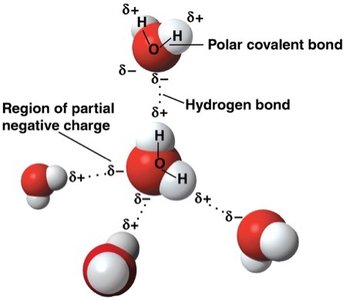
Water (H2O) is a polar molecule, meaning it has regions of partial positive and negative charge due to the unequal sharing of electrons between oxygen and hydrogen atoms. This polarity allows water molecules to form hydrogen bonds with each other, which are responsible for many of water's unique properties.
Polarity: Oxygen is more electronegative than hydrogen, creating a partial negative charge (δ−) near the oxygen and partial positive charges (δ+) near the hydrogens.
Hydrogen Bonds: Weak attractions between the δ+ hydrogen of one water molecule and the δ− oxygen of another.
Example: Hydrogen bonding is responsible for water's high boiling point compared to other molecules of similar size.
Emergent Properties of Water
Water's structure gives rise to four key properties that support life:
Cohesion: Water molecules stick to each other due to hydrogen bonding, contributing to surface tension.
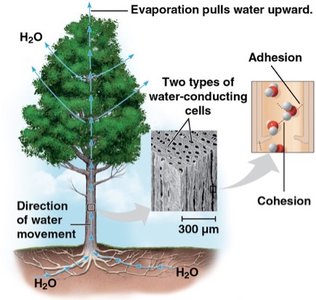
Adhesion: Water molecules stick to other substances, aiding in processes like water transport in plants.
High Specific Heat: Water can absorb or release large amounts of heat with only a slight change in its own temperature, stabilizing environments.
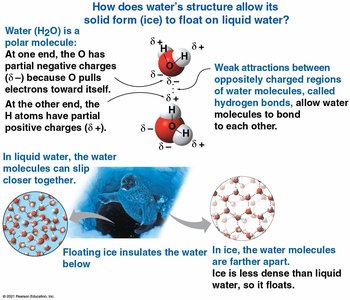
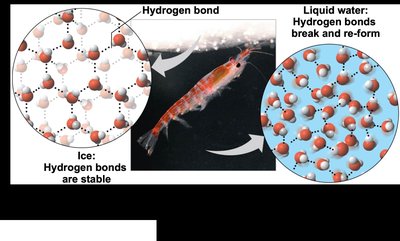
Expansion Upon Freezing: Ice is less dense than liquid water because hydrogen bonds stabilize and hold molecules apart in a crystalline structure, allowing ice to float.
Versatility as a Solvent: Water dissolves many substances due to its polarity, making it the solvent of life.
Solid Water: Ice
In ice, each water molecule forms stable hydrogen bonds with four neighbors, creating a lattice that is less dense than liquid water. This property allows ice to float, insulating aquatic life in winter.
Hydrogen bonds are more stable in ice than in liquid water.
Ice acts as an insulator, protecting aquatic ecosystems from freezing solid.
Water and Temperature Regulation
Water's high specific heat helps moderate Earth's climate and organisms' internal temperatures. It absorbs heat from warmer air and releases stored heat to cooler air.
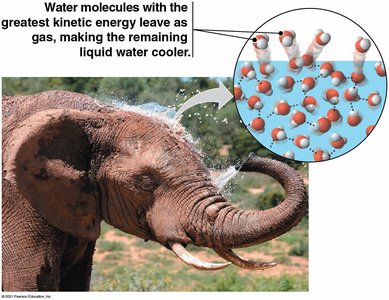
Evaporative Cooling: As water evaporates, the molecules with the highest kinetic energy leave, cooling the remaining liquid.
Example: Sweating in mammals or transpiration in plants helps regulate temperature.
Cohesion and Adhesion in Biological Systems
Cohesion and adhesion enable water transport in plants against gravity. Cohesion holds water molecules together, while adhesion helps them cling to cell walls.
Surface Tension: Cohesion at the surface allows small organisms to walk on water.
Capillary Action: Adhesion and cohesion together move water up plant stems.
Water as a Solvent
Polarity and Solubility
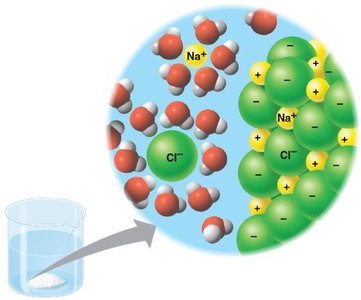
Water's polarity allows it to dissolve ionic and polar substances by surrounding them with hydration shells. Nonpolar substances, such as lipids, do not dissolve well in water.
Hydrophilic: Substances that dissolve in water (e.g., salts, sugars).
Hydrophobic: Substances that do not dissolve in water (e.g., fats, oils).
Example: Cell membranes are composed of phospholipids with hydrophobic tails, forming a barrier in aqueous environments.
Acids, Bases, and pH
Definitions and the pH Scale
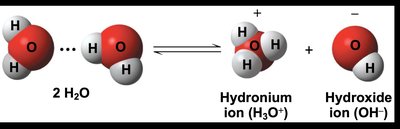
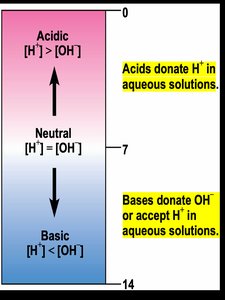
An acid increases the concentration of H+ ions in solution, while a base reduces it. The pH scale (0–14) measures the concentration of hydrogen ions, with lower values being more acidic and higher values more basic.
pH Equation:
Neutral Solution: [H+] = [OH−] = M, so pH = 7.
Logarithmic Scale: Each pH unit represents a tenfold difference in [H+].
Buffers in Biological Systems
Buffers are substances that minimize changes in pH by reversibly binding H+ ions. They are crucial for maintaining stable pH in biological fluids, such as blood.
Example: Human blood is buffered to stay within a narrow pH range (7.35–7.45).
Importance: Even slight deviations from normal pH can be harmful or fatal.
Carbon: The Backbone of Life
Unique Properties of Carbon
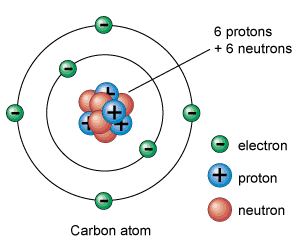
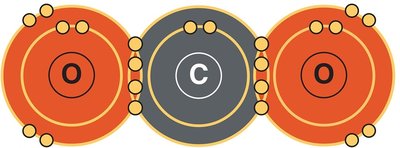
Carbon's ability to form four covalent bonds makes it uniquely suited to build the complex molecules necessary for life. Its versatility allows for the formation of chains, rings, and branching structures.
Valence: Carbon has four valence electrons, allowing it to form up to four bonds.
Bonding Partners: Commonly bonds with hydrogen, oxygen, nitrogen, sulfur, and phosphorus.
Stability: Carbon bonds are stable across a wide range of temperatures.
Molecular Diversity from Carbon Skeletons
Carbon skeletons can vary in length, branching, double bond position, and ring structure, leading to a vast diversity of organic molecules.
Hydrocarbons: Molecules consisting only of carbon and hydrogen; important in energy storage (e.g., fats).
Isomers: Compounds with the same molecular formula but different structures and properties.
Types of Isomers
Structural Isomers: Differ in the covalent arrangement of atoms.
Cis-Trans (Geometric) Isomers: Differ in spatial arrangement around a double bond.
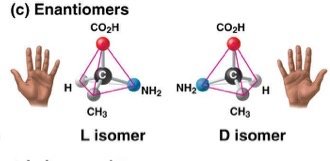
Enantiomers: Mirror images of each other, important in pharmaceuticals due to different biological activities.
Functional Groups and Solubility
Key Functional Groups
Functional groups are specific groups of atoms attached to carbon skeletons that determine the chemical properties and reactivity of organic molecules. They influence solubility, acidity, and other characteristics.
Hydroxyl (–OH): Characteristic of alcohols; increases solubility in water.
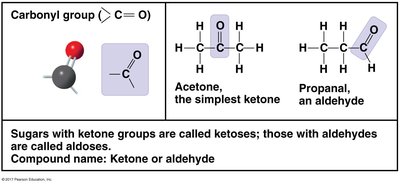
Carbonyl (C=O): Found in ketones and aldehydes; affects polarity and reactivity.
Carboxyl (–COOH): Acts as an acid; found in amino acids and fatty acids.
Amino (–NH2): Acts as a base; found in amino acids.
Sulfhydryl (–SH): Stabilizes protein structure.
Phosphate (–PO4): Involved in energy transfer (ATP, nucleic acids).
Solubility and Amphipathic Molecules
The presence of polar functional groups increases solubility in water, while nonpolar groups decrease it. Some molecules contain both polar and nonpolar regions and are called amphipathic (e.g., phospholipids in cell membranes).
Example: Phospholipids have hydrophilic heads and hydrophobic tails, forming the basis of biological membranes.
Summary
Water's polarity and hydrogen bonding give rise to its unique properties essential for life.
Acids, bases, and buffers regulate pH in biological systems, which is critical for cellular function.
Carbon's bonding versatility allows for the diversity of organic molecules, with functional groups determining their chemical behavior and solubility.
