 Back
Water and Carbon: Properties, Chemistry, and Biological Importance
Study Guide - Smart Notes
 Tailored notes based on your materials, expanded with key definitions, examples, and context.
Basic Chemistry of Water
Structure and Polarity of Water
Water (H2O) is a polar molecule, meaning it has an uneven distribution of charge due to differences in electronegativity between hydrogen and oxygen atoms. This polarity allows water molecules to form hydrogen bonds with each other and with other polar molecules.
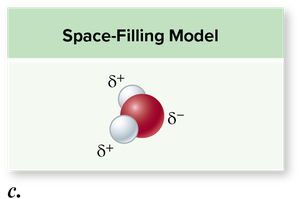
Polar Covalent Bonds: The electrons in water are shared unequally, resulting in a partial negative charge (δ–) near the oxygen and partial positive charges (δ+) near the hydrogens.
Hydrogen Bonds: Weak attractions between the hydrogen atom of one water molecule and the oxygen atom of another. These are crucial for water's unique properties.
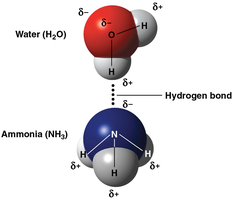
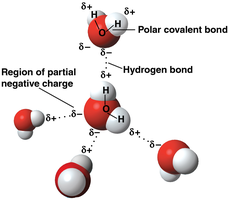
Models of Water Molecule
Different models are used to represent the structure and polarity of water, including the Bohr model, ball-and-stick model, and space-filling model. These models help visualize the arrangement of atoms and the distribution of charges.
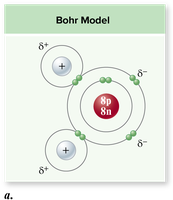
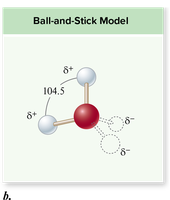
Four Vital Properties of Water for Living Systems
1. Cohesive Behavior
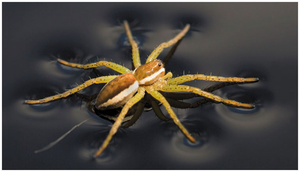
Cohesion refers to the attraction between water molecules due to hydrogen bonding. This property results in high surface tension, allowing certain organisms to move across water surfaces.
Surface Tension: The measure of how difficult it is to stretch or break the surface of a liquid.
Biological Example: Some insects can walk on water due to surface tension.
2. Ability to Moderate Temperature
Water can absorb or release large amounts of heat with only slight changes in its own temperature, due to its high specific heat. This property helps stabilize environmental and organismal temperatures.
Specific Heat: The amount of heat required to raise the temperature of 1 g of a substance by 1ºC. For water, this is 1 cal/(g·ºC).
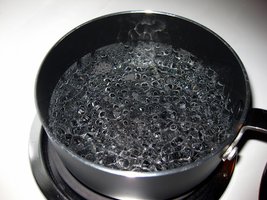
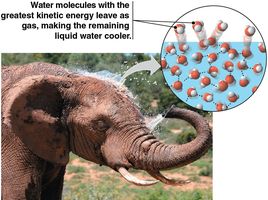
Heat of Vaporization: The heat a liquid must absorb for 1 g to be converted to gas. Evaporative cooling helps organisms regulate temperature.
3. Expansion Upon Freezing
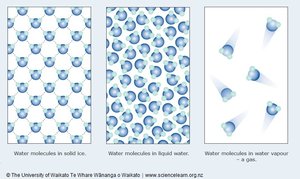
Water is less dense as a solid than as a liquid because hydrogen bonds stabilize and keep the molecules further apart in ice. This property allows ice to float, insulating aquatic life in winter.
Density of Ice: Ice is about 10% less dense than liquid water.
Biological Importance: If ice sank, bodies of water would freeze solid, making life impossible.

4. Versatility as a Solvent
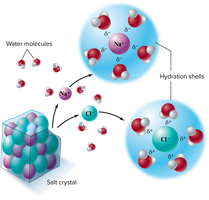
Water is known as the "universal solvent" because its polarity allows it to dissolve a wide variety of substances, especially ionic and polar compounds. This property is essential for biochemical reactions in cells.
Solution: A homogeneous mixture of two or more substances.
Solvent: The dissolving agent (water in aqueous solutions).
Solute: The substance dissolved.
Hydration Shell: Sphere of water molecules surrounding each ion in solution.
Acids, Bases, and Buffers
Acids and Bases
Acids increase the concentration of H+ ions in solution, while bases decrease it. The pH scale measures the acidity or basicity of a solution.
Acid: Substance that increases H+ concentration (e.g., HCl).
Base: Substance that reduces H+ concentration (e.g., NaOH, NH3).
pH Scale: Ranges from 0 (most acidic) to 14 (most basic); pH = –log [H+].
Buffers
Buffers are substances that minimize changes in pH by accepting or donating H+ ions. Most biological fluids are buffered to maintain a stable pH, crucial for cellular function.
Buffer System: Typically consists of a weak acid and its conjugate base.
Basic Chemistry of Carbon
Carbon: The Backbone of Life
Carbon atoms form the backbone of organic molecules due to their ability to form four covalent bonds. This versatility allows for a diversity of stable, complex molecules essential for life.
Organic Chemistry: Study of carbon-containing compounds.
Valence: Carbon has four valence electrons, allowing for a variety of bonding patterns.
Origins of Life and Organic Molecules
Experiments such as Stanley Miller's demonstrated that organic molecules could form under prebiotic conditions, supporting theories about the chemical origins of life.
Carbon Bonding and Molecular Diversity
Carbon can form single, double, or triple bonds, and its skeletons can vary in length, branching, and ring structure. This leads to a vast diversity of organic molecules.
Hydrocarbons: Molecules consisting only of carbon and hydrogen; important as energy sources.
Isomers: Compounds with the same molecular formula but different structures and properties.
Structural Isomers: Differ in covalent arrangements.
Cis-trans Isomers: Differ in spatial arrangement around double bonds.
Enantiomers: Mirror images of each other; important in biology due to their different effects.
Functional Groups
Functional groups are specific groups of atoms attached to carbon skeletons that determine the chemical reactivity and properties of organic molecules. The number and arrangement of these groups give molecules their unique characteristics.
Examples: Hydroxyl, carbonyl, carboxyl, amino, sulfhydryl, phosphate, methyl groups.
